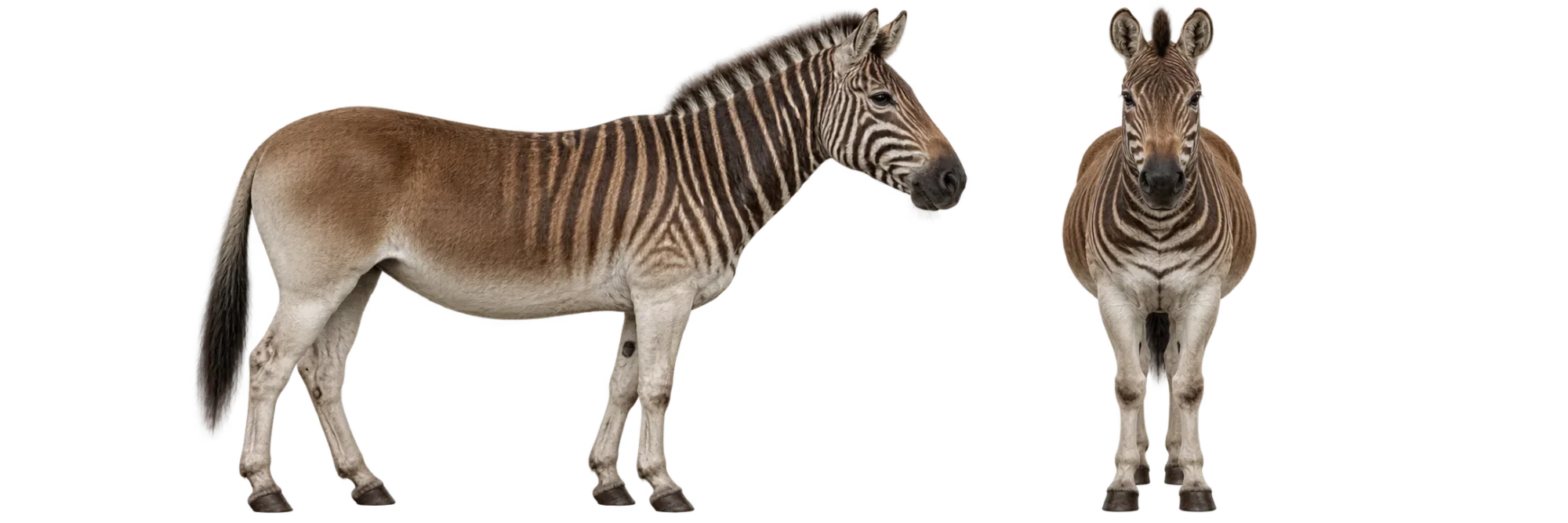
The quagga, Equus quagga quagga, was the southern form of the plains zebra, not a separate horse-like lineage with a well-documented set of reproductive traits. Genetic work on museum material places quaggas within plains-zebra diversity. That close relationship makes living plains zebras the best biological comparison, but many values commonly attached to the quagga were never measured in the extinct subspecies itself.
The Quagga Is Part of the Plains Zebra Lineage
Early classifications often treated the quagga as a separate zebra species because its coat looked so different. Its stripes were strongest on the head, neck, and front of the body, while the hindquarters could be largely brown and unstriped. Genetic evidence changed the biological interpretation of that difference.
Mitochondrial DNA recovered from several museum specimens showed quagga sequences nested within the genetic diversity of plains zebras. Later work using complete mitochondrial genomes and nuclear DNA supported the same close relationship. The extinct form is therefore generally recognized as Equus quagga quagga, within the plains zebra species Equus quagga.
This distinction matters most for life-history traits. Quaggas disappeared before long-term field studies could record pregnancies, birth intervals, age-specific survival, or the age of known individuals through their entire lives. Their taxonomic position allows informed comparison with living plains zebras without turning those comparisons into measurements that were never made.
Reproductive Numbers Come Mostly From Living Plains Zebras
Available plains-zebra evidence points to a reproductive schedule built around a long pregnancy and usually a single foal. Curated species-level data for Equus quagga place gestation at about one year and litter size at one. These figures fit the broader reproductive biology of zebras, but no surviving study followed enough original quagga mares to establish a separate quagga-specific gestation average.
Age at Reproduction Is Not a Single Quagga Number
Living plains-zebra populations also show why maturity should be interpreted carefully. Animals used by the Quagga Project, which are selectively bred plains zebras rather than surviving members of the extinct subspecies, are reported to reach reproductive maturity at roughly two to three years in mares and four to five years in stallions.
Species databases may give different maturity values because they can describe sexual maturity rather than the age at which an animal regularly breeds in a social group. For the extinct quagga, there is not enough direct evidence to replace that distinction with one precise age for both sexes.
One Foal Makes Reproduction Relatively Slow
A long gestation followed by a single foal limits how quickly a zebra mare can add offspring to a population. Long-term observations of wild plains zebras in Zimbabwe recorded a mean foaling rate of about 0.74 foal per mare per year in the monitored population. Birth intervals also varied among females rather than following one fixed schedule.
That field result is useful for understanding the kind of reproductive pace expected in a quagga-like plains zebra. It should not be read as a historical foaling rate measured in the former quagga population of southern Africa.
Survival Rates Cannot Be Reconstructed From Taxonomy Alone
Close genetic relationship does not make demographic rates interchangeable. Survival depends heavily on local conditions, including food availability, water access, age, maternal condition, and other pressures faced by a population.
Modern plains-zebra studies illustrate this variation. A long-term study in Hwange National Park found much lower annual survival during the first year of life than among adults. More recent work from the same ecosystem also found that the length of the dry season affected some age groups differently. Those measurements describe zebras living in a particular modern environment.
There is no equivalent longitudinal dataset for original quaggas. Exact quagga foal survival, adult annual survival, reproductive lifespan, and age-specific mortality therefore remain unknown rather than being recoverable from living plains-zebra averages.
Historical accounts showing quaggas in large groups can help describe their social and ecological setting, but herd observations cannot be converted into a life table. Population-level survival requires known individuals followed across time, a type of evidence that was not collected before the quagga disappeared.
The 38-Year Longevity Record Is Not a Quagga-Subspecies Record
Longevity is one of the easiest quagga traits to misread. The AnAge record for Equus quagga gives a maximum longevity of 38 years in captivity, but the individual behind that record was a wild-born member of the burchellii subspecies. It was a plains zebra, not an original Equus quagga quagga.
AnAge also notes that reports of plains zebras reaching 40 years in captivity have not been confirmed. A 38- or 40-year figure should therefore not be presented as a measured maximum lifespan for the extinct quagga population.
The last known captive quagga, a mare, died at Amsterdam Zoo on 12 August 1883. The date establishes when the final known animal died, but it does not establish her age at death or the normal lifespan of wild quaggas. No verified quagga-specific maximum longevity comparable to the modern plains-zebra record is available.
 HorseEquus caballus