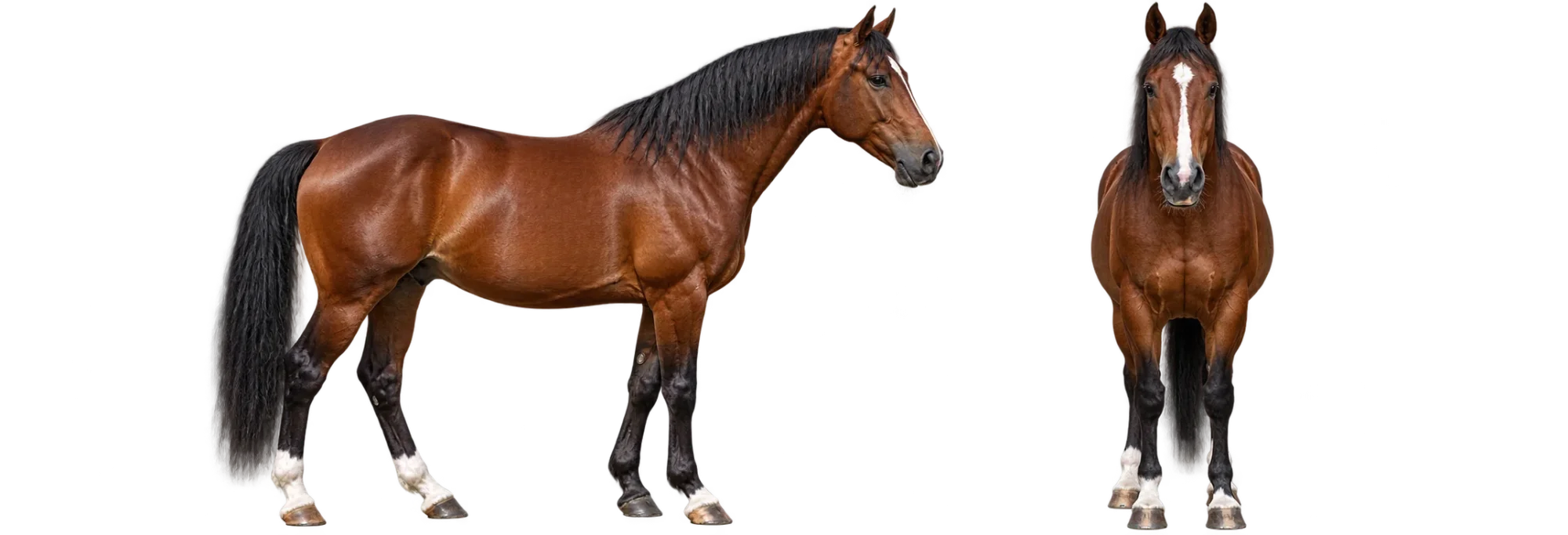
The domestic horse, Equus caballus, has a life history built around seasonal breeding, a long pregnancy, and a foal that must become mobile very soon after birth. Mares usually produce one foal at a time, yet the young animal develops quickly enough to stand, nurse, follow its mother, and begin grazing during the first months of life.
Breeding Activity Tracks Day Length
Most mares are seasonally polyestrous. Their reproductive activity rises as daylight increases, so regular cycles are concentrated in the longer-day part of the year. During winter, many mares enter anestrus, when ovarian activity becomes low or inactive. As spring approaches, they pass through a transition period before regular ovulation begins.
Once cycling is established, the interval between ovulations is usually about 21 days. Estrus lasts several days, with its length often changing across the breeding season. This seasonal pattern links conception to a calendar that tends to place foaling in the following spring or early summer, when conditions for raising a young horse are generally more favorable.
Puberty does not arrive at one fixed age. Fillies may become reproductively active from roughly the first to second year of life, with breed, body development, nutrition, and season all affecting timing. Reproductive puberty also should not be treated as the same event as full physical maturity.
The Equine Embryo Moves Before It Fixes in Place
Early pregnancy in the mare has an unusual feature among domestic mammals. After entering the uterus about six days after ovulation, the young conceptus remains free within the uterine lumen and moves repeatedly through the uterine body and horns. Its movement becomes especially active during the second week after ovulation.
This travel is part of the process by which the mare maintains pregnancy. The mobile conceptus contacts different regions of the uterine lining while maternal recognition of pregnancy is being established. The exact embryo-derived signal involved in this process is still not fully resolved, but movement through the uterus is known to be closely tied to successful pregnancy recognition.
At about day 16, movement stops and the conceptus becomes fixed near the base of a uterine horn. Fixation is not the same as immediate implantation; attachment and placental development continue later. This long mobile phase is one reason early equine pregnancy has a developmental pattern quite different from that of many other familiar mammals.
A Long Pregnancy Usually Produces One Foal
Horse gestation averages about 340 days, or roughly 11 months, although normal pregnancies can be shorter or longer. Gestation length can vary with season, fetal sex, individual mare, and other biological conditions, so a single average should not be read as an exact due date for every pregnancy.
The normal reproductive outcome is a singleton. Mares can release more than one ovum during a cycle, but carrying two fetuses to term is poorly suited to the capacity of the equine uterus and placenta. Twin pregnancy is therefore associated with a high risk of pregnancy loss and other complications rather than representing a normal two-offspring strategy.
The mare can return to estrus soon after giving birth. The first postpartum estrus, commonly called foal heat, usually occurs within about 5 to 11 days. That short interval helps explain how a mare can, under breeding management, produce foals in successive years despite spending most of each year pregnant.
Foals Shift From Newborn Dependence to Rapid Growth
A horse is a precocial mammal. A healthy newborn foal normally becomes active soon after delivery, works toward standing within the first hours, and begins nursing quickly. Early mobility matters because the foal is born into a body plan already suited for following the mare rather than remaining in a nest or den.
Growth is fast during the nursing period. Foals begin investigating and eating solid feed while they are still dependent on milk, so the transition toward grazing starts well before weaning. In managed horses, weaning commonly occurs at about 4 to 6 months. Free-ranging foals may remain with their mothers longer, with natural weaning often occurring later in the first year.
Weaning does not mark the end of physical development. Growth studies show that horses complete much of their rapid early growth during the first year and reach many adult skeletal proportions by around two years of age. Sexual puberty can occur before that point, which is why age at reproductive maturity and age at physical maturity describe different parts of development.
Adult Horses Can Remain in the Population for Decades
Domestic horses commonly live into their twenties, and many reach their thirties when health and care allow. A frequently cited average range is about 25 to 30 years, but lifespan is not uniform across all horses. Body size, breed, disease, injury, workload, living conditions, and veterinary care can all influence how long an individual survives.
That variation also makes maximum longevity a poor substitute for expected lifespan. A horse that reaches an unusually advanced age shows what is biologically possible under a particular set of conditions; it does not define the normal outcome for the species. Studies of managed and free-ranging horses likewise produce different survival patterns because the pressures acting on those populations are not the same.
From puberty onward, mares may remain reproductively capable for many years, although fertility tends to decline with age and reproductive history. The adult phase can therefore be much longer than the juvenile phase, while reproductive performance and physical condition continue to change across that span.
 QuaggaEquus quagga