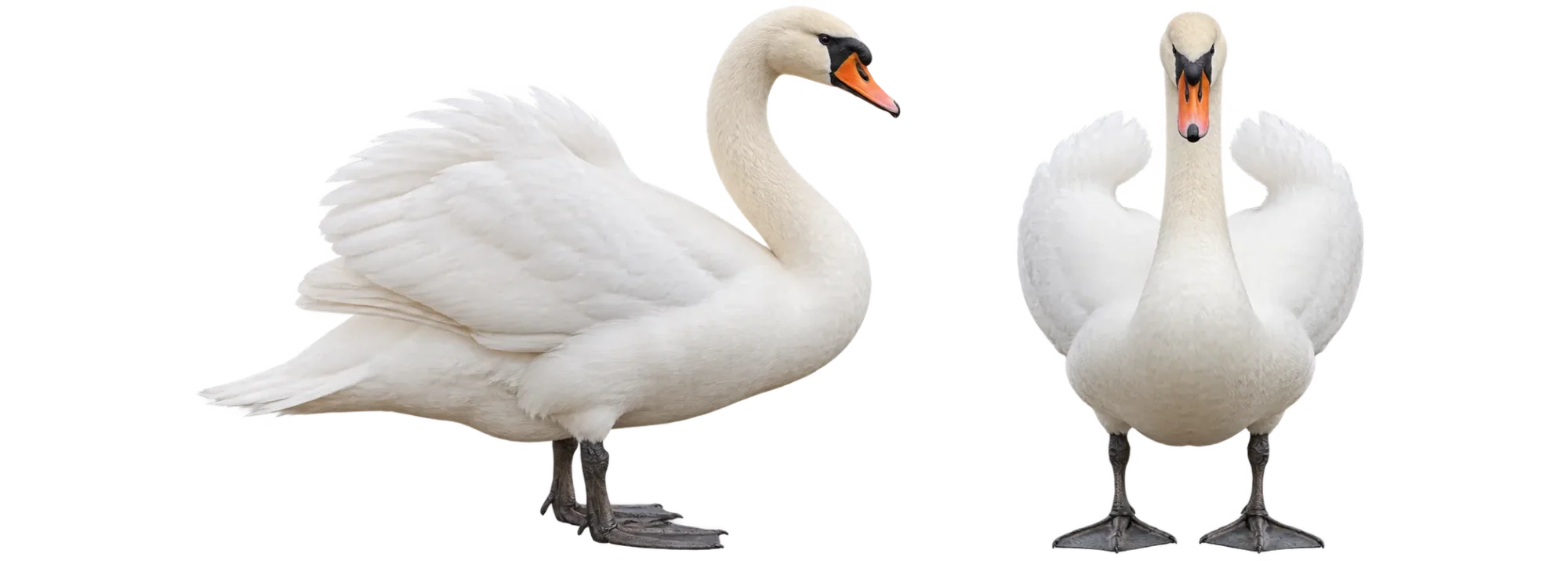
Mute swan cygnets enter the water very soon after hatching and then spend months under parental care. That long family period, combined with delayed first breeding and repeated use of established pair bonds, gives Cygnus olor a slower reproductive schedule than its early mobility might suggest.
One Brood Can Occupy Most of the Breeding Season
Mute swans normally make one breeding attempt in a season. British nest records place the average first-clutch date around mid-April, although laying can begin much earlier or later depending on the pair, year and local conditions.
A typical clutch contains about four to seven eggs. Incubation commonly lasts roughly 34 to 44 days. The female performs most incubation, while the male remains closely involved in defending the nesting territory and later caring for the brood.
This division of parental roles makes the breeding attempt a pair-level process. Long-term studies of mute swans have found that the ages of both parents can be associated with laying date and clutch size. The male is therefore more than a guard positioned beside a female-controlled nesting cycle; his age and individual history can also be linked with when reproduction begins.
Precocial Cygnets Remain Dependent for Months
Newly hatched mute swans are precocial. Their eyes are open, they are covered in down, and they can leave the nest and enter the water soon after drying. Parents do not need to deliver every meal directly to the chicks in the way many songbirds feed nestlings.
Early movement does not mark the end of parental care. Both adults accompany and protect the brood while the cygnets grow, learn to feed efficiently and develop their flight feathers. British life-history records place the fledging period at about 120 to 150 days.
Family association can last beyond that point. Observations from long-term swan studies show parental care continuing until the young become independent, sometimes during autumn and in some cases into winter. Juvenile dispersal therefore occurs after a prolonged period spent with the breeding pair rather than immediately after the young become mobile.
Breeding Usually Begins Around Four Years Old
Juvenile mute swans become physically independent well before they enter the breeding population. Data from the long-studied Abbotsbury population in England place the median age at first breeding at about four years, with substantial variation among individuals.
This delay creates several distinct life stages. A young swan can be fully mobile and living away from its parents while still spending years as a non-breeder. During this period, immature birds may associate with other non-breeding swans, form pair bonds and eventually compete for access to a suitable breeding territory.
Age at first reproduction should therefore not be treated as the age at which a mute swan first looks adult or becomes independent. Reproductive entry depends on more than physical development and can vary from one bird to another.
Pair Fidelity Affects the Age Structure of Mates
Mute swans often keep the same partner across breeding seasons, but the familiar idea that every pair remains together for life is too simple. Birds can form new partnerships after a mate disappears, and divorce has also been recorded in marked populations.
Long-lasting pair bonds still have measurable life-history effects. Because partners remain together as they age, pair fidelity contributes to the tendency for breeding mates to be similar in age. Recent work using long-term mute swan records also found evidence that age-related mate choice contributes to this pattern even after established pairs are accounted for.
Replacement partnerships do not erase age structure either. Experienced swans forming a new pair often choose partners closer to their own age than would be expected under completely random pairing. This matters because reproductive performance itself changes with parental age.
Breeding Performance Changes Across Adult Life
Decades of records from the Abbotsbury mute swans show that reproductive performance does not remain constant throughout adulthood. In that population, birds tended to lay earlier and produce larger clutches as they moved through early adulthood, with performance improving until roughly six or seven years of age.
Later in life, the pattern changed. Laying became later and clutch size declined after about 12 years of age. The study also found differences among individuals: swans that survived and continued breeding for longer tended to perform better at comparable ages than birds whose reproductive lives ended earlier.
These records show why a single value for maturity or clutch size cannot describe the whole reproductive life of a mute swan. The same individual can pass through an early period of improving breeding performance, a middle period of stronger performance and a later decline, while the age and identity of its partner also contribute to the outcome of each breeding attempt.
 MallardAnas platyrhynchos
 Canada gooseBranta canadensis