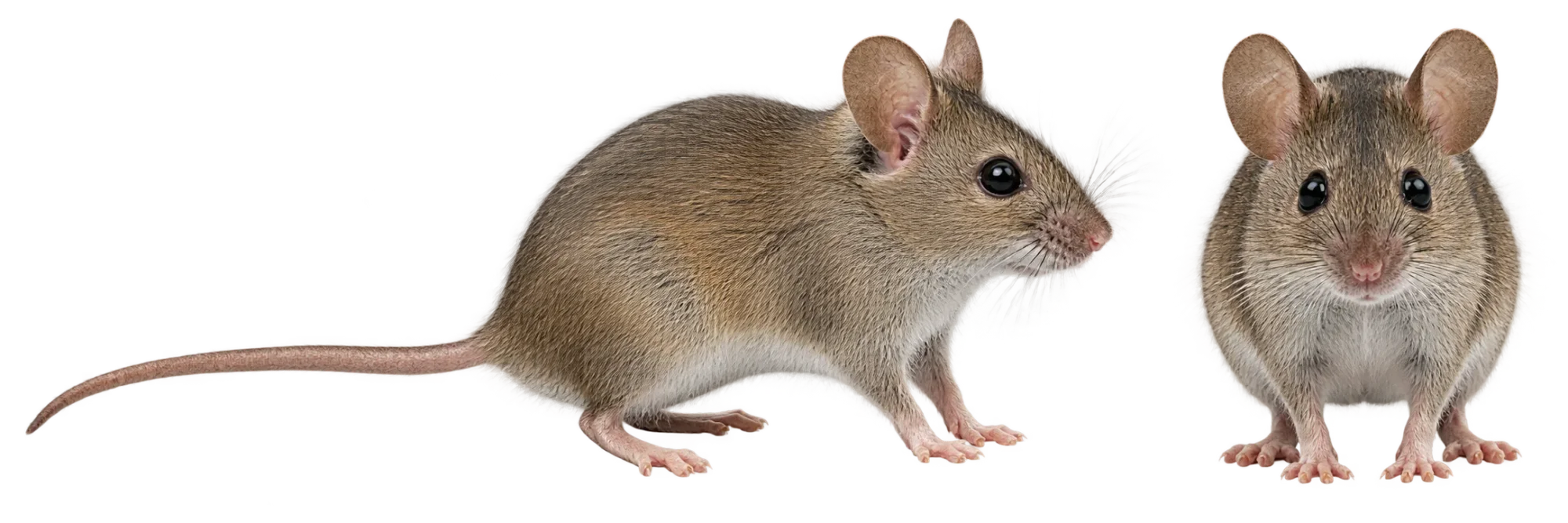
House mice (Mus musculus) move through early life on a short biological clock. Sexual maturity can arrive within weeks, pregnancy lasts about three weeks, and young are weaned on a similar timescale. That pace creates the potential for rapid population growth, while food, season, social conditions, and the demands of nursing can alter how quickly reproduction actually proceeds.
House Mice Can Reach Reproductive Age Within Weeks
Sexual maturity is commonly reached at roughly 5–8 weeks of age, although the exact timing varies with sex, strain, body condition, and environment. Under controlled laboratory conditions, the interval from one generation to the next can be only about 9–11 weeks.
Reproductive maturity does not guarantee immediate successful reproduction in a free-living mouse. Puberty describes physiological capability, while the age at which an individual first produces surviving offspring also reflects access to mates, social competition, food quality, body condition, and other environmental pressures.
This distinction helps explain why field and semi-natural studies may record first successful reproduction later than laboratory maturity tables suggest. A mouse can be physiologically mature while still spending additional time before raising its first litter.
Postpartum Estrus Compresses the Breeding Cycle
Gestation in the house mouse usually lasts about 19–21 days. Females can also enter estrus soon after giving birth. When conception occurs during this postpartum period, a mother may be pregnant with her next litter while still nursing the current one.
Pregnancy and lactation are both costly periods of maternal investment, so their overlap creates an unusually dense reproductive schedule. A female may be producing milk for growing pups while new embryos are developing at the same time.
Suckling can delay implantation after postpartum mating, especially in some laboratory strains. The result can be a pregnancy that appears longer than the usual 19–21-day interval. This extension reflects the interaction between lactation and implantation rather than a separate standard gestation length for the species.
Postpartum conception therefore increases reproductive potential without making every litter follow an identical calendar. The mother’s current litter size, nutritional state, and nursing demand can influence how the next reproductive event unfolds.
Nest Life Changes Rapidly During the First Three Weeks
House mouse pups are born in an altricial state. They have little ability to regulate their own needs and depend heavily on the nest and maternal care during the earliest part of life.
The short interval between helpless birth and weaning is one reason the species can cycle generations quickly. Even so, those three weeks represent a large maternal investment: milk production rises during early lactation, pups grow rapidly, and their dependence falls sharply near the end of the nursing period.
Free-Living Reproduction Tracks Resources and Local Conditions
Laboratory colonies provide constant food, stable temperatures, and regular access to mates. Free-living house mice experience a much less uniform reproductive environment. Females can reproduce through much of the year where resources remain plentiful, while other populations show strong seasonal breeding.
Recent semi-natural work also shows that food quality can alter the way life-history traits are linked. Growth, reproductive timing, litter production, and survival do not operate as a single fixed package. Their relationships shift with the environment in which the mice live.
This flexibility matters when interpreting house mouse data. The species has the biological capacity for very early and repeated reproduction, but a laboratory generation time should not be treated as the expected schedule of every wild individual.
Survival shows a similar contrast. Captive longevity records can extend for years, yet field populations turn over much faster. Some feral populations have reported mean life expectancy of only a few months, while a long-running free-living barn population near Zurich recorded an average life expectancy of about 196 days. These are population-level survival observations rather than maximum lifespan records.
Communal Nursing Adds a Social Layer to Maternal Care
Female house mice sometimes place separate litters in the same nest and nurse the combined young. Once pups are pooled, mothers may provide milk to offspring other than their own. This makes reproduction partly dependent on relationships among females rather than maternal effort alone.
Field research shows that communal nursing is selective. Females with an available partner often still raise a litter alone. When communal nests form, previous social familiarity and the composition of the female’s local social group can influence partner choice.
Timing also matters because litters need to be close enough in age to share the nursing period. As pups approach the transition to solid food, the window for combining them with a new litter narrows. The same fast development that shortens dependence on the mother therefore also limits how long communal nursing arrangements can begin.
 Norway ratRattus norvegicus