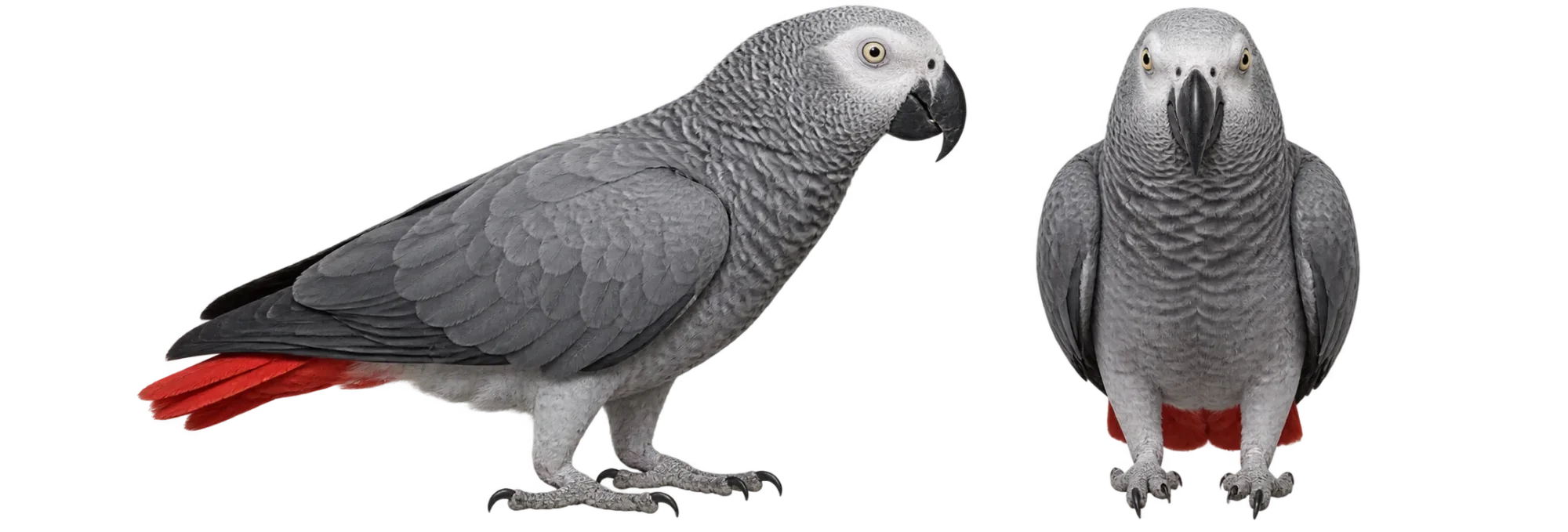
The grey parrot, Psittacus erithacus, follows a life cycle built around delayed breeding, long parental investment and the potential for a long adult life. The Timneh parrot, Psittacus timneh, is now treated as a separate species, so older records that combined the two should be used carefully when interpreting grey parrot traits.
Breeding Depends on Large Tree Cavities
Grey parrots do not excavate their own nest holes. They are secondary cavity nesters, using existing hollows in large trees. This makes a suitable mature tree more than a place to lay eggs: the availability of safe cavities can directly limit how many pairs are able to breed.
Field work on Príncipe found grey parrot nests mainly in large living trees. In one study, 66 of 83 examined cavities were concentrated in four common tree species, while the nest trees averaged more than 45 m in height. The exact trees used vary across the species’ range, but the dependence on substantial tree cavities is consistent.
Pairs are generally described as monogamous breeders. Published accounts do not give one perfectly uniform clutch range, with figures commonly falling around two to five eggs. Incubation lasts roughly four weeks, often reported at about 28–30 days. The female performs most or all of the incubation in commonly described breeding patterns while the male supplies food.
Chicks Remain in the Nest for About Three Months
Grey parrot chicks hatch in an altricial state and depend completely on parental care. Their nest period is long compared with many smaller birds. Reports generally place fledging near 11–12 weeks after hatching, with about 80 days also appearing in breeding records.
Leaving the cavity is a developmental milestone rather than an instant switch to adult independence. Parents continue to feed and protect young birds after they begin moving outside the nest, while juveniles develop the flight, feeding and social skills needed for life away from the cavity.
Breeding Begins Years After Fledging
The gap between leaving the nest and becoming a breeder is measured in years. Veterinary literature commonly places sexual maturity at roughly four to six years, while captive longevity datasets note breeding from about five years of age.
That timing matters when interpreting a grey parrot life-history timeline. Fledging, physical growth and reproductive maturity are separate stages. A young bird may be fully feathered and capable of flight long before it enters the breeding population.
The combination of delayed maturity and a small clutch keeps annual reproductive output relatively low. Adult survival therefore has a strong influence on how quickly a population can replace breeding birds that are lost.
Reliable Longevity Records Approach Half a Century
Grey parrots are long-lived, but lifespan figures require careful wording. The AnAge database lists a maximum reliable captive longevity record of 49.7 years. Much older claims of individuals reaching 73 or even 93 years have circulated historically, but they are not treated with the same level of confidence.
A maximum longevity record is not the same as a typical lifespan. It shows that the species can survive for many decades under some conditions; it does not mean that every grey parrot normally reaches that age, nor can a captive record be used as a direct estimate of survival in the wild.
This long potential adult life fits the species’ slower reproductive schedule. Grey parrots do not depend on producing large numbers of young in a short period. Reproduction is spread across repeated breeding opportunities after a relatively late start.
Nest Conditions Can Change Reproductive Output
Wild breeding results show how strongly local conditions can shape the number of young that survive from each nesting attempt. On Príncipe, monitored or locally documented nests produced one to three chicks, averaging about 1.9 chicks per cavity. Researchers described this productivity as high for a large parrot.
The island also has unusually dense nesting populations. Suitable large trees are widespread in parts of the landscape, while some nest competitors and predators found on mainland Africa are absent. Those conditions allow more cavities to remain available and more nesting attempts to reach the fledgling stage.
This helps explain why clutch size alone gives an incomplete picture of grey parrot reproduction. Eggs must pass through a month-long incubation period, chicks then spend roughly three months developing in the cavity, and successful recruitment depends on the nest remaining usable and safe throughout that extended period.
 Scarlet macawAra macao
 BudgerigarMelopsittacus undulatus