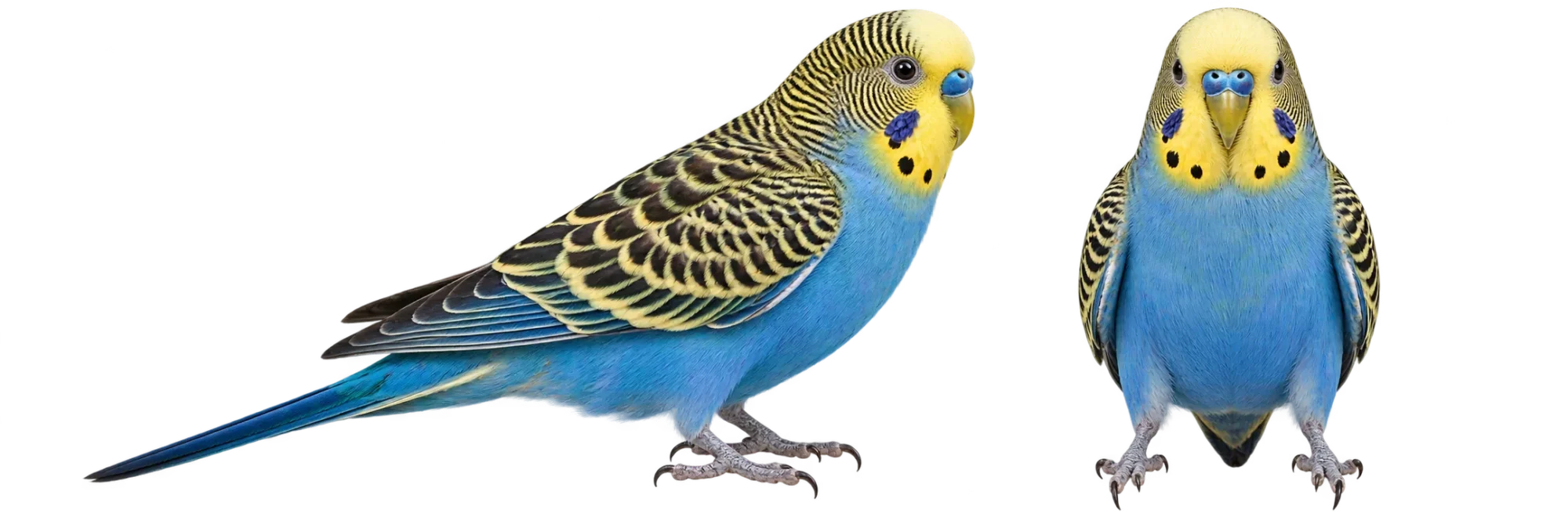
For wild budgerigars, breeding can begin when rain turns dry-country grasslands into a temporary supply of fresh seed. This flexible timing shapes much of the life history of Melopsittacus undulatus: birds move widely, settle where food and water improve, and may raise more than one brood while favorable conditions last.
Breeding Tracks Rainfall and Seed Production
Budgerigars do not follow one breeding calendar across Australia. They are nomadic birds of open, often dry country, and their reproductive timing changes with regional rainfall patterns and the plant growth that follows them. Abundant grass seed gives adults the food supply needed to begin nesting and support growing chicks.
This produces different seasonal patterns across the species’ broad range. Long-term field observations have found breeding concentrated in spring and summer in the far south, shifting toward summer and autumn through many mid-latitude areas. In northern Australia, much breeding occurs during autumn and winter, in the earlier part of the dry season.
| Part of Australia | Common Breeding Pattern | Life-History Context |
|---|---|---|
| Far south | Spring to summer | Birds can arrive after winter rainfall has supported new plant growth and seed production. |
| Mid-latitudes | Often summer to autumn | Timing varies strongly between places and years as rainfall changes. |
| North | Often autumn to winter | Breeding is commonly concentrated in the earlier dry season rather than at the height of the wet season. |
These are regional tendencies, not fixed dates. A productive rain event can alter local conditions, and budgerigars can respond quickly when food becomes plentiful. Rain matters largely through its effect on vegetation and seed availability, which helps explain why breeding can shift so much from one year or location to another.
Nesting also depends on suitable cavities. Wild pairs use existing hollows in trees, branches, logs and similar sites rather than building an exposed nest. Several pairs may nest close together when both hollows and food are available.
Staggered Hatching Shapes the Nestling Period
A budgerigar brood does not begin development all at once. Eggs are laid across several days, and the female starts incubation before the clutch is complete. As a result, the first chick may hatch days before the last one.
This asynchronous hatching creates a visible age and size range within a single nest. Incubation for an individual egg is roughly 18 to 20 days, while young commonly remain in the nest for about five weeks. The oldest chick can therefore be well ahead in feather growth and body size while a later-hatched sibling is still at an earlier developmental stage.
The chicks are altricial at hatching: they emerge poorly developed and depend fully on parental care. The female handles incubation, while the male supplies food during much of this period. Parental roles change as the brood grows, and both parents can contribute to feeding older nestlings.
Studies of captive budgerigar families have found that females can direct feeding toward smaller chicks, helping explain how very different-sized nestlings can continue growing within the same brood. This finding comes from captive behavioral work, so it should not automatically be treated as a measured rule for every wild nest.
Older siblings leave the nest first. Younger chicks can continue receiving care after those siblings have fledged, so the brood gradually becomes smaller rather than reaching independence on a single day. When environmental conditions remain productive, the parents may proceed to another brood.
Age Records Describe Different Life Stages
Budgerigar age data can look contradictory when different biological stages are given the same label. Published records place the onset of puberty within the first several months of life, and curated life-history data record sexual maturity at about six months for both sexes. Some avian clinical references distinguish this early reproductive development from a later point of full sexual maturity.
For that reason, an age given for puberty, reproductive capability or sexual maturity should be read according to the definition used by its source. None of those measurements automatically marks the age at which a bird has finished growing, reached behavioral adulthood or would be an appropriate breeding bird under captive management.
The longevity distinction is especially important for this species because captive records are much easier to follow than the complete lives of highly mobile wild birds. A long-lived captive individual can establish what the species is capable of under recorded conditions, but that record alone cannot show how long a typical budgerigar survives in inland Australia.
 Grey parrotPsittacus erithacus
 Scarlet macawAra macao