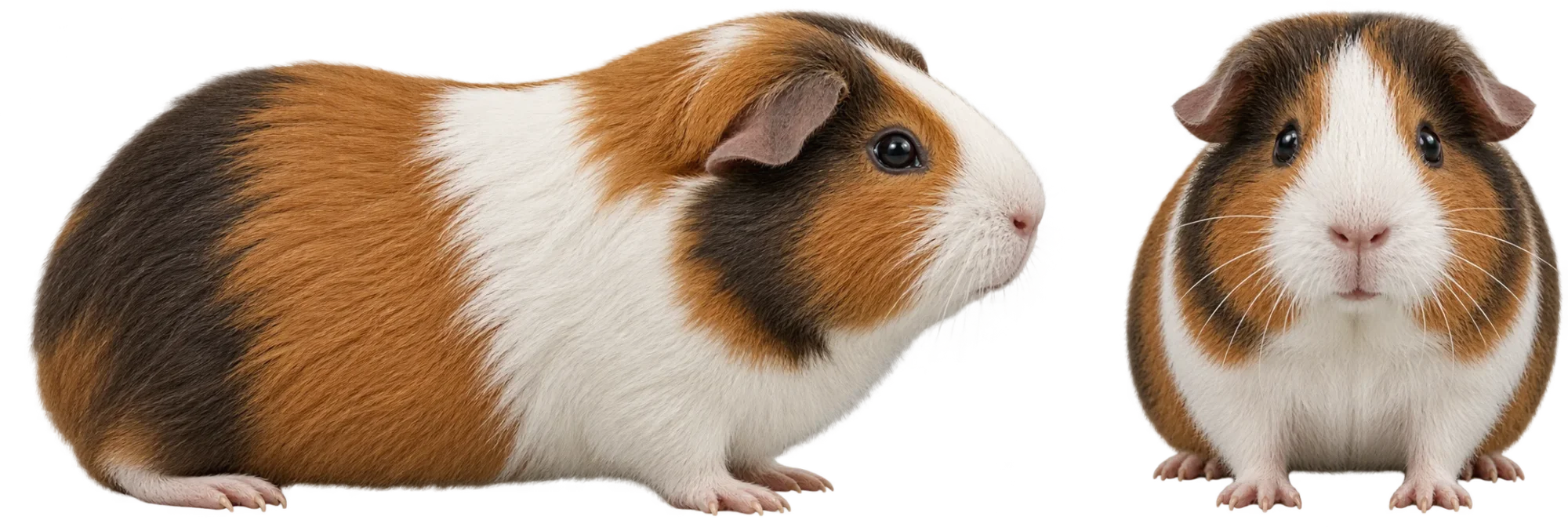
Guinea pigs (Cavia porcellus) spend unusually long in the womb for a rodent, and much of their early development happens before birth. The result is a newborn that can see, hear, walk, and begin sampling solid food almost immediately, even though nursing and maternal contact continue for several weeks.
A Long Pregnancy Produces Well-Developed Pups
Guinea pig pregnancy generally lasts about 59–72 days, with veterinary references placing the average close to 68 days. That is a long gestation compared with many familiar small rodents. The extra prenatal development changes what happens after birth.
Instead of being born hairless, blind, and largely immobile, guinea pig pups are precocial. They arrive fully furred, their eyes and ears are open, and they can move within a short time. Research on guinea pig development has even followed fetal growth and movement across the later stages of this extended pregnancy.
Pregnancy therefore carries a larger share of the developmental process than it does in rodents whose young complete much more growth after birth. This is one reason guinea pig litters are usually modest in size. Veterinary references commonly report an average of roughly two to four pups, although individual litters can fall outside that range.
Newborn size also interacts with litter size. Veterinary physiological data report that birth weight tends to be lower in larger litters. Each pregnancy therefore reflects a balance between the number of developing pups and the growth achieved by each pup before birth.
Mobility Begins Before Nutritional Independence
A guinea pig pup may walk and investigate its surroundings soon after birth. It can also begin consuming small amounts of solid food during its first days of life. Neither ability means that the pup has finished its dependent stage.
Solid-food intake starts well before milk is no longer needed. Guinea pig development is better viewed as an overlap: movement and feeding skills appear early while nursing continues.
Published sources use somewhat different weaning ages because husbandry practices and definitions vary. Current veterinary references commonly place weaning at roughly three to five weeks. Other biological accounts describe nursing ending earlier in some populations or conditions.
This overlap is one of the distinctive parts of guinea pig early life. A pup can follow adults, graze or nibble solid foods, drink water, and still depend on milk. The transition is gradual rather than a sudden change from helpless newborn to independent juvenile.
Maternal behavior also differs from the intensive nest-based care seen in mice and rats. Guinea pig mothers nurse their offspring, but pups are mobile enough to maintain much of the physical contact themselves. Studies of young guinea pigs describe a strong tendency for pups to remain close to the mother even though she does not constantly retrieve them or keep them inside a permanent nest.
The Breeding Cycle Can Restart Soon After Birth
Domestic guinea pigs are capable of breeding throughout the year under suitable conditions. The female reproductive cycle is about 16 days on average, although reported ranges are wider.
A particularly important feature is fertile postpartum estrus. Biological studies have recorded a receptive period only a few hours after giving birth. When an adult male remains continuously housed with a female, another pregnancy can therefore begin almost immediately after the previous litter is born.
This creates a life-history pattern in which a long pregnancy can be followed by very little reproductive pause. Under managed breeding conditions, females may consequently produce several litters within a year.
Sexual maturity also arrives early relative to total lifespan. Veterinary sources generally place it within the first few months of life, although exact ages differ by sex, strain, husbandry, and the definition used by a particular reference. Reproductive maturity should therefore not be treated as the same point as full physical development.
Pet Lifespan and Longevity Records Describe Different Things
Veterinary references commonly give a guinea pig lifespan of about four to eight years, with some sources using a narrower five-to-eight-year range. These values describe the lifespan expected for domestic animals more usefully than the oldest known records do.
Individual guinea pigs can live beyond the usual range. A maximum longevity figure, however, represents an exceptional recorded age rather than the age most guinea pigs should be expected to reach. Captive longevity is also shaped by genetics, diet, veterinary care, reproductive history, and long-term health.
This distinction matters especially for Cavia porcellus because nearly all modern life-history observations come from domestic, laboratory, or managed populations. There is no equivalent living wild population of domestic guinea pigs from which a separate natural lifespan can be measured directly.
 CapybaraHydrochoerus hydrochaeris