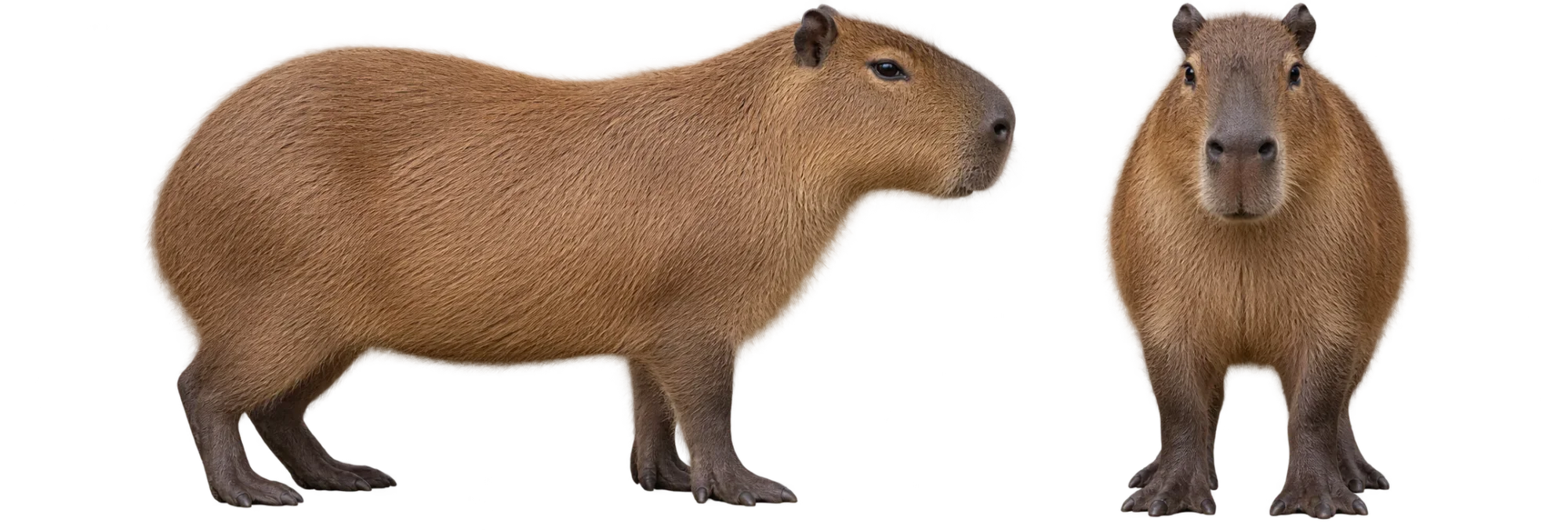
For Hydrochoerus hydrochaeris, much of the life-history pattern is set before birth. A pregnancy lasting close to five months produces well-developed pups that can move almost immediately, yet their early survival still depends on nursing and life inside a stable social group.
A Long Gestation Produces Well-Developed Pups
Capybara gestation is commonly reported at about 145–150 days, which is long for a rodent. Litters often contain around three or four pups, although both smaller and larger litters occur. The long prenatal period allows each pup to reach an advanced stage of development before birth.
Newborn capybaras arrive covered in fur, with their eyes open and their limbs ready for movement. They can stand and follow other animals soon after birth. Grazing also starts very early, sometimes within the first several days of life.
That mobility should not be confused with nutritional independence. Pups continue to drink milk while beginning to eat vegetation, with weaning commonly placed around two to three months. Their first weeks therefore combine two forms of development: rapid use of adult-like foods and continued access to milk.
Pups Grow Within a Shared Social Nursery
Maternal care in capybaras can extend beyond the relationship between one female and her own litter. Communal suckling has been documented in wild capybaras, and observations of captive family groups found females nursing both their own pups and pups born to other females in the same group.
Young from different mothers may gather together while adults provide vigilance around them. This shared care is especially relevant because being able to walk soon after birth does not remove the risks faced by a small juvenile. Pups remain much smaller and less capable than adults for months.
Young capybaras can remain with their natal group for roughly the first year. During that period, the group provides more than access to milk. Staying among familiar adults and other young creates a protected social setting while the pups grow, improve their movement and shift fully onto the adult diet.
Breeding Peaks Shift With Local Seasons
Capybaras are capable of reproducing across much of the year, but breeding is not timed identically throughout their range. Research on caviomorph reproduction shows that tropical populations often concentrate more reproductive activity around seasonal changes in rainfall, while populations in less sharply seasonal environments may reproduce more continuously.
Even the relationship with the rainy season varies by location. Birth peaks reported from the Venezuelan Llanos and the Brazilian Pantanal do not fall at exactly the same point in the seasonal cycle as observations from Marajó Island. A single calendar month therefore does not describe the breeding season for the species as a whole.
One litter per year is a common description of wild capybara reproduction, but it is not an absolute biological limit. Two litters can occur when conditions allow it. Captive breeding studies have produced two births per female within a year under particular feeding and management conditions, so those results should not be treated as the normal reproductive rate of every wild population.
Breeding also takes place within a social hierarchy. Dominant males gain much of the mating access within established groups, while subordinate males may also mate. Reproductive output is consequently shaped by both female reproductive physiology and an individual’s position within the social group.
Published Maturity Ages Reflect Different Stages
Reported ages for capybara maturity vary because researchers and animal institutions do not always measure the same event. Some reproductive literature places puberty at roughly 10–12 months, while other sources report reproductive or sexual maturity later, commonly from about 15 months onward and sometimes closer to two years.
These figures are not necessarily contradictory. Puberty marks the onset of reproductive physiological activity, whereas practical breeding age may reflect later development, body condition or observations of animals actually reproducing. Wild and managed populations can also develop under different nutritional and social conditions.
A juvenile reaching reproductive physiology is still developing within a species that has long-lived social groups and strong dominance relationships. Physical ability to reproduce and actual access to mating are therefore separate parts of the capybara life cycle.
 Guinea pigCavia porcellus