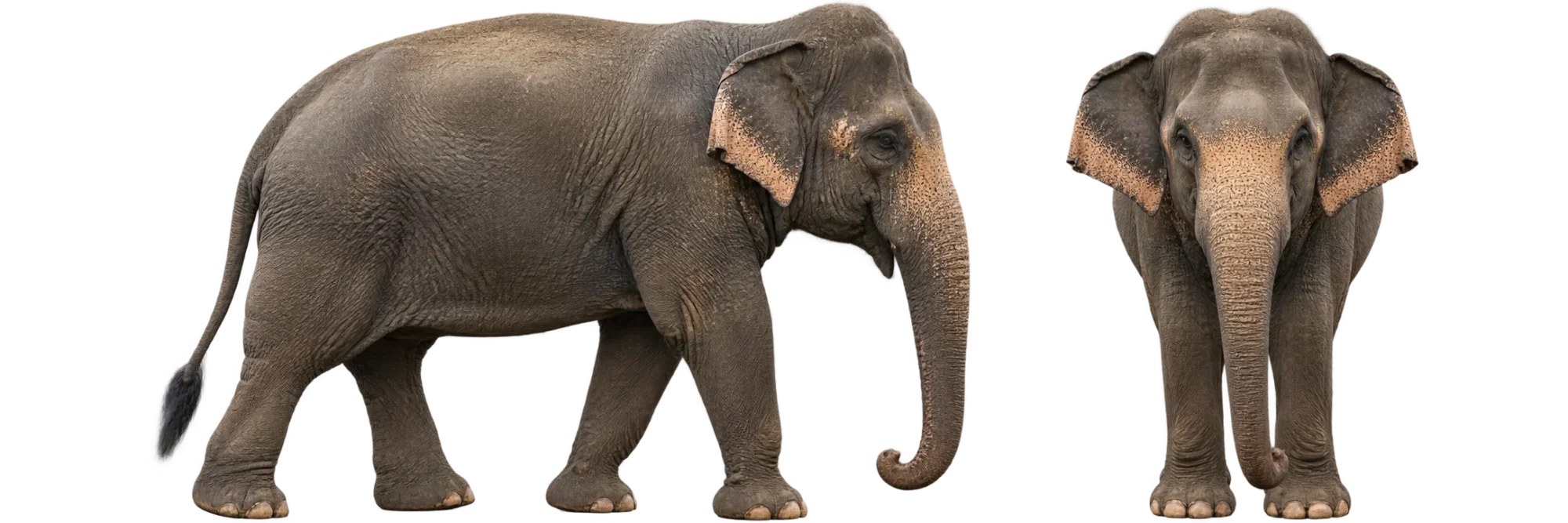
The Asiatic elephant, more commonly called the Asian elephant (Elephas maximus), follows an unusually slow life-history schedule. A single calf requires nearly two years of pregnancy and then years of nursing, protection, learning, and social development. Reproduction may begin before all physical growth is complete, and the meaning of adulthood differs sharply between females and males.
Reproduction Operates on a Multi-Year Clock
Asian elephant reproduction is slow not simply because pregnancy is long, but because each successful birth occupies a large part of a female’s reproductive schedule. Gestation lasts about 21.5 to 22 months, and a pregnancy normally produces one calf. Twins occur, but they are uncommon.
Births are therefore separated by years rather than months. Longitudinal observations of wild elephants in Sri Lanka found a median inter-birth interval of about six years, while managed populations have produced averages closer to four or five years. These figures are not contradictory. Birth spacing can change with nutrition, reproductive condition, calf survival, management, and the characteristics of the population being measured.
A short interval is not automatically a reproductive advantage. In a large long-term dataset from semi-captive elephants in Myanmar, calves had a higher mortality risk when their mothers gave birth again less than about 3.7 years after the previous calf. Calves of first-time mothers also faced higher mortality. These findings describe that study population rather than a universal biological cutoff, but they show why reproductive rate cannot be judged from birth frequency alone.
The long interval also means that an adult female can produce only a limited number of calves even across several decades of reproductive life. Losing a breeding female consequently removes not only one animal from a population but many years of potential future reproduction.
Calf Development Continues for Years
Asian elephant calves are physically capable soon after birth but remain developmentally dependent for a long time. They can stand and begin nursing soon after delivery, yet early mobility should not be confused with adult-level independence. Feeding skills, trunk control, social behavior, and nutritional independence emerge on different schedules.
This extended development takes place within a female-centered social environment. Mothers provide the main care, but other females can also interact closely with calves. Research on wild calves younger than six months has identified particular females acting as escorts and providing active allomaternal care rather than all nearby females contributing equally.
The social setting therefore supplies more than protection. A calf spends years observing feeding, movement, communication, and interactions within its group while its own physical and behavioral abilities continue to develop. Female offspring normally remain associated with their natal social unit, whereas males eventually leave it as they mature.
Growth and Reproductive Timing Do Not Follow the Same Schedule
There is no single age at which an Asian elephant becomes fully adult in every biological sense. Sexual maturity, first reproduction, skeletal growth, body-mass growth, and social access to breeding can occur at different times.
The distinction is especially important for males. Being physiologically capable of reproduction does not guarantee immediate breeding success. Adult males compete for access to females, and older, larger males in musth can have an advantage. As a result, the age of sexual maturity can occur well before the age at which a male regularly fathers calves in a wild social population.
Females show a different overlap between growth and reproduction. Research on semi-captive elephants in Myanmar found that females at the population’s peak reproductive age of 19 years had reached about 81% of their eventual body weight. Reproduction was therefore already well established while some mass growth remained.
Reproductive Life Has No Simple Late-Age Cutoff
Long life does not translate into a fixed reproductive endpoint shared by all Asian elephant females. A longitudinal wild population in Sri Lanka showed relatively stable fecundity across the observed reproductive ages of roughly 11 to 60 years. Other long-running datasets have also documented births from females well into adulthood.
Research on Myanmar elephants has found evidence for a post-reproductive portion of female lifespan, but that finding should not be reduced to a simple claim that Asian elephants undergo a human-like menopause at a particular age. The researchers found that the apparent post-reproductive period was unlikely to result solely from a universal physiological shutdown of reproduction. Condition, mating opportunities, demographic history, and the length of the observation period can all affect the pattern.
For Asian elephants, ages such as sexual maturity, first calving, peak reproduction, final height, final body mass, and last reproduction describe different events. Treating any one of them as the point of complete adulthood hides much of the species’ actual development.
The same caution applies to lifespan records. An exceptionally old captive individual establishes that a particular age was reached; it does not establish the normal lifespan expected for every Asian elephant. Survival also depends strongly on population, sex, life stage, environmental conditions, and management history.
 African bush elephantLoxodonta africana