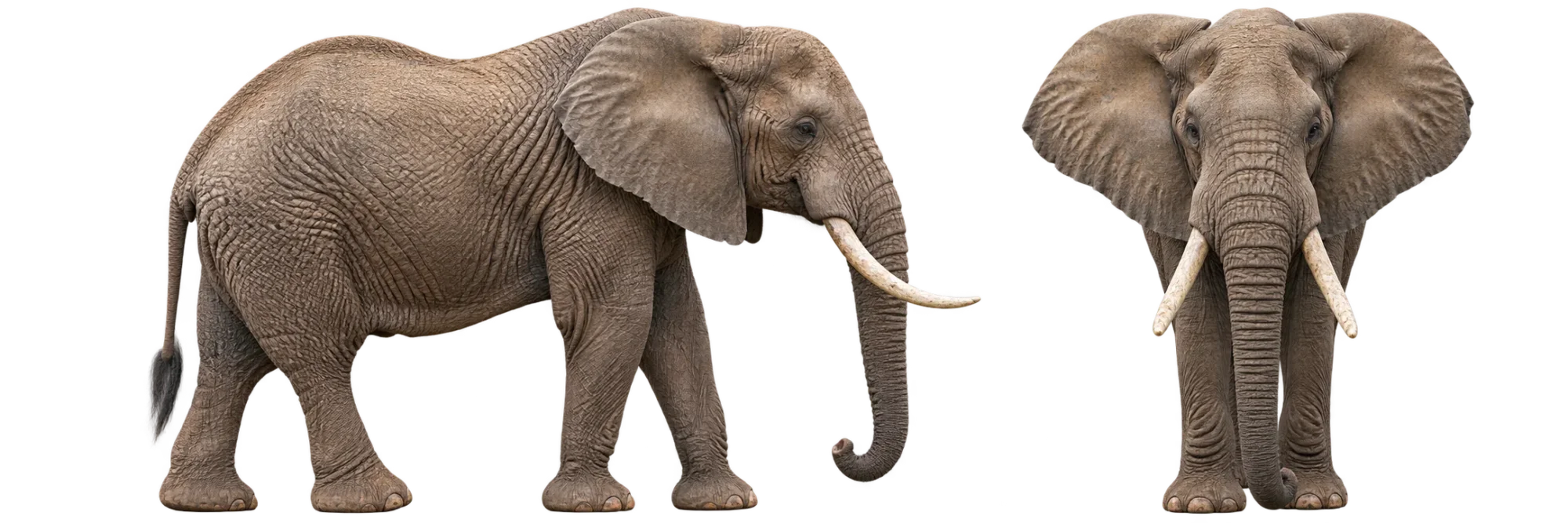
For the African bush elephant (Loxodonta africana), reproduction unfolds across a long biological schedule. Pregnancy lasts about 22 months, a calf depends on its mother for years, and another birth commonly comes several years later. Long-term field studies also show that conditions early in life can still be reflected in growth, survival, and reproduction decades afterward.
Species Scope
African bush elephant and African savanna elephant are common names for Loxodonta africana. Current mammal taxonomy recognizes the African forest elephant, Loxodonta cyclotis, as a separate species. Older research using the broader name “African elephant” therefore needs to be interpreted according to the population actually studied.
A 22-Month Pregnancy Is Only Part of the Birth Interval
Female African bush elephants can become reproductively mature during adolescence, but maturity does not mark the start of a rapid breeding cycle. In the long-monitored Amboseli population in Kenya, the mean known age at first reproduction was 13.8 years. Only about 5% of females had begun reproducing by age 10.
Pregnancy itself lasts roughly 22 months, among the longest gestation periods in mammals. A single calf is the normal outcome. Twins can occur, but they are not the usual reproductive pattern.
The interval between births is much longer than gestation alone. Studies of wild African elephants have reported intercalving intervals of roughly 4 to 8 years, with variation linked to food availability, population conditions, and other environmental influences. In Amboseli, intervals of about four to five years between surviving calves have often been observed.
This variation matters when interpreting a single average. An interbirth interval is partly a property of the mother and partly a record of the conditions she experienced. Rainfall can affect vegetation and body condition, while the age of the previous calf determines whether a female is physiologically ready to conceive again. Years with many females simultaneously available for conception can later produce noticeable pulses of births because every successful conception is followed by the same long gestation.
Drought During Calfhood Can Affect Outcomes for Decades
A newborn elephant enters the world physically advanced enough to stand, walk, and begin nursing very early. Studies comparing newborn African elephants in wild and managed populations found similar timing for the first attempts to stand and walk. Nursing requires coordination with the mother, so maternal experience can influence how quickly that step is completed.
The more important developmental story unfolds over years rather than hours. Milk remains part of the calf’s diet well beyond the newborn stage, while physical growth and dependence continue through a long juvenile period. This extended development gives young elephants time to grow, learn, and respond to changing conditions, but it also means that poor conditions can affect a large portion of early life.
Long-term records have revealed effects that would be difficult to detect in a short study. Research using decades of life-history and growth data found that elephants exposed to drought and maternal inexperience early in life could carry measurable disadvantages much later. Slow growth during early lactation was associated with smaller adult size, later reproductive onset, lower survival, and reduced lifetime reproductive output.
The pattern was especially informative because some calves could compensate for poor growth experienced before birth. Growth restriction during gestation did not automatically produce permanently smaller survivors. Conditions during the years after birth, when the calf was still growing rapidly and receiving maternal investment, were more strongly connected with later outcomes.
For African bush elephants, early growth therefore cannot be treated simply as the route from birth weight to adult mass. The rate at which a calf grows can become part of its later reproductive history.
Amboseli Females Reproduce Across Much of Adult Life
Female reproduction continues for decades after the first calf. A long-term analysis of 834 wild females in Amboseli found that the timing of reproductive onset differed among individuals. Females that began reproducing earlier tended to maintain higher age-specific fertility than females that started later, without an accompanying survival difference between those groups.
Reproduction does decline with advanced age, but there is no sharply defined age at which every female becomes reproductively inactive. In the Amboseli data, 95% of observed fertility occurred before age 50, yet reproduction did not completely disappear in females beyond 65.
This creates an important difference between reproductive lifespan and lifespan itself. A female may live for many years after the period in which most of her calves were produced. Those later years also take place within a multigenerational family structure rather than in isolation.
The same Amboseli analysis found an association between maternal presence and reproduction in adult daughters. Daughters whose mothers were also reproducing showed higher reproductive rates than daughters without that circumstance. The finding does not mean that an older mother directly determines her daughter’s fertility, but it shows why elephant life history extends beyond individual pregnancy records. Mothers and adult daughters can remain together while both are reproductively active.
Researchers also found no evidence that females over 40 routinely compensated for age by greatly extending the time to another birth or producing higher calf mortality. Reproductive ageing is gradual and individual rather than a simple switch from fertile to infertile.
Older Bulls Gain a Larger Share of Paternity
Male life history follows a different timetable. A young bull may be physiologically capable of reproduction well before he can compete effectively with large adults. Growth continues through much of male life, so age brings changes in body size as well as reproductive experience.
Wild observations have shown that males generally do not compete successfully for access to receptive females at the same age that sexual maturity first becomes possible. Males in their twenties can reproduce, but older bulls gain a much larger role. Many observed matings involve males older than 35, particularly when those males are in musth, the temporary reproductive state associated with elevated androgen levels and intense sexual activity.
Genetic paternity work in the Amboseli population supports the behavioral observations. Analysis of 119 calves born across 22 years found that both age and musth status were related to paternity. Among males in musth, reproductive success rose with age until the oldest age classes, where it declined modestly.
Age at sexual maturity therefore describes only one stage of male development. It should not be read as the age at which a typical male reaches peak reproductive performance. For a species in which bulls continue growing for decades, the distance between physiological maturity and high paternity success can itself span decades.
Later research tracking adult males also found that reproductive effort changes with age. Older bulls altered their movement far more strongly during musth than younger adults, covering larger areas and moving faster while reproductively active. Male reproductive strategy is therefore tied to continued growth and changing energetic investment throughout adult life.
Wild Survival and Maximum Age Describe Different Measures
African bush elephants are long-lived, but a longevity record should not be interpreted as the lifespan expected for every individual. Maximum longevity records describe the upper end of observed survival, while life expectancy depends on mortality experienced across an entire population.
The Amboseli female study illustrates the difference. Among females that survived to the minimum observed reproductive age used in the analysis, estimated mean remaining life produced a life expectancy of about 41 years, while 95% of recorded mortality had occurred by age 65. Some females survived and even reproduced beyond the ages at which most fertility and mortality had already occurred.
That broad spread of ages is biologically important. Starting reproduction a few years earlier, surviving through more reproductive cycles, or maintaining condition into later adulthood can alter lifetime calf production substantially when births are normally separated by several years. Longevity in this species is therefore closely connected with how many reproductive opportunities an individual lives long enough to experience.
 Asiatic elephantElephas maximus