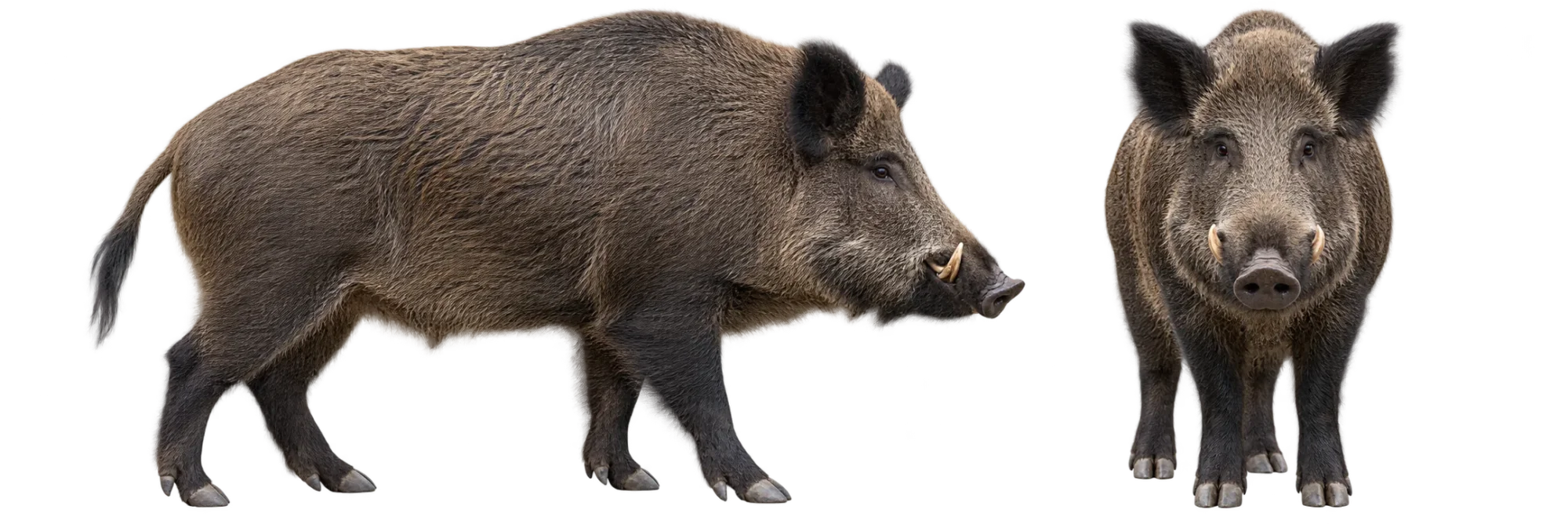
Wild boar (Sus scrofa) can become reproductively capable while they are still growing. Early maturity, a gestation of roughly four months, and litters of several piglets give the species a relatively fast reproductive tempo for a mammal of its size. The timing is flexible, however. Body condition, food supply, season, and local climate can shift when breeding begins and when young are born.
Breeding Timing Changes Across Wild Boar Populations
Wild boar reproduction often has a strong seasonal pattern in temperate regions, but the pattern is not fixed across the species. In a South Korean population studied over several years, most conceptions occurred in December and January, followed by births mainly in April and May. A Swedish study found a broader pattern, with pregnant females and reproductive activity occurring outside the main season as well.
This flexibility matters when interpreting a single breeding-season value. Wild boar can reproduce outside the usual winter mating period when environmental conditions allow it. Abundant food can help females reach the body condition needed for reproduction, while poor nutritional conditions can delay or suppress breeding.
Gestation is generally about 108–120 days. A mating peak in winter therefore commonly produces a spring birth peak, but shifts in conception dates can move farrowing into other parts of the year.
Body Condition Strongly Influences the Start of Reproduction
Calendar age alone does not determine when a wild boar becomes reproductively active. Females can reach puberty during their first year, but individuals of the same age may be at very different reproductive stages because growth rate and body condition differ.
Research on young females in Sweden found that body weight was a better predictor of puberty than age class when the two were considered together. Females that grow quickly and reach an adequate body condition can therefore enter the breeding population earlier than slower-growing animals. Pregnant females as young as about 10 months have also been recorded in field studies.
Male development follows a similar distinction between physiological maturity and full adult development. Research on young male wild boar in Germany found sperm production in many animals around nine to ten months old when adequate body condition had been reached. Being physiologically capable of reproduction does not mean that a young male will obtain the same mating opportunities as a larger adult male.
Wild boar also continue growing long after puberty. Sexual differences in body size become clearer as animals age, so reproductive maturity should not be treated as the point at which adult growth is complete.
Litter Size Responds to Female Size and Local Conditions
Wild boar do not have a single normal litter size that applies to every population. Studies frequently report averages near five to six offspring, while individual litters can be smaller or considerably larger.
The variation is biologically meaningful. Older or heavier females often have greater reproductive output than younger, lighter females. In the South Korean study, litters ranged from three to ten and litter size rose with maternal weight. The Swedish population showed the same general relationship between female size, age, and reproductive potential.
This makes a litter-size value more useful when treated as a population estimate rather than a fixed species rule. Food availability, female condition, age structure, climate, and local population characteristics can all change the number of young produced.
Before giving birth, a sow typically separates temporarily from her social group and prepares a sheltered farrowing site. The piglets depend on maternal milk and protection during early development. They become progressively more mobile and independent over the following weeks, with weaning commonly occurring within the first few months.
Early life also connects with the species’ social structure. Females and their offspring commonly live in related groups known as sounders. Young females may remain associated with their natal group after reaching maturity, while males usually become more independent as they grow. This creates different developmental paths for the sexes even though both may reach physiological maturity relatively early.
Longevity Records and Survival in the Wild
The longest recorded life should not be read as the expected lifespan of a wild boar. The AnAge longevity database records a maximum of 27 years in captivity for Sus scrofa, based on an individual from the Ryukyu wild boar lineage. It is a longevity record rather than a description of how long wild animals normally survive.
Free-ranging populations usually contain far more young animals than individuals approaching such ages. In one South Korean population sample, animals three years old or younger made up about 90% of those examined. Local mortality, food conditions, disease, accidents, and other environmental pressures shape the age structure seen in the wild.
Wild boar life history therefore combines the biological capacity for a fairly long life with reproduction that can begin early. A female does not need to approach maximum adult age before contributing offspring; under favorable conditions, reproduction may start during the first year and continue through repeated breeding seasons.