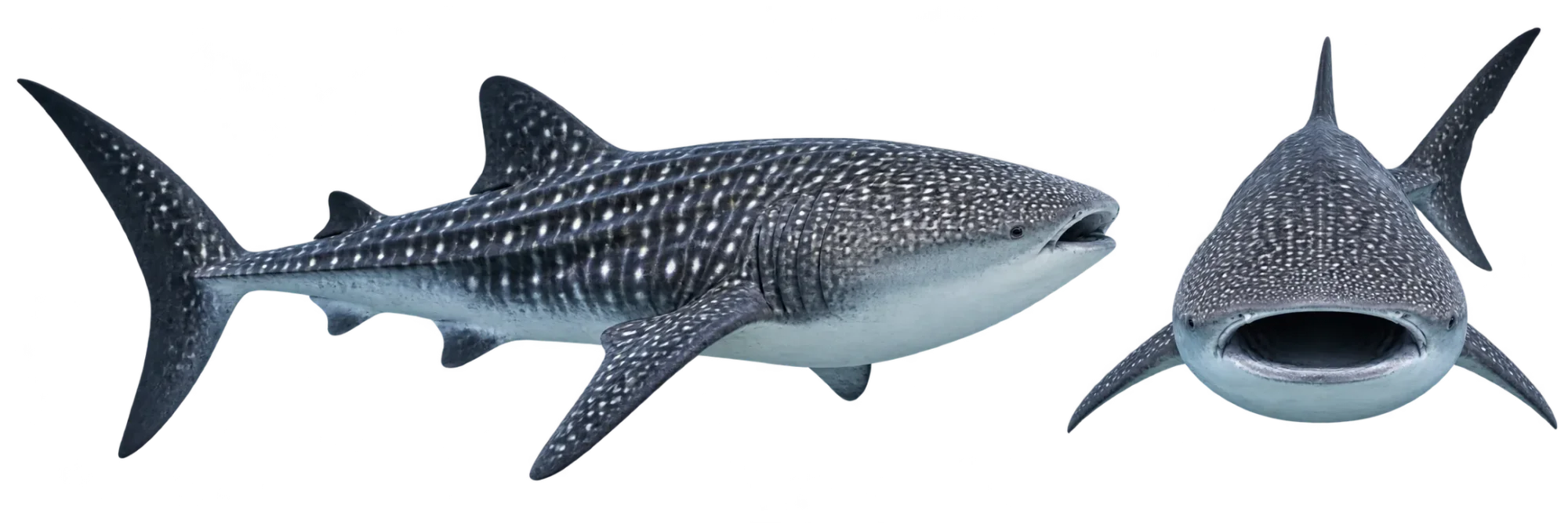
Much of the life history of the whale shark, Rhincodon typus, has been reconstructed from vertebrae, repeated measurements of known individuals, and a remarkably small number of reproductive records. Ageing methods have become more reliable, but pregnancy, birth timing, and the whereabouts of the youngest sharks remain far less certain.
Growth Continues Across Decades
Whale sharks grow on a time scale that is unusually long for a fish. Researchers can estimate age from growth bands preserved in the vertebrae, but for years there was disagreement over how often those bands formed. Radiocarbon analysis later showed that the bands are deposited once each year, making them usable as annual age markers.
A radiocarbon-validated study aged one female of about 10 m at roughly 50 years and one male of similar length at about 35 years. Fifty years is an observed age from the sampled material, not a demonstrated maximum lifespan for the species.
This distinction matters because estimates of total longevity extend beyond the oldest directly aged animals and depend on growth models. The available evidence supports a long life, but it does not support treating one modelled maximum age as the normal lifespan of every whale shark.
Long-term measurements at Ningaloo Reef also suggest that males and females follow different growth trajectories. In one study, males approached an average modelled length of roughly 8–9 m as their growth slowed. The female model projected a much larger eventual size, around 14.5 m, with growth continuing more gradually for longer.
The female estimate is less certain because only six females could be followed repeatedly, compared with 48 males. The study therefore provides strong evidence for slower late growth in males, while the exact female growth curve still needs more observations.
Sexual Maturity Is Closely Tied to Body Size
Male whale sharks can be assessed for maturity in free-swimming animals because the claspers change in size, thickness, and calcification as they mature. Even with this visible marker, studies from different regions have produced different size thresholds.
In the Arabian Gulf, half of the assessed males were estimated to be mature by about 7.3 m. Research combining sharks from Mozambique and northeastern South Africa placed the equivalent estimate closer to 9.2 m. Earlier work from other aggregation sites also produced values within this general size range.
These differences should not be compressed into a single universal maturity length. Regional biology can contribute, but measurement technique and the composition of the sampled aggregation also affect the result. Large whale sharks are particularly difficult to measure accurately by eye.
Female maturity is harder to determine because there is no comparable external structure that can be assessed as easily in the water. Examination of female reproductive tissues has shown that individuals longer than 7 m can still be immature. Mature females reported in earlier work have generally been larger, including a 9.6 m female from Taiwanese waters.
Published ages at maturity are often calculated by combining an estimated maturity length with a growth model. Because whale shark growth models have changed as ageing methods improved, maturity size is currently more directly supported than one fixed maturity age.
One Pregnancy Revealed an Unusual Reproductive System
Direct knowledge of whale shark pregnancy still rests heavily on a 10.6 m female found off eastern Taiwan in 1995. She carried 304 embryos, making this specimen one of the most informative reproductive records available for the species.
The embryos were not all at the same developmental stage. Some remained inside egg cases with attached yolk sacs, while larger embryos had already emerged from the cases and were free within the uterus. Near-term individuals reached roughly 58–64 cm in total length.
This established that whale sharks use aplacental yolk-sac viviparity. Fertilized eggs develop inside the female, the embryos obtain their nutrition from yolk rather than a placenta, and they hatch internally before live young are released.
The mixture of developmental stages raised another question: were embryos being fertilized at different times? Genetic testing later examined 29 embryos spread across the range of sizes and stages. All of those tested were full siblings with the same father.
That result is consistent with a female being able to retain sperm and use it to fertilize eggs over time. It does not prove that every embryo in the entire litter had the same father, because only a fraction of the 304 embryos was genetically tested.
Several basic reproductive measurements remain unresolved. The length of gestation has not been established, and there is no well-supported standard interval between pregnancies. The 304-embryo pregnancy demonstrates what one female was capable of carrying, but it should not automatically be treated as the normal litter size for the species.
The Earliest Free-Swimming Stage Remains Rarely Seen
The near-term embryos from the Taiwanese female show that whale sharks can approach birth at around 60 cm long. Yet animals close to this size are rarely encountered in the wild. Most well-known seasonal aggregations contain much larger juveniles, often several metres long, leaving a large observational gap between birth and the sharks commonly photographed or measured at feeding sites.
New records are gradually filling part of that gap. Observations made in Saleh Bay, Indonesia, during 2024 and published in 2025 included several whale sharks estimated at about 1.2–1.5 m long. One small male was measured at roughly 1.35–1.45 m.
Those observations suggest that Saleh Bay could be used during very early life and may have a role as a pupping or nursery area. The evidence is promising rather than conclusive: finding very young sharks in one area does not by itself establish where they were born or how long they remain there.
The scarcity of newborns, mature females, and pregnant females also explains why whale shark life-history data can look uneven. Coastal feeding aggregations provide thousands of encounters with juveniles in some regions, while several stages that determine reproduction and population turnover are encountered only occasionally.