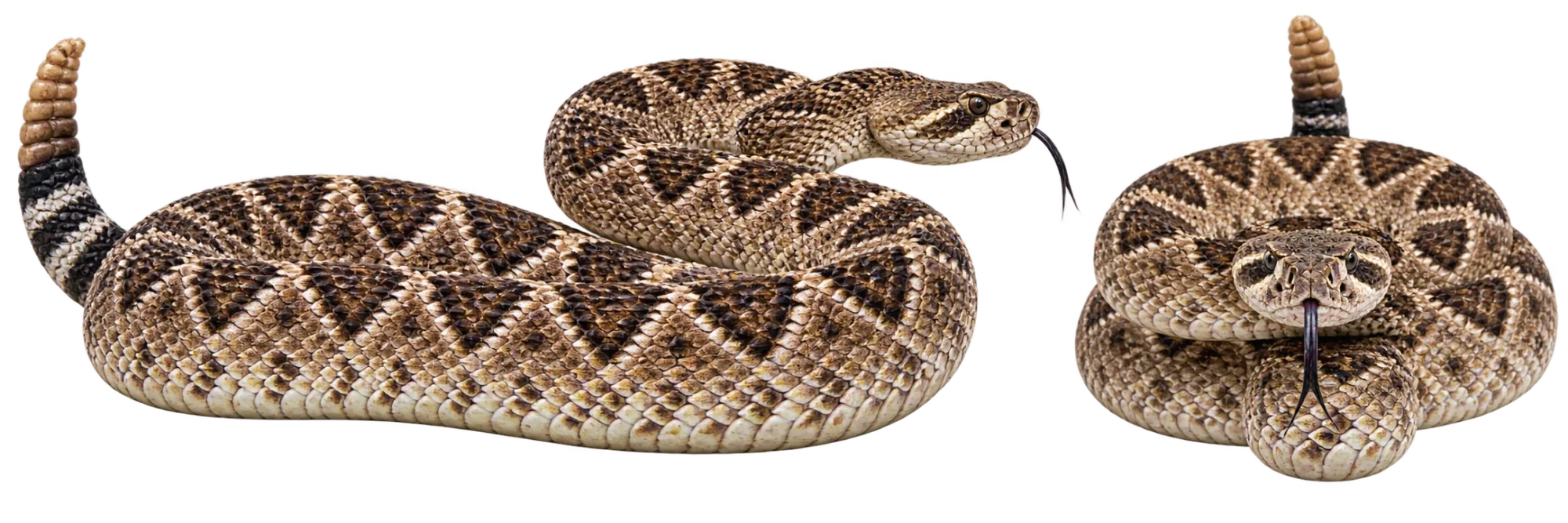
The life history of the western diamond-backed rattlesnake (Crotalus atrox) is unusually responsive to growth, food supply, and local conditions. Long-term work in Arizona shows that females can shift between annual and multi-year reproductive schedules, populations can differ markedly in litter size, and faster growth can bring reproductive maturity earlier. Fixed values for maturity, litter size, or birth interval therefore describe only part of the species’ biology.
The Reproductive Year Has Two Mating Windows
Detailed field studies in the Sonoran Desert show a reproductive schedule that stretches across much of the year. Adult western diamond-backed rattlesnakes can mate in late summer and again in early spring. Females that reproduce that year develop ovarian follicles rapidly during spring, followed by ovulation in early summer and birth later in summer.
Crotalus atrox is viviparous, so embryos develop inside the female and the young are born alive rather than being deposited as shelled eggs. The exact timing can vary across the species’ broad geographic range, making the Arizona sequence most useful as a well-documented population example rather than a calendar for every western diamondback.
Female Birth Intervals Change With Available Energy
A female western diamond-backed rattlesnake does not necessarily produce a litter every year. Long-term radio-tracking in the Sonoran Desert found many females following two-year or longer reproductive intervals. The same study also recorded females reproducing in consecutive years, including individuals that changed from a longer interval to annual reproduction.
Food availability appears closely tied to this flexibility. Years associated with greater rainfall were also associated with more annual reproduction in the monitored population. The proposed biological link is indirect: rainfall can support higher rodent abundance, giving females more opportunities to rebuild the body reserves required for another reproductive cycle.
Experimental food supplementation produced a similar pattern. Females receiving additional food reproduced more often than untreated females, and some were able to reproduce in successive years. This supports the idea that reproductive frequency is partly controlled by the female’s energetic condition rather than by a rigid every-other-year schedule.
This flexibility helps explain why a single reproductive interval can be misleading for the species. A female may reproduce annually under favorable conditions, then require a longer recovery period at another time.
Litter Size Varies Between Populations and Measurements
Published litter values for western diamond-backed rattlesnakes span a broad range, and research from Arizona shows why one species-wide number should be treated cautiously. Female size, local population characteristics, food conditions, and even the way reproductive output is measured can affect the reported value.
| Research Context | Observed Pattern | What It Shows |
|---|---|---|
| Arizona reproductive study | Overall mean of about 7 young or developing offspring per reproductive female | Females in this desert sample produced smaller litters than some values reported elsewhere for the species. |
| Oviductal ova or completed litters in the same study | Mean about 5.6, with records from 4 to 9 | Counts closer to actual birth output were lower than counts based on enlarged ovarian follicles. |
| Long-term south-central Arizona population | Mean litter size about 4.3 neonates | A local field population can fall well below broad species averages. |
The distinction between follicles and young actually born is especially useful. An enlarged follicle count represents reproductive investment at one stage of the cycle, while a completed litter records the young that reached birth. Treating the two measurements as interchangeable can make litter size appear more uniform than it is.
Body size also matters. Arizona work found more enlarged follicles in longer females, while geographic studies have shown that adult body size itself varies among western diamondback populations. Population-level differences in litter size can therefore reflect real biological variation rather than conflicting observations.
Growth Rate Helps Determine When Maturity Is Reached
Western diamond-backed rattlesnakes are often assigned an approximate sexual maturity age of around three years, but controlled growth experiments show that age alone does not describe the transition well.
Researchers raised young Crotalus atrox under different feeding schedules for two years. Snakes receiving more food grew and gained mass faster, and they reached reproductive maturity earlier than snakes receiving less food. Body size was a better predictor of maturity than chronological age in that experiment.
A recorded age such as three years is useful as a population estimate, not as a biological deadline. Two snakes of the same age can differ in growth because of feeding history and other conditions, and they may not become reproductively mature at the same time.
This growth response connects juvenile development directly with later reproduction. Faster growth can shorten the time required to reach a reproductively capable body size, while restricted food intake can extend that period without changing the animal’s chronological age.
Mothers Remain at Birth Sites Through the First Shed
The first days after birth include a short but distinct mother-young association. Long-term observations in Arizona found females giving birth at sheltered sites such as small-mammal burrows, rock shelters, and packrat middens. Mothers remained there with their offspring until the neonates completed their natal ecdysis, the first skin shed after birth.
At the studied sites, this first shed usually occurred about five to seven days after birth. Only after this period did the family group separate. That field evidence gives a more precise picture than older descriptions in which newborn western diamondbacks were said to leave their mother within only a few hours.
Genetic work has also revealed that a litter can have more than one father. In one long-running Arizona population, half of the complete litters tested for parentage contained offspring from multiple males. Females can store sperm, so a male observed with a female shortly before birth is not necessarily the father of all, or even any, of her offspring.
The Longest Recorded Lives Come From Captivity
A longevity record should not be read as the ordinary lifespan of a western diamond-backed rattlesnake. The AnAge longevity database records a maximum of 27 years in captivity for Crotalus atrox. That figure demonstrates that the species can survive for decades under managed conditions, but it does not establish a typical lifespan for wild snakes.
Wild individuals face mortality pressures that captive animals largely avoid, and long-term ages are difficult to verify in free-ranging rattlesnakes. For life-history comparisons, the 27-year value is therefore best retained specifically as a documented captive maximum rather than converted into an expected wild lifespan.