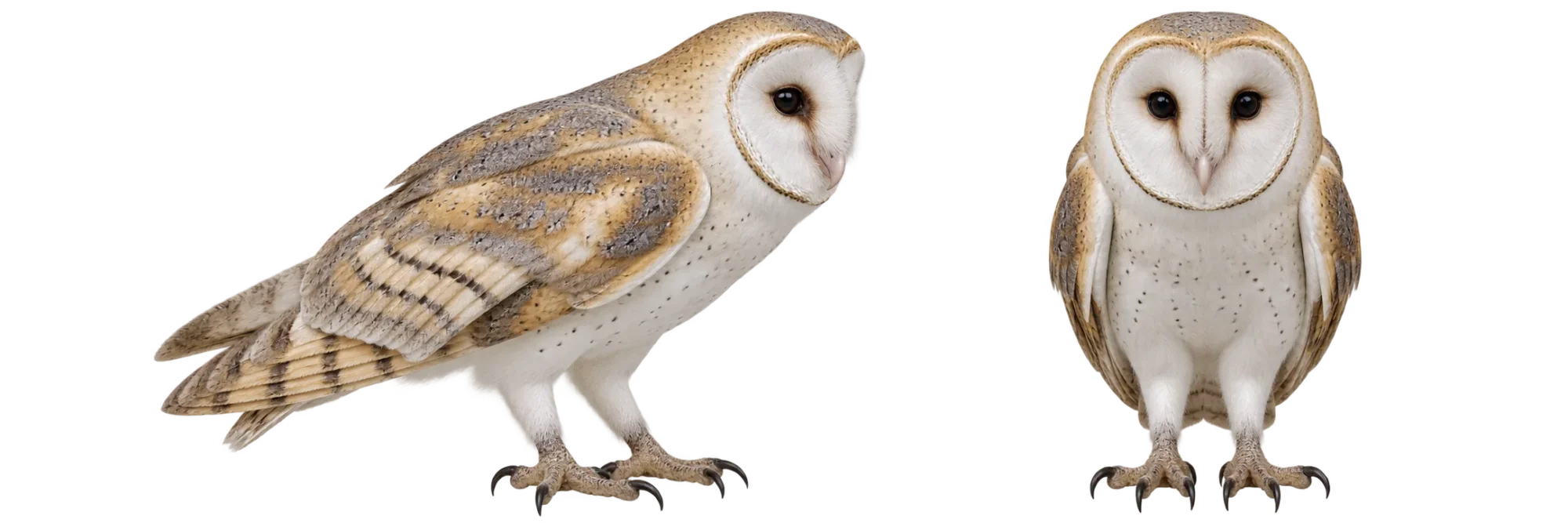
In the barn owl (Tyto alba), the spacing between eggs shapes much of the early life cycle. Incubation begins before the clutch is complete, so chicks from the same nest may differ greatly in age and size. That staggered start affects feeding, growth, fledging, and survival when prey becomes scarce.
Incubation Begins with the First Egg
Barn owl eggs are usually laid about two to three days apart. A female does not wait for the final egg before settling into continuous incubation. Instead, development begins with the first egg, while later eggs are still being laid.
Incubation of an individual egg lasts roughly a month. British nest records place the typical period near 32 days, with observed values commonly around 30–34 days. Because laying itself can continue for well over a week in a large clutch, the first chick may already be growing rapidly by the time the youngest chick hatches.
This creates an obvious size hierarchy within the nest. The oldest chicks are larger, stronger, and generally better placed to receive food when deliveries are limited. Younger siblings can still develop normally when prey is plentiful, but food shortages can reduce the number of chicks that survive to fledging.
The pattern gives barn owls a way to produce several young when feeding conditions are favorable without requiring every chick to receive an equal share during a poor prey period. Large differences between nestmates are therefore a normal result of the breeding schedule rather than evidence that the younger chicks developed unusually slowly.
The female performs the incubation and remains closely involved in brooding the youngest chicks. During this early period the male supplies much of the food. As the chicks become better able to maintain their own body temperature, the female can spend more time away from the nest and contribute to hunting.
Young Barn Owls Keep Developing After Their First Flights
Newly hatched barn owls are altricial. They are dependent on their parents and begin life covered in down rather than the developed flight plumage of a juvenile ready to leave the nest.
Growth over the following weeks is rapid but uneven across the brood because the chicks did not hatch together. In well-studied British populations, fledging is commonly recorded at roughly 53–61 days of age, with an average close to 56 days. A younger sibling in the same nest may still be developing while the oldest bird is approaching its first flights.
Fledging should not be treated as the moment a barn owl becomes independent. Young birds initially make short flights and continue to use the nest site or nearby roosting places. Their parents still provide food while the juveniles improve their flight control and begin learning to capture prey for themselves.
Fledging and independence are separate stages
A barn owl may be capable of leaving the nest at around eight weeks yet remain dependent on parental food for several more weeks. Independence is commonly reached closer to three months of age.
Physical development also changes how young barn owls can be aged. During the first month, measurements of growing skeletal structures can give useful age estimates. Later in development, feather growth becomes more informative because many skeletal dimensions are already approaching their later proportions.
Prey Conditions Can Change the Breeding Schedule
Barn owls depend heavily on small mammals, and fluctuations in this food supply can alter reproductive output from one season to another. A pair may raise a large brood in a strong prey year, while far fewer chicks may survive when prey numbers are low. Breeding can also be delayed or skipped under poor feeding conditions.
Clutch size varies widely across populations and circumstances. British records commonly show four to six eggs, while long-running European studies have documented clutches extending well beyond that range. The largest clutch should not be treated as the normal reproductive output of the species.
Food availability also helps explain why a second brood is possible in some places and years. Barn owls are capable of breeding again when conditions allow, rather than following a rigid one-brood schedule everywhere. Geography, season, weather, prey abundance, and the condition of the adults all affect how much breeding a pair can support.
This flexibility is paired with early reproductive maturity. Barn owls can breed at about one year of age, allowing individuals that survive their first year to enter the breeding population relatively quickly.
Survival Changes Sharply After the First Year
Longevity records can give a misleading impression of how long a barn owl normally lives. Ringing data show that a few individuals survive for many years, but early mortality is much higher than those exceptional records suggest.
British ringing analyses estimate first-year survival at about 0.37, meaning that many juveniles do not reach their second year. Survival is higher among adults, with an estimated annual rate of about 0.72 in the same data. The transition from a dependent fledgling to an experienced, self-sufficient hunter is therefore one of the more demanding parts of the life cycle.
For barn owls that reach breeding age, British data give a typical life expectancy of about four years. This figure describes expected survival after reaching that stage; it should not be confused with the maximum age recorded for an unusually long-lived bird.
The British ringing record reported by the BTO reaches more than 15 years. Such a record shows what an individual barn owl can occasionally achieve, not the lifespan expected for most birds. Juvenile dispersal, difficulty finding enough food, severe weather, and accidental mortality all contribute to the much shorter lives experienced by many individuals.