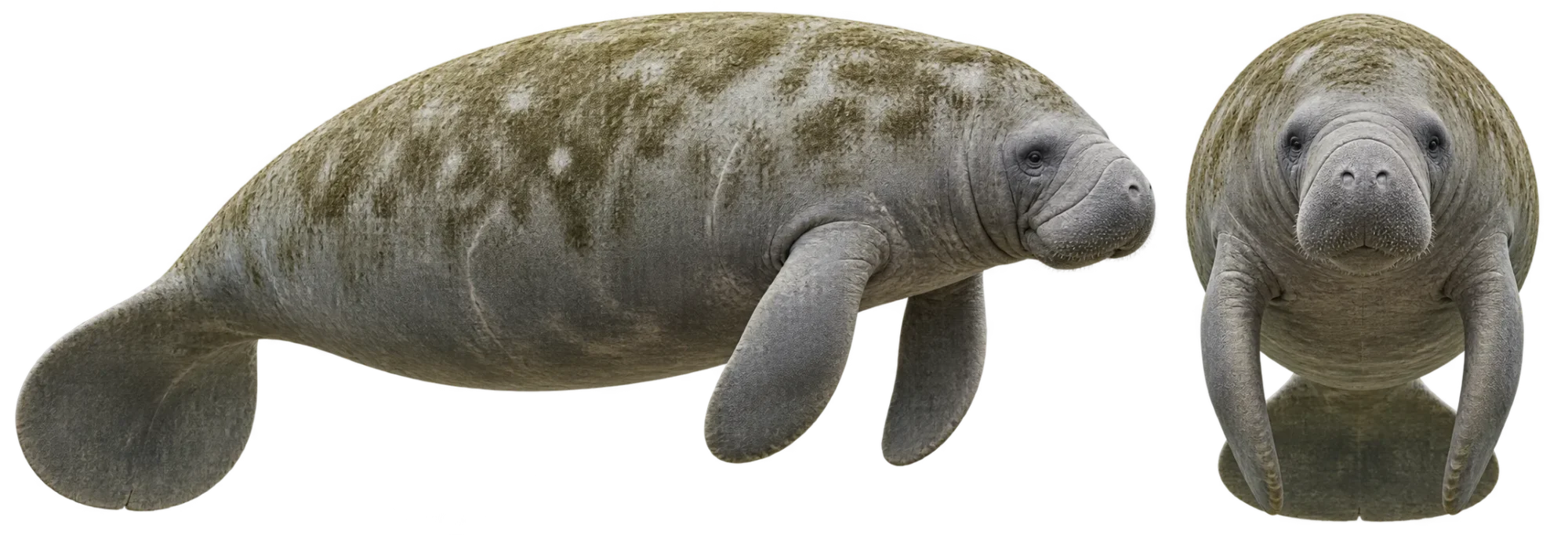
Trichechus manatus has a reproductive schedule built around prolonged investment in one calf. Pregnancy lasts about a year, births are usually single, and the calf can remain closely associated with its mother for roughly two years. The result is a life history in which each successful birth represents a long maternal commitment rather than the start of a short juvenile stage.
Single-Calf Births Set a Slow Reproductive Pace
West Indian manatees usually produce one calf per pregnancy. Twins occur, but they are uncommon. Long-term observations of Florida manatees at Blue Spring recorded overwhelmingly single births, with only one twin birth among the documented litters in that study.
Gestation is generally estimated at about 11 to 14 months. Pregnancy is only one part of the interval between calves, however. The female then enters an extended period of nursing and calf care, so another successful birth does not normally follow the next year.
At Blue Spring, intervals between documented births averaged about 2.6 years. That figure describes one well-studied Florida population rather than a fixed species-wide interval. Individual reproductive histories vary, and a female that continues caring for a surviving calf may have a different interval from one whose calf is lost early.
Mating itself is much more temporary than the mother-calf relationship. Receptive females can be followed by several males in short-lived mating herds. The males compete for mating opportunities but do not form lasting pairs or take part in raising the resulting calf.
Calf Development Extends Through Years of Maternal Care
A newborn manatee enters the water able to swim and surface, but independence develops gradually. Calves nurse from mammary glands behind the mother’s flippers and may remain with her for about two years.
This association does more than provide milk. Young manatees accompany their mothers through the places used for feeding, freshwater access, shelter and movement. In Florida, this period can also expose a calf to seasonal travel routes and the warm-water locations used when water temperatures fall.
The distinction between beginning to eat vegetation and becoming independent is therefore important. A calf can investigate or consume plant material while it is still nursing and closely dependent on its mother. Weaning is a developmental process rather than a single moment when solid food first appears in the diet.
Mother and Calf Form the Persistent Social Unit
Many manatee gatherings are temporary, including feeding groups, warm-water aggregations and mating herds. The prolonged association between a female and her calf is different: it can persist across seasons while the calf develops the behavior needed for independent life.
Reproductive Maturity Varies Across the Species
A single maturity age does not describe every West Indian manatee population equally well. Much of the detailed long-term reproductive evidence comes from the Florida subspecies, Trichechus manatus latirostris, while information for the Greater Caribbean or Antillean subspecies, Trichechus manatus manatus, comes from a different mix of field observations and animals under human care.
Florida Manatee
Early reproduction can occur within the first several years of life.
Long-term Blue Spring records placed estimated first conception between about three and six years in the females for which reproductive histories could be reconstructed. The mean age at the first recorded birth producing a calf that survived to the following winter was about 5.4 years in that sample.
Greater Caribbean Manatee
Published maturity estimates are often later.
Recent work on Antillean manatees has described sexual maturity at roughly six to seven years, but these estimates should not be treated as an exact threshold for every population or individual.
Body size alone also cannot define adulthood precisely. Age, reproductive anatomy and hormonal evidence may give different kinds of information about maturity, and individuals overlap in size as they move from juvenile to adult stages. For species-level data, preserving that variation is more accurate than assigning one universal age or body length to sexual maturity.
Long Parental Investment Limits How Quickly Generations Turn Over
The sequence of long gestation, predominantly single births and extended calf care means that West Indian manatees replace adults slowly. A female may be reproductively capable for many years, yet she cannot produce a large number of independent young in a short period.
This pattern also explains why adult survival carries so much weight in manatee population biology. Modeling based on Florida manatee life-history data has found population growth to be especially sensitive to changes in adult survival. Losing a mature animal removes an individual that otherwise could contribute calves over many reproductive cycles, while replacing that adult requires years of juvenile growth and maturation.
The slow schedule is visible even before population modeling is considered: roughly a year of pregnancy can be followed by up to two years of close maternal association, with the next birth often separated from the previous one by several years. West Indian manatee reproduction is therefore best interpreted as a sequence of long, overlapping stages rather than as isolated values for gestation, litter size and maturity.