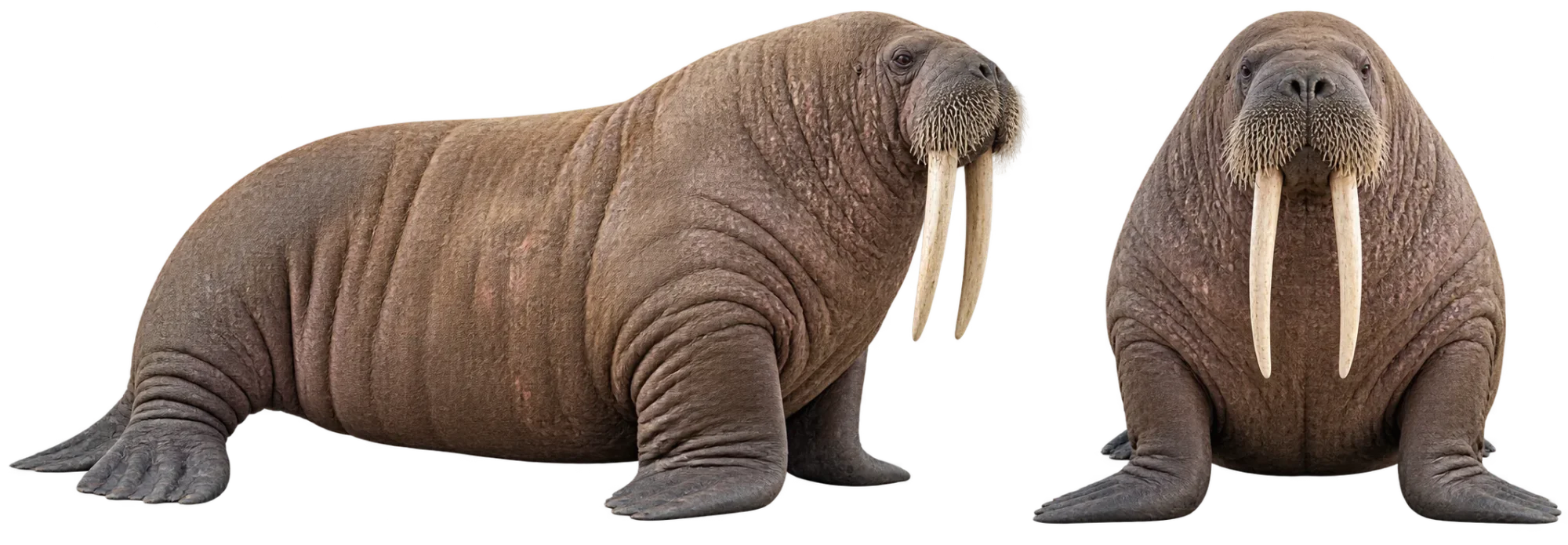
A walrus calf is born from a reproductive cycle that began more than a year earlier. Fertilization is followed by several months in which the embryo has not yet implanted, and birth is followed by an unusually long period of nursing and close maternal care. These linked stages help explain why Odobenus rosmarus produces young at a slower rate than other living pinnipeds.
Delayed Implantation Sets the Walrus Pregnancy Calendar
Walrus reproduction includes delayed implantation, also called embryonic diapause. After mating and fertilization, the early embryo remains in a suspended state before attaching to the uterus. This delay lasts roughly four to five months in well-studied populations.
Because of that pause, the commonly reported 15–16-month interval from mating to birth should not be interpreted as 15–16 months of continuous fetal growth. The delay is part of the reproductive cycle but occurs before implantation.
The timing is not identical across the species. Pacific walrus studies commonly place births from late April through early June, while work on Atlantic walruses has recorded later average dates in some populations. A single universal birth date would therefore hide real geographic variation.
One Calf Can Shape Several Years of a Female’s Reproductive Cycle
Walruses normally produce one calf at a time; twins are rare. Maternal investment then continues far beyond birth. Calves remain closely associated with their mothers while nursing, travelling and gradually learning to feed for themselves.
Atlantic walrus observations from the Svalbard region describe nursing that can last two to three years. Young calves accompany their mothers to sea and can nurse in the water. By about five months, they may begin taking benthic prey while milk is still part of their diet. Feeding independently therefore develops gradually rather than beginning with an abrupt separation from the mother.
This long dependency affects how often a female can reproduce. The extended pregnancy already makes two years the shortest interval between successful births. In some females, reproduction is delayed further while a dependent calf is still being nursed, producing birth intervals of three years or more.
The length of lactation is also one reason researchers are interested in identifying weaning ages from biological records such as tooth growth layers. Following a wild mother and calf continuously for several Arctic seasons is difficult, so the end of maternal dependence is not equally well documented in every population.
Calf growth places a large energy demand on the mother. Research based on Pacific walruses in managed care found mean calf mass increasing from about 68 kg at birth to roughly 301 kg by two years of age. Milk supports much of this early growth while the calf slowly develops its own feeding ability.
Reproductive Age Is a Sequence of Milestones
A single “age at maturity” value can conceal several different biological events. Sexual development, first ovulation or conception, first birth and regular breeding success do not necessarily occur at the same age.
This difference is especially important for males. A physiologically mature young male and an older breeding bull occupy very different places in the reproductive system. Large adult males compete during the breeding season through displays, underwater vocalizations and physical competition. Reaching puberty alone does not give a male the body size or social position needed for regular mating opportunities.
Female estimates also vary among studies. Research on Atlantic walruses from north-west Greenland found an average age of first ovulation a little above six years, while population-level sources often place first birth several years later. Captive Pacific walrus records have produced later averages for first ovulation and conception. These values describe different milestones under different conditions and should remain separate rather than being compressed into one exact age.
A Multi-Decade Reproductive Life
Walruses can live for around four decades, with some documented animals reaching their early forties. That long potential lifespan fits a life history in which females produce relatively few calves and invest heavily in each one.
Maximum age, however, should not be treated as the expected lifespan of every walrus. Wild survival changes with age, sex, population and environmental conditions, and precise age-specific survival rates remain difficult to measure. Captive longevity records describe what individuals can achieve under managed conditions rather than the normal lifespan of a free-ranging population.
Current Pacific walrus research therefore examines age structure, female condition, reproduction and survival together. New field work begun in 2023 has included age-structure sampling from animals resting on sea ice, while aerial and drone-based studies are being used to follow females and calves. These measurements can show whether changes in body condition or calf survival are eventually reflected in population age structure without assuming that one short-term observation represents the species as a whole.