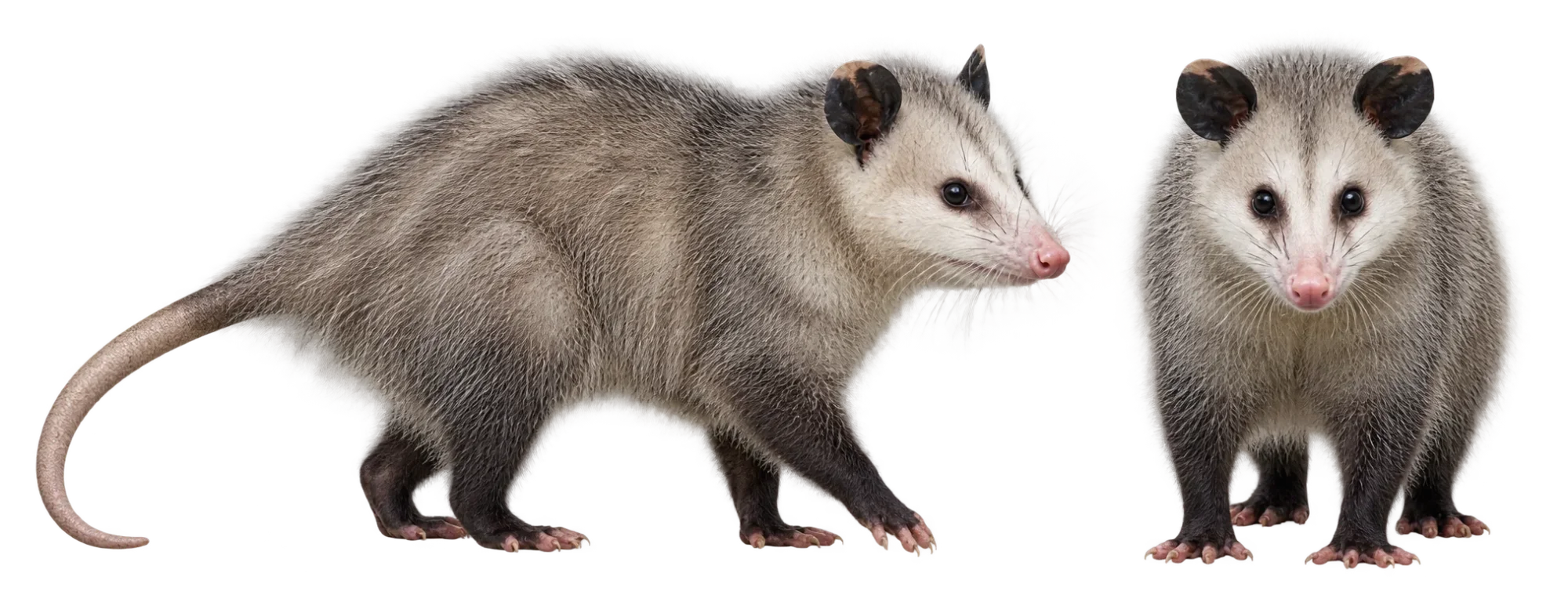
A Virginia opossum (Didelphis virginiana) is born after only about 12–13 days of gestation, when much of its development still lies ahead. Its life history depends on a rapid transfer from pregnancy to pouch development, several months of maternal care, early sexual maturity, and an adult life that is often unusually short for a mammal of its size.
Birth Moves Development Into the Pouch
Pregnancy is exceptionally brief. Research on Virginia opossum reproduction has found implantation around day 10 of a roughly 13-day gestation, leaving only a short interval between implantation and birth. The newborn therefore enters the outside world at a very early developmental stage.
Newborns are only about 14 millimeters long. Their hind limbs and many other structures remain poorly developed, but the forelimbs are functional enough for the young to crawl from the birth canal toward the mother’s pouch. Reaching a teat and attaching to it is an immediate survival requirement.
A female can give birth to far more young than she can ultimately nurse. Reported litters range from about four to 25 newborns, while females generally have 13 mammae, and not every teat is necessarily functional. Young that fail to reach and secure a teat cannot continue developing. This helps explain why the number born can be much larger than the number later present in the pouch.
The pouch is therefore not simply a place where already developed young are carried. It performs a central role during a stage of growth that, in placental mammals, would occur much earlier relative to birth.
Most Early Growth Occurs During Maternal Care
Young remain attached to the mother’s teats for roughly 50–70 days. During this period they grow from extremely undeveloped newborns into recognizable juvenile opossums. Lactation continues beyond the period of continuous teat attachment, and the composition of the mother’s milk changes as development progresses.
After becoming too large to remain continuously inside the pouch, juveniles may stay in a den while the female forages or travel on her body. Some remain associated with their mother until about 120 days of age, even though weaning usually occurs earlier.
This extended postnatal investment makes the short pregnancy less informative by itself. The mother’s reproductive commitment continues for months after birth, and juvenile survival remains vulnerable around the transition from maternal care to independence. A field study in southeastern New York, near the northern edge of the species’ range, recorded particularly heavy juvenile mortality after weaning and before dispersal.
Breeding Pace Changes With Climate and Latitude
Virginia opossums mature within their first year. Females may reach sexual maturity at about six months and males around eight months, although first breeding commonly occurs closer to ten months of age. Early maturity allows many animals to reproduce during the breeding season following their birth.
The reproductive calendar is not identical across the species’ range. Breeding can begin earlier in warmer regions and continue for much of the year. Northern populations face a shorter period in which females can raise young before cold weather returns.
That geographic difference also affects litter frequency. Across the range, females may produce one to three litters in a year. One litter can be typical toward the colder northern edge, while two are common across much of the range and three may occur in warmer climates.
Producing another litter requires more than another 12–13-day pregnancy. Each birth starts a much longer period of pouch development and lactation. The amount of warm-season time available for completing that maternal investment helps shape how many litters a female can raise.
Female condition can also influence reproductive output. Research on northern opossums found a relationship between maternal fat reserves and litter size, showing that the number of young successfully carried is connected to the energetic condition of the mother rather than being a fixed species-wide value.
Most Adults Reproduce Within a Short Lifetime
Wild Virginia opossums commonly survive only about 1.5–2 years. Animals living under human care often reach about three or four years. These values describe typical survival patterns rather than an absolute biological limit, so unusually old captive records should not be treated as the expected lifespan of the species.
Such short survival compresses reproduction into a narrow part of life. An animal that first breeds at roughly ten months may have only a small number of breeding seasons available. Mortality can also differ by sex and season. A field study of free-ranging males in Oklahoma found only juveniles in its August sample, consistent with heavy adult male mortality during or following the breeding period.
The species does not show the obligatory post-mating male death found in some other marsupials. Virginia opossum males can survive to breed again, but field populations may still experience strong seasonal losses that make repeated breeding uncommon for many individuals.
Survival Conditions Can Alter the Aging Pattern
Virginia opossums have also provided an unusual natural test of how outside mortality can shape mammalian aging. A long-term comparison examined mainland animals and an isolated island population that had experienced thousands of years with fewer mammalian predators.
Females from the island population showed greater survivorship and slower age-related mortality than mainland females. They also retained juvenile-growth performance later in life and showed slower age-related change in collagen tissue. At the same time, their litters were smaller.
The comparison shows that the species’ familiar short lifespan is not simply a fixed consequence of being an opossum. Populations exposed to different long-term survival conditions can differ in how quickly aging appears and how reproductive effort is distributed across the brief adult life.