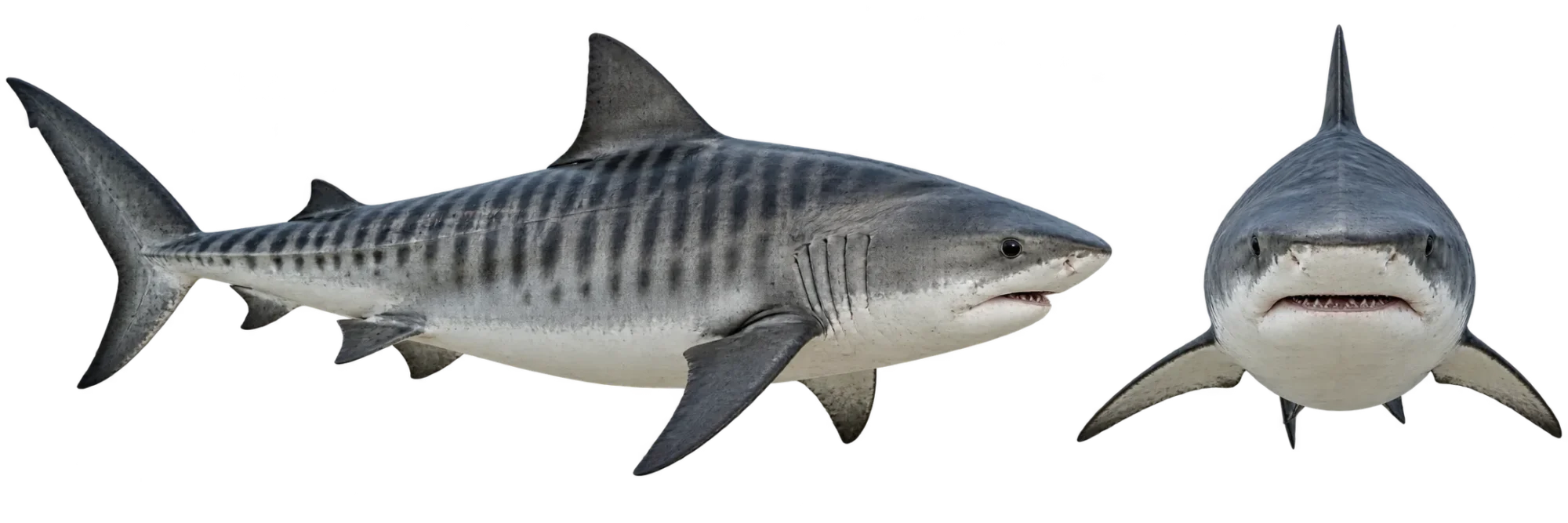
Tiger sharks (Galeocerdo cuvier) pair unusually fast juvenile growth with a reproductive system that is rare among their close relatives. Females carry live young for well over a year, embryos receive maternal nutrition without a placenta, and research from different oceans shows that age and growth cannot be reduced to one universal schedule.
Embryos Receive Maternal Nutrition Without a Placenta
The tiger shark stands apart from other members of the requiem shark family in the way its embryos develop. The young are retained inside the female and born alive, but they do not form the yolk-sac placenta used by closely related sharks.
Development begins with nutrients stored in a relatively large egg. As that supply declines, the embryo continues growing while enclosed in a fluid-filled egg case within the uterus. Research on tiger shark embryos found that this fluid contains organic material that can provide additional energy. The process has been described as embryotrophy.
What makes the system unusual?
Tiger shark embryos remain physically unattached to a placenta, yet maternal resources continue to support their growth. Measurements made during embryonic development showed large increases in both wet and dry body mass that could not be explained by the original egg reserves alone.
This places tiger sharks among matrotrophic sharks: part of the resources used to build the developing pup come from the mother during pregnancy. It is more precise than treating the species simply as an egg-dependent shark that happens to give birth to live young.
Published gestation estimates are commonly around 13 to 16 months. Reported litter sizes vary widely, from roughly ten pups to more than eighty in some records. Such ranges should not be read as the expected litter size of every female because reproductive samples differ by region, female size and study design.
Pregnancy Fits Into a Longer Female Reproductive Cycle
A long gestation does not describe the entire reproductive timetable. Work in Hawaiʻi has shown that mating, sperm storage, ovulation, embryo development and birth can be separated by many months.
Historical reproductive data from the Hawaiian population placed most mating activity in January and February. Females can retain sperm before ovulation, which was reported mainly from May into July. Gestation then continues for about 15 to 16 months, with births concentrated around September and October in that population.
That timing led researchers to propose a roughly three-year reproductive cycle for Hawaiian females. It should be treated as a population-level finding rather than a calendar that automatically applies to tiger sharks throughout their global range. Seasonal timing can shift with latitude and local environmental conditions.
Recent tracking work has added another layer to the Hawaiian picture. A six-year telemetry study published in 2025 recorded more tiger shark detections at several Maui monitoring sites during winter. One site, Olowalu, showed a particularly clear seasonal pattern. Most sharks arriving there during the known January–February mating period were sexually mature, and some captured animals carried fresh physical signs associated with mating.
The tracking evidence supports the possibility that particular coastal areas can become seasonal meeting points for otherwise wide-ranging sharks. It does not imply that the entire population gathers in one place or that every mature shark follows the same movement pattern.
Juvenile Growth Can Be Rapid, but the Rate Is Not Fixed
Young tiger sharks can add length quickly during their first years. Tag-recapture work in Hawaiʻi found juvenile growth rates exceeding 100 cm per year in some animals, and growth models from that population indicated that sharks may approach adult dimensions within only a few years.
A 2026 study from northeastern Brazil produced another detailed view of early growth. In its model, tiger sharks were predicted to reach about 165 cm total length at one year and approximately 200 cm at one and a half years. Using a previously published maturity length of 310 cm, the researchers estimated an age near 4.7 years at maturity for that population.
The same study also found an age-related change in where sharks were sampled. Coastal catches were dominated by newborn and very young animals, while oceanic samples contained mainly juveniles. That pattern is consistent with young tiger sharks changing habitat use as they grow.
Growth models are population estimates
Results from Hawaiʻi, northeastern Brazil and eastern Australia do not produce identical growth curves. Differences can reflect local biology, the sizes represented in each sample and the method used to estimate age. Vertebral growth bands can also be difficult to interpret consistently in tiger sharks.
An eastern Australian study, for example, estimated slower growth parameters than several studies from other regions and identified narrow or split vertebral bands as possible causes of age underestimation. For that reason, a length predicted for a given age in one ocean should not automatically be assigned to a tiger shark elsewhere.
Size at Maturity Is More Directly Observed Than Age at Maturity
Sexual maturity in tiger sharks is often assessed from reproductive anatomy and body length. Published values vary among samples, but maturity generally occurs when the shark is already several metres long. Hawaiian research has placed the transition around 292 cm total length for the smallest mature males in one dataset, while mature females were recorded at larger sizes, with later analyses often using values above roughly 330 cm for females.
Age at maturity is less direct. Researchers usually estimate it by combining observed maturity size with a growth model. If the growth curve changes, the inferred maturity age changes as well. Hawaiian modelling has placed maturity near four years for males and about five years for females on average, while the 2026 northeastern Brazil analysis estimated about 4.7 years from a 310 cm maturity threshold.
These estimates describe the studied populations and models rather than a fixed birthday on which all tiger sharks become mature. Individual growth rate, sex, region and the assumptions used for age determination all matter.
Maximum Reported Age Is Not the Same as Normal Lifespan
Tiger shark databases include maximum-age records reaching several decades, including a reported value of about 50 years. A record of that kind represents an observed or estimated upper age in available data. It should not be interpreted as the usual lifespan of a wild tiger shark.
Longevity is especially difficult to summarize when age estimates come from different techniques and populations. The uncertainty seen in vertebral ageing studies is one reason maximum longevity, average survival and expected lifespan should remain separate concepts rather than being collapsed into a single age figure.