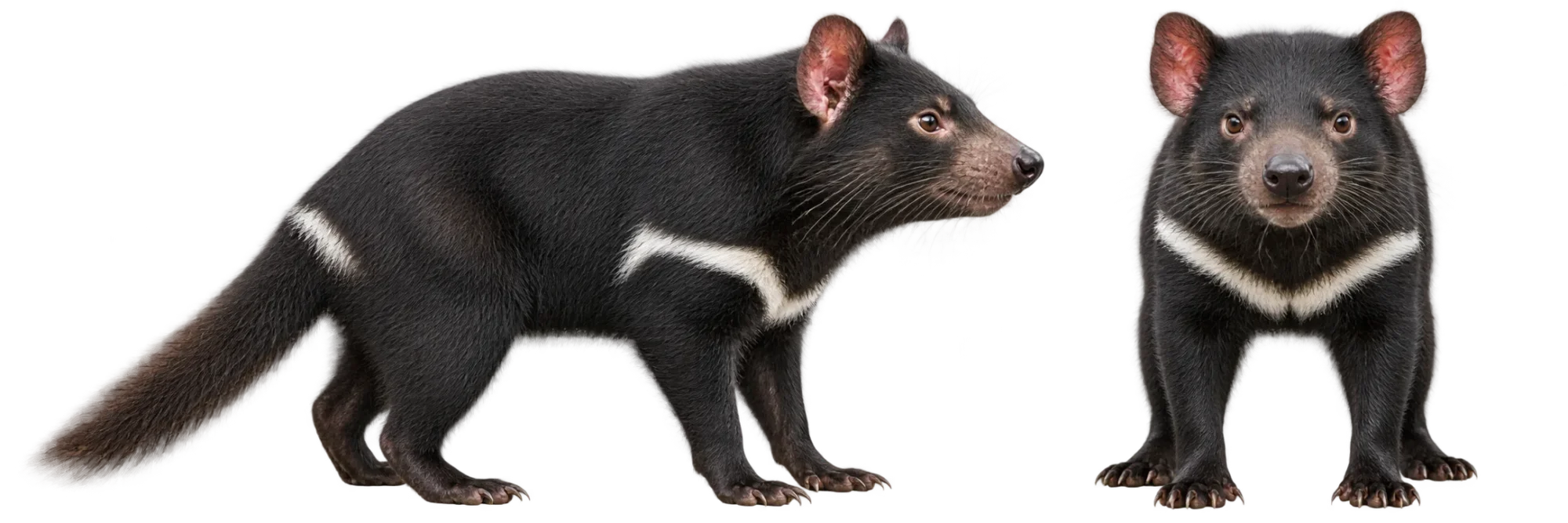
Tasmanian devil reproduction is shaped by an extreme early-life bottleneck. A female can give birth to dozens of tiny young after a pregnancy of only about three weeks, yet her pouch has just four teats. From that point onward, Sarcophilus harrisii shifts from producing many newborns to investing heavily in the few joeys that secure a teat.
Four Teats Set the Maximum Litter From Birth
Tasmanian devils usually mate during a seasonal breeding period that extends through late summer and autumn in Tasmania. Gestation lasts about 21 days, after which a female may produce far more newborns than she can raise.
The newborns are extremely undeveloped. They must make their way into the pouch and attach to a teat. With only four functional teats available, no more than four young can continue developing in the pouch, even when many more were born.
This creates an unusual division of reproductive investment. Producing numerous newborns does not translate into a large litter later in development. The effective litter size is set almost immediately by teat availability, and surviving young remain firmly attached during their earliest growth.
A reported birth count of 20, 30 or more does not describe the number of young a female can ultimately carry. Pouch anatomy limits the surviving litter to four before the long period of maternal care has properly begun.
Development Continues Long After the Young Leave the Pouch
Joeys remain in the pouch for roughly four months. By the time they begin leaving it, they are much larger and more developed, but maternal care is still far from finished.
The female moves this next stage of development to a sheltered den. Hollow logs and burrows can provide the dry, protected space needed while the young continue growing and nursing. The mother can then leave to forage and return to feed them.
Published sources give somewhat different ages for weaning, partly because leaving the pouch, beginning solid food, ending milk dependence and becoming fully independent are separate events rather than a single moment. The more consistent pattern is a sequence of about four months in the pouch, followed by several months of den-based care.
Young devils gradually spend more time outside the den and are normally living independently by the following summer. A joey born during the main autumn birth period therefore remains associated with its mother through much of its first year.
Annual Breeding Fits Into a Short Adult Life
Tasmanian devils are strongly seasonal breeders. Most females normally begin reproducing near the end of their second year rather than immediately after reaching juvenile independence.
That timing matters because wild devils have relatively short lives. Females do not have an unlimited series of breeding seasons available to them, and reproduction after about four years of age is uncommon. A missed breeding year can therefore represent a meaningful part of an individual’s lifetime reproductive opportunity.
The usual cycle is also tied to the calendar. Most mating occurs between roughly February and May, followed by the short pregnancy, months of pouch development and an extended period of maternal care. By the time one cohort becomes independent, the next breeding season is approaching.
Some Devils Shift Reproduction Into Their First Year
Two years is the usual age for first breeding, but Tasmanian devils can alter that schedule. Studies of populations affected by Devil Facial Tumour Disease found more females reproducing as one-year-olds after adult survival fell and population density declined. Earlier breeding has also been recorded in some low-density populations without the disease.
Early breeding is not simply triggered by reaching a particular birthday. Field research found that body size was closely related to whether a one-year-old female reproduced. Young females apparently need enough growth and body condition to become reproductively active before the seasonal opportunity passes.
Yearling females also tend to enter reproductive condition later than older females. Where many young animals breed early, births and pouch young can therefore appear over a broader part of the year than would be expected from the usual synchronized season.
This flexibility changes generation timing without changing the four-teat limit. A female may begin breeding a year earlier, but she still cannot raise more than four pouch young in a litter.
Young in the Same Litter Can Have Different Fathers
Tasmanian devil litters do not always share a single father. Genetic analysis of wild litters has documented multiple paternity, showing that a female may mate successfully with more than one male during the same reproductive period.
A genetic study of nine wild litters detected multiple fathers in four of them. The same research also identified yearling males as sires, showing that early reproduction is possible in males as well as females.
The sample was small, so those four litters should not be treated as a population-wide percentage. The finding instead establishes that multiple paternity occurs naturally in wild Tasmanian devils and that the mating system can produce more genetic mixing within a litter than a single-pair model would suggest.