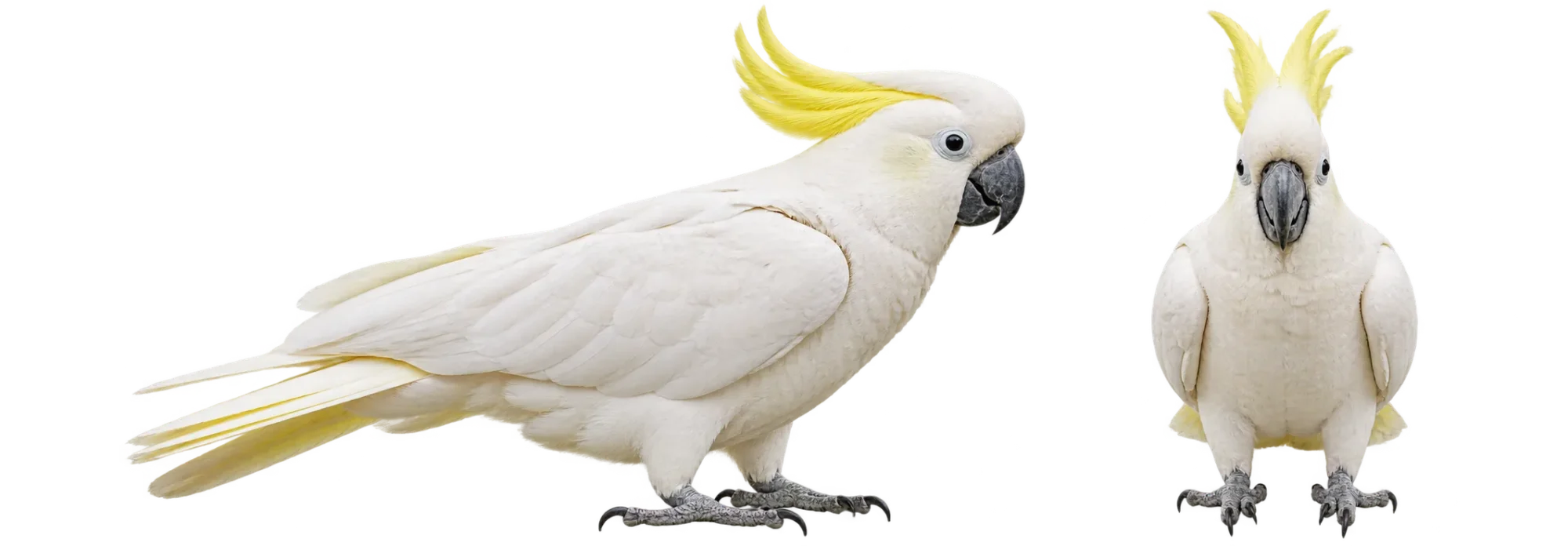
The life history of Cacatua galerita is closely tied to a year-round social system. Adults gather in communal roosts, breeding pairs shift to tree hollows for the nesting period, and dependent young return to the wider roosting group after fledging. The result is a life cycle in which the nest occupies only a short part of a much longer period of family and flock association.
Breeding Happens Inside a Year-Round Social Network
Sulphur-crested cockatoos can gather in communal night roosts containing tens or hundreds of birds. During the day, those large gatherings split into smaller and changing foraging groups. Breeding pairs remain part of this wider social population even though they move to nearby tree hollows when nesting.
Suitable hollows are not available to every adult. Research on an urban Sydney population found that most adults were not breeding at a given time, while earlier estimates placed the proportion of breeding adults at about 20% to 40%. A later study at two roost areas found 29% and 44% of adults breeding. Large old trees with usable cavities can therefore influence which pairs reproduce in a season and where nesting takes place.
A 2026 study of wild sulphur-crested cockatoos found that males nesting closer together tended to have stronger social associations during the previous winter. The same pattern was not detected in females. More socially connected males also tended to breed nearer the communal roost. The findings show that seasonal nesting does not erase the social relationships formed outside the breeding period.
Breeding birds defend their nest hollows, but they are not described as maintaining broad breeding territories around them. After the nesting period, pairs and their dependent offspring can again use the communal roost, linking reproduction directly back into flock life.
The Nesting Cycle Extends From Incubation to About Two Months in the Hollow
Breeding timing changes across the species’ broad range. Southern Australian populations are commonly reported nesting from about August to January, while northern populations may breed from May to September.
Both adults prepare the tree hollow, incubate the eggs and care for the chicks. Published accounts give small clutch ranges, commonly around two eggs, with reported ranges of one to three or two to three eggs. These differences reflect the way individual sources summarize observations rather than a need to force the species into one exact clutch value.
From egg laying to fledging, a successful nesting attempt therefore occupies roughly three months. The longer developmental story continues outside the cavity.
Young Remain With Their Family After Fledging
Fledging should not be treated as full independence in this species. Young sulphur-crested cockatoos can remain with their parents through the year, and family groups may persist for long periods. Recent field research also describes breeding pairs returning to communal roosts with dependent offspring soon after the young leave the nest.
This creates a long social phase between leaving the hollow and becoming a breeding adult. A commonly reported estimate places reproductive maturity at around three to four years for both sexes. Most of that early life is therefore spent outside the nest while the bird is still developing within a complex flock environment.
Juveniles are not fixed permanently to one roost. Research on marked wild birds found movement between neighbouring roosting communities, with juvenile females especially likely to move between them. At the same time, cockatoos can maintain preferred social relationships with relatives even when individuals have many possible flock partners.
The transition from chick to adult is therefore better represented as a sequence: intensive parental care in the hollow, continued family association after fledging, participation in communal social groups and, later, entry into the breeding population.
Captive Longevity Records Use Different Evidence Standards
Sulphur-crested cockatoos are long-lived birds, but maximum-age records should not be read as the expected lifespan of every individual. They are especially easy to misinterpret because different databases apply different rules when accepting captive records.
The AnAge longevity database currently retains 57 years as its accepted maximum longevity for the species, based on a captive bird. It also notes reports of greater ages but does not treat them as verified records.
A large zoo-based study published in 2012 used records from 1,668 sulphur-crested cockatoos and reported a maximum age of about 72.95 years. AnAge refers to a similar roughly 73-year report while noting that it has not been independently verified to the standard used for its accepted record.
These values describe exceptional captive longevity rather than normal survival in nature. Reliable wild lifespan estimates require long-term tracking of known-age birds, so a precise typical wild lifespan should not be inferred from zoo maxima or anecdotal reports of extremely old cockatoos.