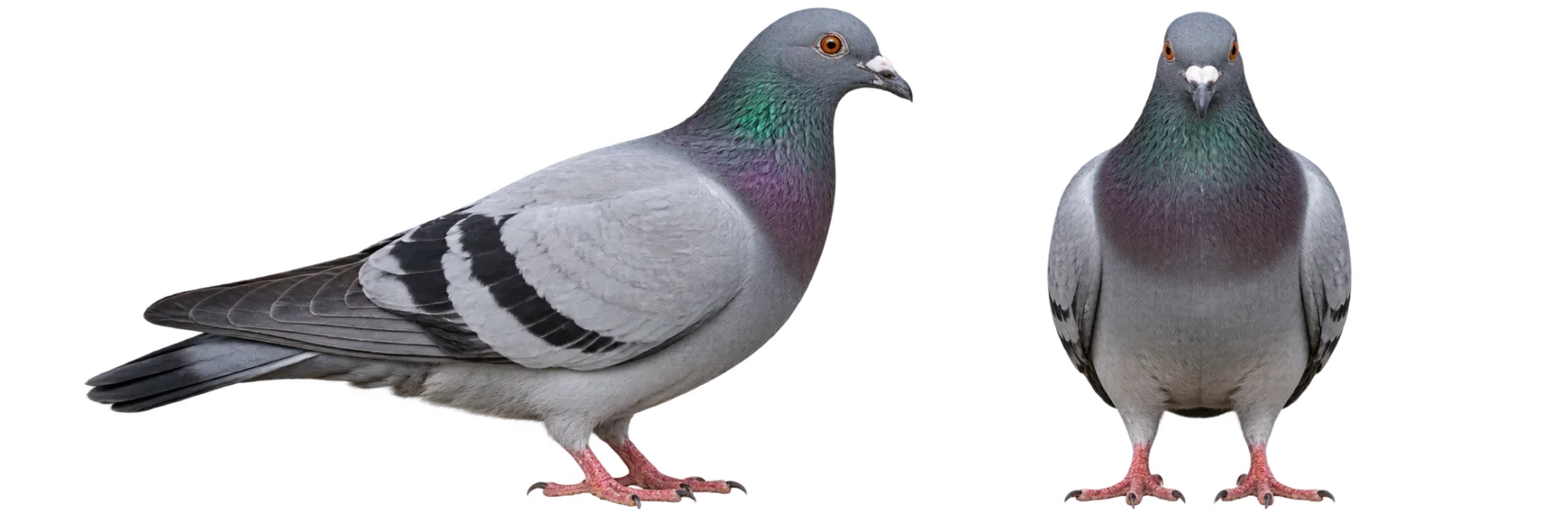
A rock dove can complete repeated nesting attempts within a year because its breeding cycle combines a small clutch with shared incubation and unusually intensive feeding of the young. In Columba livia, both parents remain closely involved from the egg stage through the weeks when the squabs are growing in the nest.
Repeated Breeding Can Extend Through Much of the Year
Rock doves do not rely on one short nesting period everywhere they occur. In mild climates, and especially in feral populations with dependable food and sheltered nesting sites, pairs may breed during every part of the year. Seasonal conditions still matter, so continuous breeding in an urban colony should not be treated as the schedule of every wild population.
The usual clutch is small, most often two eggs. The important feature is how often another attempt can follow. Rock pigeons may produce several broods in a year, with Cornell Lab reporting a range of one to six broods under suitable conditions. Research on feral populations also shows that the interval between clutches varies with season, brood demands and the condition of the female.
This repeated-brood strategy makes the breeding calendar very different from that of a bird that lays one large clutch and then ends reproduction for the year. Young feral pigeons can also enter the breeding population relatively early, with field research commonly placing sexual activity at around six months of age.
Both Parents Divide the Work of Incubating the Eggs
Incubation lasts about 18 days. Care is shared rather than being left mainly to one parent. Observations summarized by Cornell Lab describe a regular daily pattern in which the male generally incubates from mid-morning into the afternoon, while the female covers much of the late afternoon, night and early morning.
The division continues after hatching. Newly hatched squabs are altricial: they are poorly developed, sparsely covered with down and unable to feed themselves. This keeps both adults tied to the brood during a stage when the young depend almost completely on parental care.
Rock doves also reuse nest sites. A ledge or cavity may support repeated nesting attempts, and material can accumulate as the same nest is used again. For a species capable of producing several broods, returning to an established nesting place reduces the need to build a completely new nest for every clutch.
Crop Milk Supports the Fastest Phase of Squab Growth
The most distinctive part of rock dove development begins after hatching. Both the male and female produce crop milk, a nutrient-rich material formed from cells shed from the lining of the crop. It is not mammalian milk, even though it performs a similar feeding role.
During the earliest days, squabs depend heavily on this food. Studies of Columba livia show that the parental crop changes around hatching as milk production begins. The material is rich in protein and lipids, and research has also found immune-related substances in it.
Crop milk dominates the earliest feeding period. During the following days, parents gradually mix more partly digested adult food with the crop secretion. The young therefore move from a specialized neonatal diet toward the grain-based diet they will use after independence.
Experimental work with pigeon squabs helps explain why this stage matters so much. Reduced crop-milk production is associated with poorer early growth, while studies of its protein production show that the parents’ crop undergoes active physiological changes during the feeding period. The squab is not simply receiving softened adult food from the day it hatches.
Nest Departure Comes After Several Weeks of Parental Feeding
Rock dove nestlings normally remain in the nest for roughly 25 to 32 days. This is much longer than the incubation period and reflects how much development occurs after hatching. By the time a young bird leaves the nest, it has changed from a helpless hatchling dependent on crop milk into a fully feathered juvenile capable of flight.
The transition is gradual. Crop milk is most important early, then other food becomes a larger part of parental feeding as the digestive system develops. Research on pigeon development has followed parental feeding for close to four weeks, matching the period in which wild and feral nestlings approach fledging.
Because the reproductive cycle is relatively short, the adults may soon begin another nesting attempt when conditions remain favorable. A two-egg clutch therefore tells only part of the reproductive story of the rock dove: much of its reproductive output comes from the ability to repeat that small investment several times rather than producing many young in a single nest.