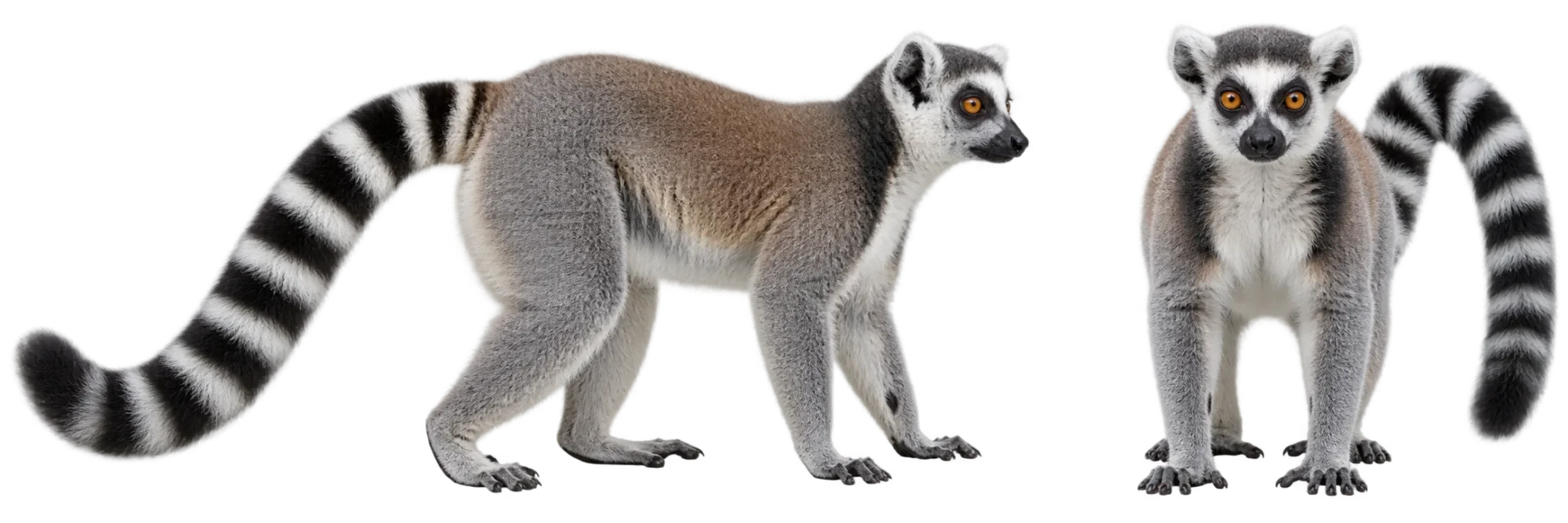
Ring-tailed lemurs (Lemur catta) fit most of their reproduction into a tightly timed annual cycle. Females in Madagascar mate during a short period in the austral autumn, carry their young through much of the dry season, and usually give birth as conditions begin moving toward the wetter, more productive part of the year.
Breeding Is Concentrated Into a Short Annual Window
Wild ring-tailed lemurs are strongly seasonal breeders. Mating in Madagascar is concentrated around April and May, while most births occur in August and September. Gestation is roughly four and a half months, commonly reported within a range of about 130–144 days.
The timing matters because female reproduction spans very different seasonal conditions. Pregnancy and the early part of lactation can overlap with the dry season in southern and southwestern Madagascar, when preferred foods may be less abundant. Field research on reproductive females in dry and spiny forests has found selective use of foods offering favorable protein, fiber, and water content during this demanding period.
Breeding months reported by zoos outside Madagascar may be shifted by several months. Ring-tailed lemurs respond strongly to changing day length, so populations living under Northern Hemisphere light cycles can breed during the opposite part of the calendar year. At the Duke Lemur Center in North Carolina, mating commonly occurs in autumn and births follow in spring. The biological seasonality remains; the calendar months change.
Females have a very brief period of sexual receptivity within the breeding season. This concentrates mating activity and competition into a short interval rather than spreading reproduction throughout the year.
Females Commonly Reproduce Year After Year
Wild females usually begin producing offspring at about three years of age. Once reproductively active, many breed annually. A 15-year study at Beza Mahafaly Reserve recorded an average female fecundity rate of about 84%, showing that missing a breeding year was less common than producing an infant.
A single infant is the usual outcome, although twins occur. The mother’s investment continues well beyond pregnancy. Studies of physiological stress also show that lactation can be particularly demanding, with reproductive females experiencing higher glucocorticoid levels during lactation than during the period before breeding.
This pattern has been described as income breeding: females depend heavily on resources obtained during the reproductive period rather than financing reproduction mainly from large stored energy reserves. That helps explain why seasonal food conditions can affect reproductive outcomes even though females are capable of breeding in successive years.
Infants Develop Quickly but Face a Risky First Year
Newborn ring-tailed lemurs are carried directly by the mother rather than being left in a nest. Their position and mobility change quickly during the first months of life.
Rapid development does not make the first year safe. Long-term field studies have recorded high infant mortality, with the exact rate varying among populations, years, and environmental conditions. At Beza Mahafaly, one long-running demographic study recorded first-year mortality of 52% in a nondrought year. Other field estimates have also placed substantial losses within the first year.
This early mortality changes how annual reproduction should be interpreted. A female may produce infants in many successive seasons without every infant surviving to juvenile or adult life. Drought and other periods of poor resource availability can further alter population outcomes.
Female Fertility Can Persist Into Advanced Age
Ring-tailed lemurs show an unusual degree of reproductive persistence for their body size. A 24-year study of free-ranging females at Berenty Reserve found little evidence that reproduction stops well before the end of life. Females aged 12–17 still produced infants, and the oldest mother recorded in that study gave birth at 17 years.
The difference between lifespan and a longevity record is especially important for this species. Wild populations experience considerable mortality early in life, so an exceptional individual surviving close to 20 years does not represent the expected lifespan of every ring-tailed lemur. The Berenty study recorded a maximum of 20 years, while another long-term wild study suggested that roughly 18–20 years may represent the upper end observed under natural conditions.
Animals under human care can live much longer. Research published in 2025 using Duke Lemur Center health records included ring-tailed lemurs older than 20 years and individuals reaching more than 30 years of age. Those captive records show what the species can achieve under managed conditions, not what should be treated as the normal lifespan of a wild animal.
Female reproductive output can therefore extend through much of adult life even as mortality rises at older ages. In the Berenty population, some females reproduced during the final year of their lives, indicating that reproductive aging and survival aging do not follow exactly the same schedule in this species.