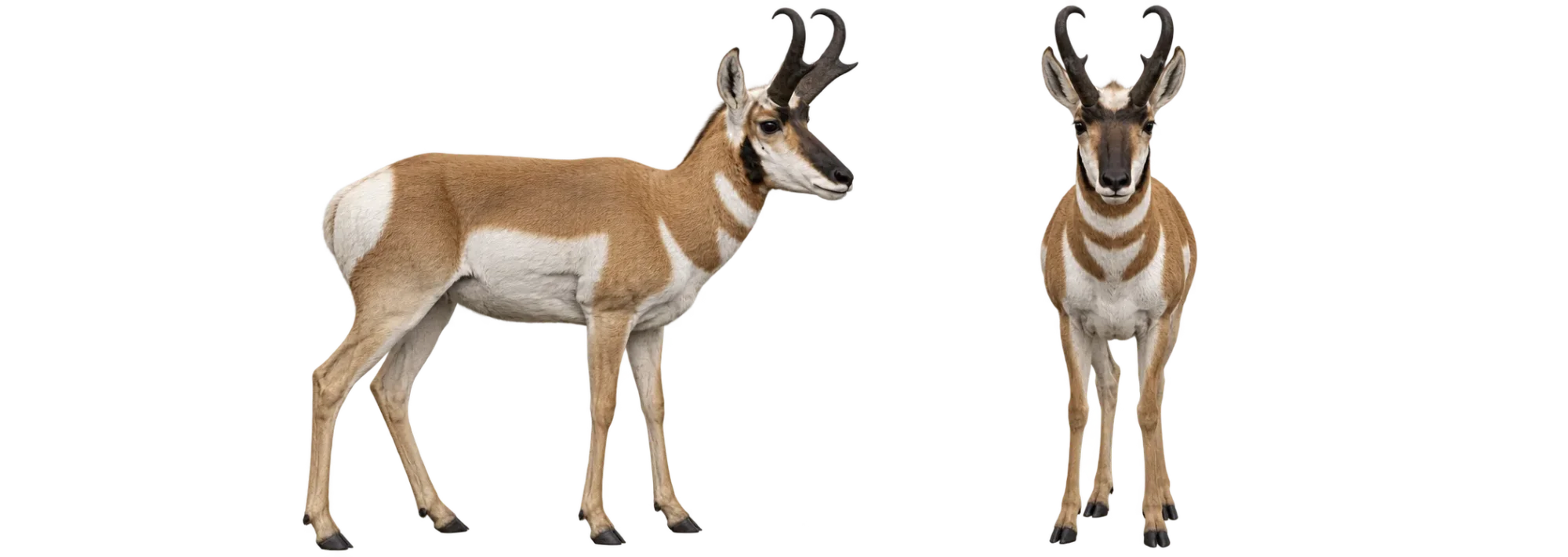
The life history of the pronghorn, Antilocapra americana, is shaped by an unusual reproductive system and a remarkably fast transition after birth. Females may begin pregnancy with several developing embryos, yet twin births are typical. The surviving fawns then spend their earliest days hidden and vulnerable before becoming mobile enough to travel with their mothers only weeks later.
Several Early Embryos Commonly Narrow to Twins
Pronghorn reproduction has an unusual feature among large hoofed mammals. A female commonly ovulates and fertilizes more eggs than the number of young she will eventually carry to term.
A detailed anatomical study of pregnant pronghorn found that three to seven fertilized ova could develop into elongated blastocysts. Some are lost while these early conceptuses lengthen through the uterus. If more than one embryo remains in the same uterine horn, further reduction can occur around implantation as the developing membranes interact. The usual outcome is one surviving embryo in each uterine horn.
A distinctive reproductive pattern
Pronghorn commonly begin pregnancy with more early embryos than they eventually carry. Twin births are therefore produced partly through embryo reduction rather than simply by ovulating two eggs.
The pregnancy itself lasts about 250 days. Across much of the northern range, mating takes place during the fall rut and births follow in late spring. The long interval means fetal development extends through winter before females give birth when spring growth is underway.
First-time mothers are more likely to have a single fawn, while twins become common in later pregnancies. Triplets have been recorded, but they are not the usual reproductive outcome.
The First Three Weeks Bring a Rapid Change in Fawn Life
Pronghorn fawns arrive well developed for a mammal of their size. In Yellowstone, births usually occur from late May into June. Newborns there have been reported at roughly 6–9 pounds, or about 2.7–4.1 kilograms.
A newborn can stand and walk within roughly half an hour. Within only a few days, its running ability improves enough that it can outrun a person. Yet speed is not its main defense immediately after birth.
During the earliest period, a fawn spends long stretches lying quietly in vegetation while its mother feeds nearby. Twin fawns may be hidden separately, reducing the chance that a predator finding one will immediately locate the other. The mother returns to nurse them rather than keeping them beside her continuously.
Birth
The fawn can stand soon after delivery but initially relies heavily on concealment.
First Days
Running ability develops quickly while the fawn still spends much of its time hidden.
Around Three Weeks
Young pronghorn begin following females more regularly during feeding and movement.
By about three weeks of age, the pattern changes. Fawns begin accompanying females as they forage, and females with young may gather into nursery groups. The animal has moved from a largely stationary hiding strategy toward the mobile lifestyle characteristic of older pronghorn.
Early Survival Changes Greatly From One Pronghorn Population to Another
The first weeks after birth can be the most dangerous part of a pronghorn’s life. Adults possess exceptional running ability, but very young fawns have not yet reached that level of mobility. Predation can therefore have a large effect on how many newborns eventually enter the juvenile population.
A study published in 2026 followed 70 radio-collared fawns in a declining Oklahoma population. Survival was lowest during the first 15 days. About 33% survived to day 15 and 12% to day 60. Nearly 87% of recorded fawn deaths were attributed to predation, and coyotes accounted for more than three quarters of those predation events.
Those figures describe one population under its particular environmental conditions. Research from western South Dakota produced a very different result. Among 116 monitored neonates during 2002–2005, estimated survival through 90 days was about 80%.
| Monitored Population | Age Interval | Reported Survival |
|---|---|---|
| Oklahoma | Birth to 15 days | 33% |
| Oklahoma | Birth to 60 days | 12% |
| Western South Dakota | Birth to 90 days | About 80% |
The contrast shows why a single fawn-survival value cannot describe the species well. Predator abundance, vegetation, weather, birth timing, maternal condition and local habitat can all alter the outcome of this short but demanding stage. For population growth, the number of twins born matters less if few survive their first weeks.
Male Maturity Arrives Before Regular Access to Breeding
Female pronghorn can enter the reproductive population at a relatively young age. Most first breed at about 16 months, although reproduction at younger ages has been recorded. Once mature, females normally have one breeding period each year.
Males have a different timetable because physical reproductive maturity does not guarantee mating. Young males may be capable of reproduction during their first year, but breeding opportunities are strongly affected by competition with older males during the rut.
Territorial or dominant males can control access to groups of females, leaving younger males with few opportunities even after they are physiologically capable of breeding. Regular male breeding is therefore more typical from around the third year of life. This creates a gap between sexual maturity and effective breeding age that is much smaller for females than for males.