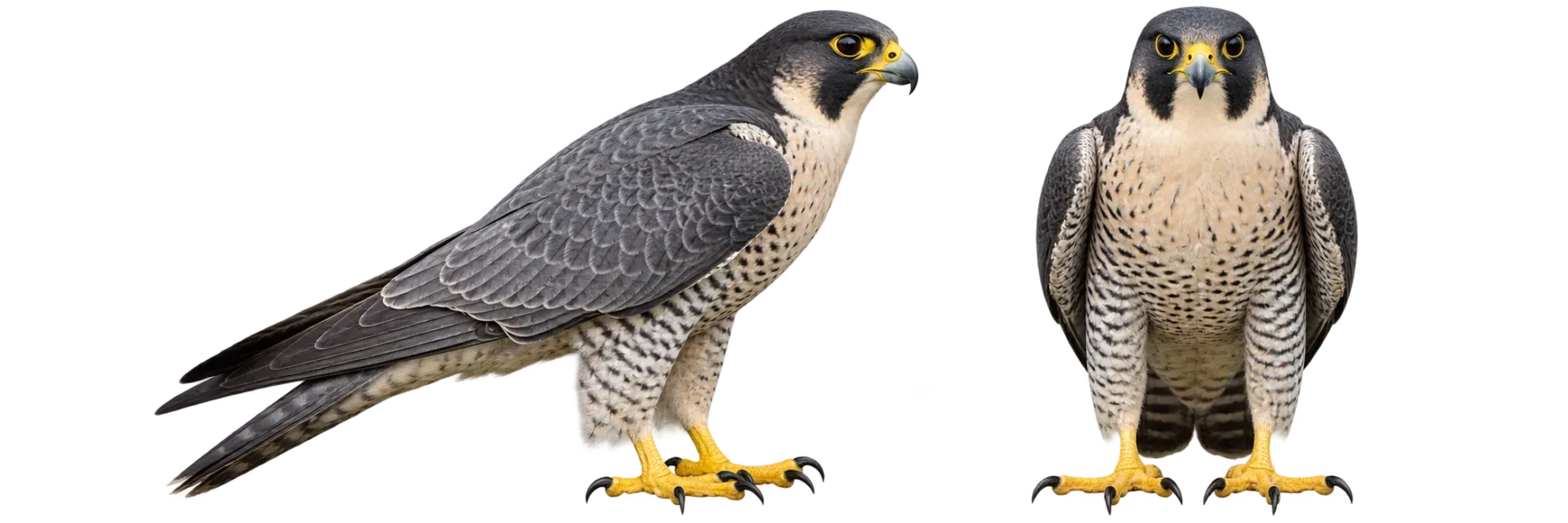
Peregrine falcons (Falco peregrinus) raise their young on a compressed seasonal schedule. Eggs develop for about a month, nestlings reach flight age only five to six weeks after hatching, and fledged juveniles then spend several more weeks learning to fly and hunt while their parents continue to provide food. Breeding age is much more flexible: some birds reproduce early, while others spend several years outside the breeding population before securing a territory and mate.
Breeding Timing Changes With Latitude and Elevation
Peregrine falcons usually produce one brood in a breeding season. A typical clutch contains three or four eggs, although clutches outside that range occur. Successful pairs often return to established nesting territories, using a shallow scrape on a cliff ledge, building, bridge, or another suitable structure rather than constructing a conventional nest.
The calendar cannot be applied uniformly across the species’ enormous range. Egg laying generally begins earlier in warmer, lower-latitude areas and later farther north or at higher elevations. Studies in southwestern North America have recorded laying from roughly mid-February into May, with northern and higher sites tending toward the later part of that period. The same geographic effect can shift hatching and fledging dates by weeks.
Incubation Is Shared but Unequal
Incubation generally lasts about 29 to 35 days, depending on the population and how the period is measured. Both adults can incubate, but the female normally spends more time on the eggs. The male commonly supplies food and takes shorter incubation shifts while the female leaves the nest.
An early failed clutch may be followed by another laying attempt. Successful pairs, however, normally devote the season to raising the young from a single clutch. This places much of their annual reproductive effort into one extended sequence of incubation, nestling care, fledging, and post-fledging support.
Young Falcons Reach Flight Age in About Six Weeks
Newly hatched peregrines are dependent on their parents. They emerge covered in pale down and cannot regulate all of their needs on their own. During the early nestling period, an adult spends long periods brooding the chicks while food is brought to the nest.
Growth is rapid. Feathers develop over the following weeks, wing exercise becomes more frequent, and the young begin moving around the nesting ledge as their flight muscles develop. Most peregrines reach the fledging stage at roughly 35 to 42 days after hatching.
The first departure from the nest is only the beginning of juvenile flight development. Newly fledged peregrines must learn controlled landings, maneuvering, pursuit, and prey handling. Their parents continue to supply food during this period, sometimes transferring or releasing prey in ways that encourage the juveniles to pursue it in the air.
Fledging and Independence Are Separate Stages
Parental dependence commonly continues for several weeks after the first flight. The exact period varies among populations and individuals. Young from some migratory populations may become independent as seasonal movement approaches, while juveniles from resident populations can remain around the natal territory for longer.
This extended learning period explains why fledging age alone gives an incomplete picture of development. A six-week-old peregrine may already be capable of flight while still relying heavily on experienced adults for food and opportunities to practice the skills needed for independent hunting.
Entry Into the Breeding Population Varies Widely
Physical independence arrives long before breeding is guaranteed. Most peregrine falcons begin breeding at roughly two to four years of age, although successful breeding by yearlings has been documented. Females tend to enter the breeding population earlier than males in several studied populations.
The delay is not simply a matter of reaching sexual maturity. Access to a breeding territory, availability of suitable nesting sites, population density, mate availability, and individual condition can all affect when a young peregrine first breeds. A bird capable of reproduction may therefore remain outside the established breeding population until an opportunity becomes available.
First attempts can also differ from later ones. Young breeders have sometimes shown lower reproductive success, and yearling females may lay smaller clutches than older females. Long-term observations indicate that reproductive performance can improve through the early part of adult life as birds gain breeding experience.
A 21-year study of peregrine falcons found that female reproductive output rose strongly during the early breeding years and then reached a fairly stable level around the fourth calendar year. Males showed a slower early-age pattern. Such results help explain why a single maturity-age value cannot fully describe the transition from juvenile independence to an established breeding adult.
Surviving the Early Years Shapes the Breeding Career
Banding records show that individual peregrine falcons can live for many years. One North American bird was documented at at least 19 years and 9 months old. That figure is a longevity record rather than an expected lifespan for every peregrine.
Mortality is much heavier during early life than among established adults. Many young peregrines never survive long enough to join the breeding population, so the birds observed repeatedly at nest territories represent a selected group that has already passed through the more vulnerable juvenile period.
Long life also creates the possibility of many breeding seasons. Peregrines can retain territories and breed repeatedly across successive years, and established pairs may return to the same nesting area. Replacement of a mate can occur if one member of the pair disappears or dies.
Age does not produce a simple, steady fall in reproductive performance. In the 21-year population study, researchers found little evidence for a broad late-life decline in the number of young produced. Female laying timing became later at older ages in that population, but reproductive output itself showed no clear equivalent collapse. A peregrine that survives into later adulthood can therefore maintain an active breeding career for many seasons.