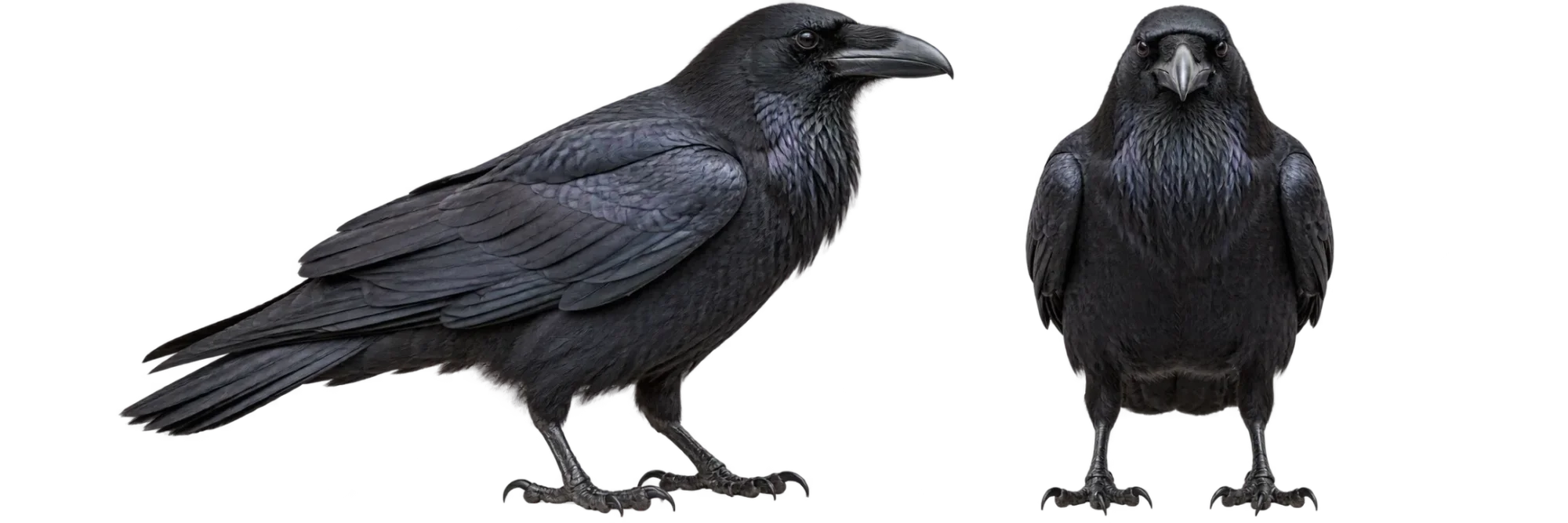
Corvus corax reaches flight capability long before it reaches the social position needed to breed. A young Common Raven moves from a dependent family stage into a mobile non-breeding period that may last for years, and only later into the year-round territorial life of a breeding pair. That separation between physical development, independence, and breeding status is one of the clearest features of the species’ life history.
Fledging Begins a Longer Family Stage
Common Ravens usually raise one brood in a breeding season. A clutch commonly contains three to seven eggs. The female carries out most or all incubation, while the male supplies food; after hatching, both parents feed and protect the young.
Incubation is roughly three weeks, with published accounts commonly falling between about 18 and 25 days. Nestlings then remain in the nest for about five to seven weeks, although reported nestling periods vary with study methods and local conditions. The chicks hatch in a highly dependent state, so leaving the nest marks a change in mobility rather than immediate independence.
Parental care continues after fledging. Young ravens remain associated with their parents while their flying, foraging, and social skills develop. Field-based accounts describe this family period extending through the first months after fledging, with independence occurring at roughly six months in some studied populations.
A raven can leave the nest at only a few weeks of age yet remain within the parental social unit for months. Treating fledging age as the end of parental dependence would compress two different developmental stages into one.
Young Ravens Can Spend Years as Non-Breeders
After becoming independent, juvenile ravens commonly enter non-breeder groups used for feeding, roosting, and social interaction. These are not fixed flocks with the same members every day. Tracking and field studies describe a fluid system in which birds split, reunite, move between feeding sites, and repeatedly encounter some of the same individuals over large areas.
This stage changes the social environment sharply. A fledgling begins life mainly among parents and siblings; an independent non-breeder meets unrelated juveniles, older non-breeders, and territorial adults. Within those groups, ravens form selective affiliative relationships rather than interacting with every bird in the same way. Some bonds persist, others change, and bonded birds can gain advantages during competition for food.
The non-breeding period also explains why reproductive maturity should not be treated as identical to first breeding. Common Ravens are often placed around three years of age for sexual maturity, while field studies of territorial birds commonly describe the transition to breeding at about three to four years or later. A mature bird still needs a suitable partner and access to a territory it can defend.
May remain within the mobile non-breeder population while forming relationships and competing for access to space and resources.
Lives as part of a long-term pair and defends a breeding territory that supports nesting and parental care.
Pair and Territory Acquisition Mark the Adult Breeding Stage
Breeding Common Ravens are typically long-term monogamous and defend territories through the year. This creates a different social life from the mobile non-breeder stage: established adults are often encountered alone or as pairs, while concentrations of many ravens are more often associated with non-breeders or unusually rich food sources.
Pair formation can begin before a bird actually breeds. Courtship and affiliative behavior help create and maintain pair bonds, but a pair also has to obtain a defensible territory before it can function as an established breeding unit. Territory availability can therefore delay reproduction beyond the age at which a bird is physiologically mature.
Once established, the annual nesting cycle brings the pair back to intensive parental investment. The female incubates the eggs, and both adults provision the nestlings. After the young fledge, care continues into the family stage rather than ending at the nest edge. The next generation therefore starts its life within a stable pair territory before later moving into the much less stable social setting of the non-breeder population.
Breeding status is also not necessarily permanent for every adult. If a long-term pair is broken by the loss of a partner or separation, an adult may return to a non-breeding state while seeking another partner or territory. In Common Ravens, life stage is partly defined by social and territorial status, not by age alone.