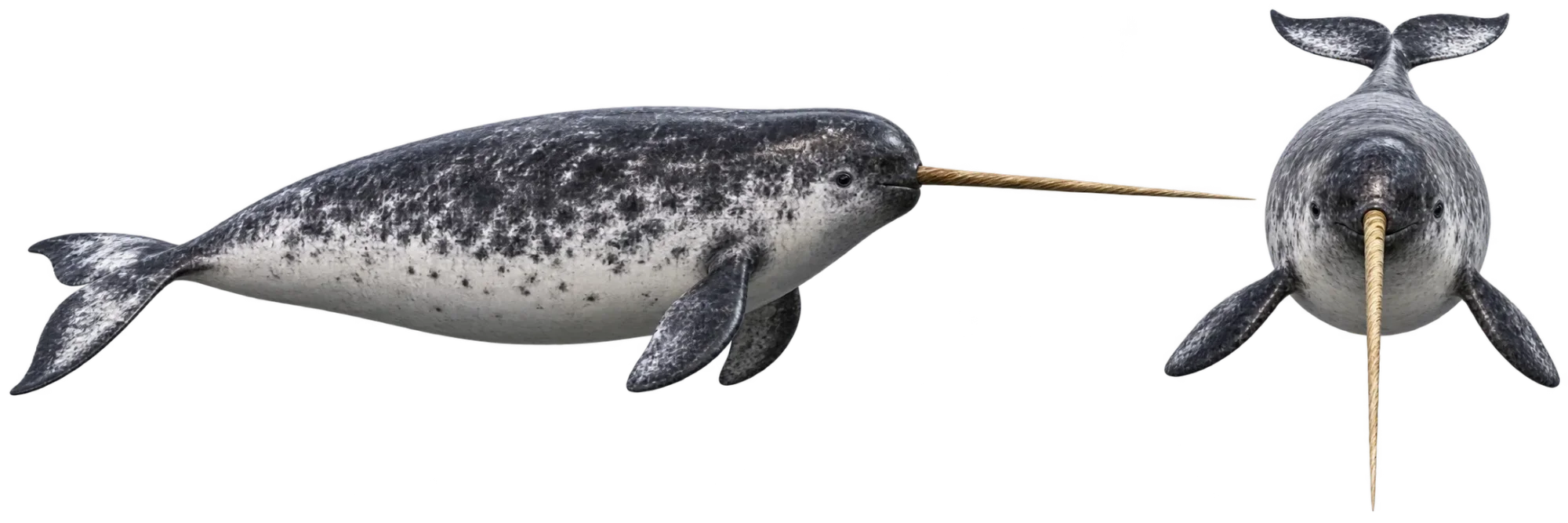
A narwhal calf may keep nursing for two to six years, while its mother usually produces only one calf in a reproductive cycle that spans several years. This extended period of care sits within a long life history: females can reproduce for decades, and some narwhals may live for about a century.
Reproduction Runs on a Multi-Year Cycle
Narwhals are seasonal breeders. Research from Canadian and Greenland populations places most conceptions in spring, with mating activity concentrated from March into May. Gestation lasts about 14 to 15 months, carrying pregnancy through an entire annual cycle before birth.
The three-year average is better understood as a reproductive pace rather than a fixed schedule for every female. Pregnancy rates, local observations and individual histories show variation, but annual calving is not compatible with the species’ gestation length.
Narwhal Calves Can Remain Dependent for Several Years
A newborn narwhal is typically around 160 cm long and about 80 kg. The calf receives milk from its mother and remains closely associated with her while developing the skills needed for independent feeding and movement in Arctic waters.
Older accounts often placed weaning near one or two years. A study of growth layers preserved in narwhal teeth found a wider pattern. Among the animals examined, estimated nursing duration ranged from about two to six years, and more than half showed evidence of nursing beyond two years.
The longer nursing period does not mean that older calves live only on milk. Chemical records in the teeth indicate a gradual transition in which solid food is introduced while nursing continues.
This makes maternal care a large part of early narwhal life. A calf may already be learning to forage while still receiving milk, rather than passing through a sharp switch from complete dependence to complete independence at one fixed age.
Females and Males Reach Reproductive Maturity at Different Ages
Modern estimates from West Greenland show a clear sex difference in the timing of maturity. These ages are population estimates rather than exact deadlines for every narwhal.
The difference matters when interpreting growth data. Reaching a large body size, developing the male tusk and becoming reproductively mature are related parts of development, but they are not interchangeable measures of age.
Modern Age Estimates Reveal a Much Longer Life
Narwhal longevity has been difficult to measure. Their teeth do not provide the simple annual age record available in some other mammals. Growth layers in embedded teeth can be lost through resorption, while reading the full record in an erupted male tusk requires cutting through the tusk itself.
This difficulty helps explain why older references often placed narwhal longevity near 40 or 50 years. Later work used chemical aging of proteins in the eye lens, calibrated with growth records from tusks. One study estimated an exceptionally old female at about 115 years, with an uncertainty of roughly 10 years. Later Greenland life-history work placed maximum lifespan expectancy near 100 years.
A century-scale estimate describes the upper end of observed or modeled longevity. It should not be read as the normal lifespan of every narwhal.
Long female lives also extend beyond reproduction in some individuals. Analysis of ovarian activity has found evidence for a prolonged post-reproductive stage in narwhals, meaning reproductive aging can occur before the end of the female’s physical lifespan. At the same time, reproduction can continue to advanced ages: West Greenland data included a pregnant female estimated at nearly 68 years old. There is no single age at which every female stops reproducing.
 BelugaDelphinapterus leucas