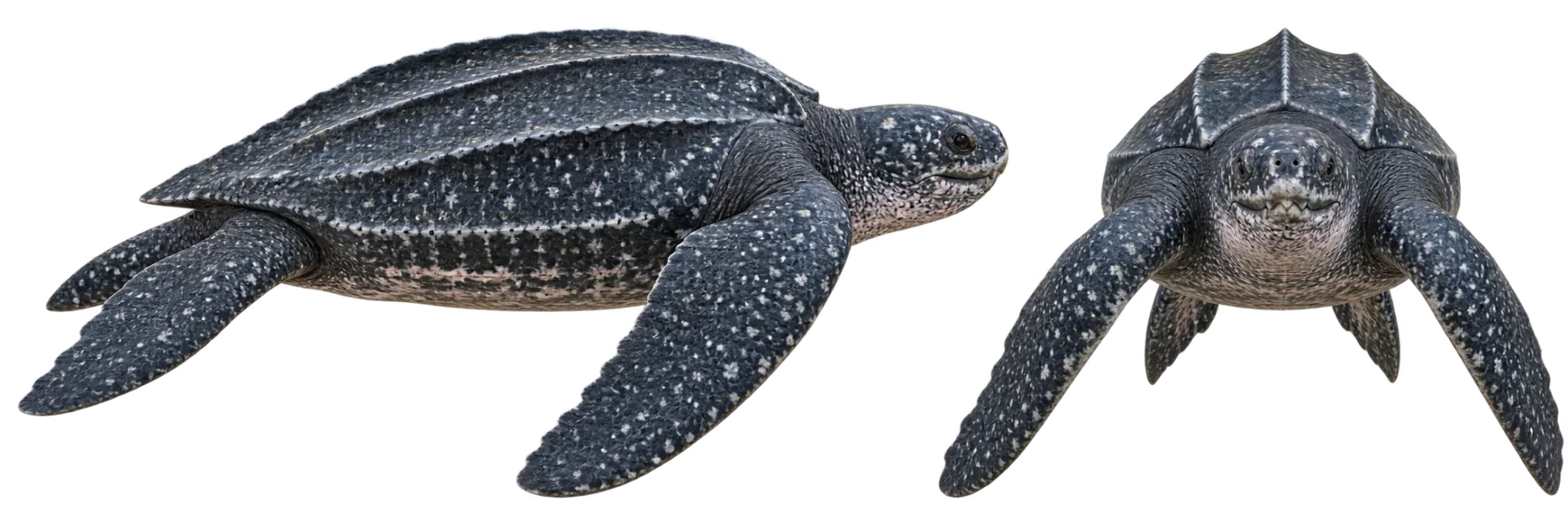
Leatherback sea turtles spend almost their entire lives at sea, yet reproduction is concentrated into short periods when adult females return to nesting beaches. A female may produce several clutches during one nesting season and then remain away from nesting beaches for years. The least certain part of this schedule is the transition from juvenile to breeding adult: published estimates of maturity vary widely, reflecting how difficult it is to age an animal that grows and travels through open ocean habitats.
Growth and the Uncertain Age of Maturity
Dermochelys coriacea grows rapidly compared with hard-shelled sea turtles. Young leatherbacks can increase greatly in size during their first years, but rapid growth does not provide a simple way to determine when sexual maturity begins.
Current biological summaries often place maturity somewhere within the first two decades of life. Other research has produced older estimates. A study using growth marks in skeletal tissue from western North Atlantic leatherbacks estimated a median age at maturity of roughly 24.5 to 29 years. Research based on captive growth has produced younger estimates.
Why Maturity Estimates Differ
Juvenile leatherbacks are difficult to follow continuously from hatching to adulthood. Researchers therefore have to estimate age using methods such as skeletal growth marks, body-size models, and observations of known-age captive turtles. Each method measures a different part of the growth process and carries its own uncertainty.
For that reason, age at maturity is better represented as an uncertain biological range than as one fixed number for every leatherback population. Growth rate can also vary with feeding conditions, individual history, and population.
Repeated Nesting Within a Breeding Season
Adult females do not normally reproduce on a simple annual schedule. A female may return to nesting areas every two to four years, although intervals differ among individuals and populations. Once a nesting season begins, however, reproduction becomes much more concentrated.
A female can come ashore several times during the same season. Successive nests are commonly laid about 8 to 12 days apart. She digs a deep egg chamber with her rear flippers, deposits the clutch, covers it, and returns to the sea. There is no guarding of the nest after laying.
Descriptions of leatherback clutch size often use a value close to 100 eggs, but the number needs context. Counts differ among nesting populations, and leatherback nests have an unusual feature that can affect how clutch totals are reported.
Leatherback Clutches Include Non-Developing Shelled Material
Along with normal yolked eggs, leatherbacks commonly deposit smaller yolk-deficient structures that cannot develop into hatchlings. These have traditionally been called yolkless eggs and are also described in research as shelled albumen gobs. Their biological function remains unresolved. Studies that report only yolked eggs can therefore give a different clutch count from records that include all shelled material deposited in the nest.
This repeated nesting pattern produces a large reproductive investment during a relatively short part of the female’s multi-year cycle. The eggs from one female are also spread among several separate nests rather than placed into a single clutch for the entire season.
Incubation Conditions Shape Early Development
Leatherback eggs develop in the sand for about two months. Once the nest is covered, development depends on the conditions inside the nest rather than on further care from the female.
Sex is determined by incubation temperature. Warmer conditions generally produce a higher proportion of females, while cooler conditions produce more males. There is no single temperature that can be treated as a universal boundary for every nest and population. The temperature experienced during the temperature-sensitive stage of embryonic development is what matters.
Temperature also affects development beyond sex determination. Excessive heat can reduce successful development, while nest moisture, gas exchange, flooding, and local sand conditions can influence whether embryos reach hatching. This means that the roughly two-month incubation period is an active developmental stage rather than simply a waiting period between laying and emergence.
When development is complete, hatchlings break out of their eggs and work upward through the nest together. They then move toward the sea without parental assistance. From this point onward, growth takes place in the marine environment, far from the nesting beach where development began.
Feeding Migrations Fill the Years Between Nesting Seasons
The years between reproductive seasons are spent at sea. Leatherbacks can move across entire ocean basins between nesting areas and productive feeding grounds, with some individuals traveling more than 10,000 miles in a year.
These movements are part of a repeating adult life cycle. Satellite tracking in the Pacific has shown that many adults return to the same feeding areas between nesting seasons. A turtle may therefore alternate between widely separated but repeatedly used parts of the ocean rather than moving without any recurring pattern.
This marine phase also separates the concentrated reproductive effort of one nesting season from the next. Feeding, growth, and long-distance movement occupy far more of an adult leatherback’s life than the nights spent nesting on land. Because the turtles are difficult to observe during these long offshore periods, many of the remaining uncertainties about growth, maturity, and adult longevity come from the part of their life cycle that takes place far from shore.