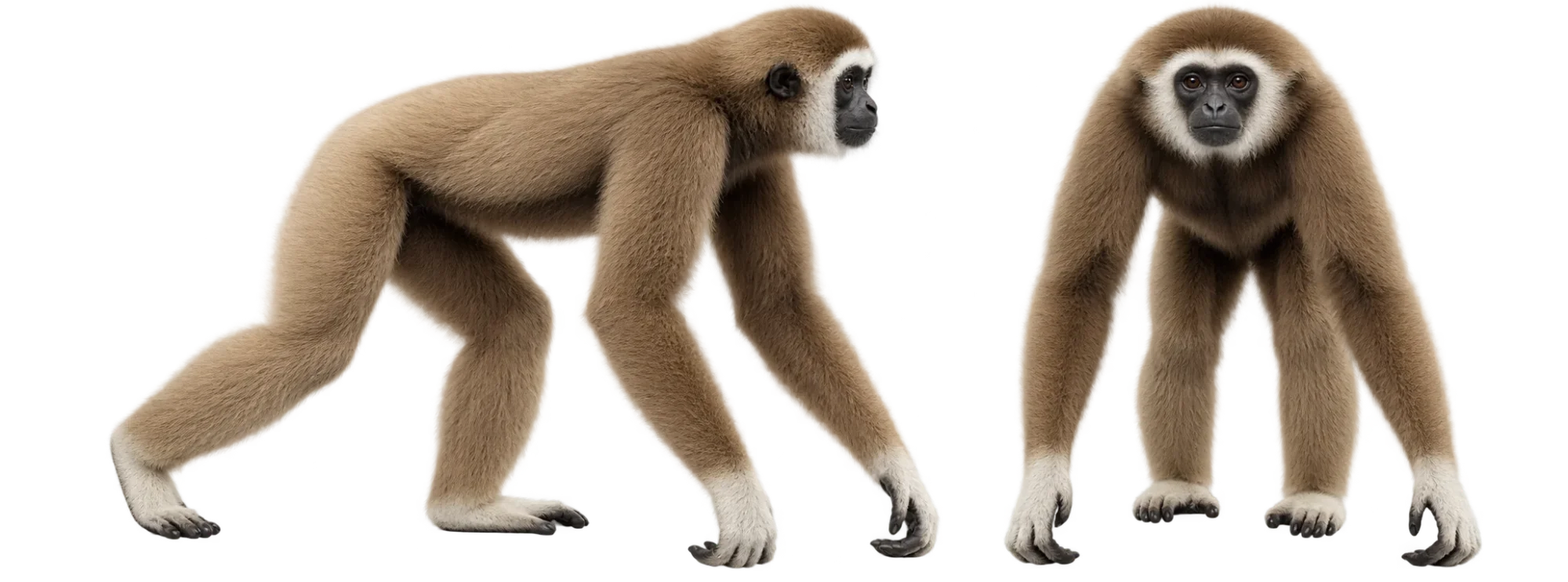
White-handed gibbons (Hylobates lar) spend many years growing before reproduction begins, then invest a long period in each offspring. Long-term observations of wild groups in Thailand show that the timing of first birth, infant survival and departure from the natal group are closely linked parts of this slow reproductive schedule.
Wild Females Begin Reproducing Late
Long-term research at Khao Yai National Park found a mean female age at first reproduction of about 11 years. Individually tracked females gave birth for the first time at roughly 10 to 12.5 years of age.
This is later than some estimates of sexual maturity based on captive animals or physical development. Observations of known-age females at Khao Yai help explain the difference. Two females developed visible reproductive swellings at about eight years old while they were still living in their natal groups, yet hormonal monitoring did not show the regular ovarian pattern expected from reproductively active adults.
Both females later left their natal groups, settled elsewhere and conceived. In these animals, therefore, the appearance of reproductive development preceded actual first reproduction by several years. Age at sexual development and age at first birth describe different stages of the life history.
Infant Survival Shapes the Interval Between Births
White-handed gibbons normally raise one infant at a time, and successful offspring are followed by a long interval before another birth. In the Khao Yai study, 17 complete intervals between births averaged about 41 months, or 3.4 years.
The interval changed when an infant died before completing the nursing period. In those cases, the observed average fell to about 25 months. The difference shows that birth spacing is partly tied to the energetic and reproductive demands of raising a surviving infant rather than operating as a fixed calendar cycle.
Reproduction also showed some seasonality without being confined to a narrow breeding season. Conceptions were concentrated during the first half of the year in the long-term Thai population, while recorded births occurred across much of the calendar. Births showed their strongest concentration around the transition from the rainy season toward the dry season.
Young Gibbons Have an Extended Developmental Period
A newborn initially depends heavily on its mother and travels by clinging to her underside. Observations of infant development in the wild are limited, but one closely watched infant began taking solid food and moving short distances away from its mother at about four months. Similar timing for solid food has been reported in captivity.
Independent movement develops gradually. Captive observations have recorded the first brachiating movements at around nine months, while nursing continues much longer. Weaning in wild white-handed gibbons occurs at roughly two years of age.
Weaning does not end the juvenile period. Long-term Khao Yai data produced an estimated juvenile period of about 9.5 years. Young animals remain associated with their natal group for years after nursing ends, and dispersal has commonly been recorded around eight to ten years of age.
This long interval gives a young gibbon time to develop the locomotor, foraging and social abilities needed for an almost entirely arboreal adult life before establishing itself away from the family group.
Adult Reproductive Relationships Are Flexible
White-handed gibbons are often described as pair-living apes, but long-term field observations show a more varied reproductive system. At Khao Yai, groups containing two adult males and one adult female occurred alongside conventional adult pairs, and individual females could experience different group arrangements during their lives.
Mating can also extend beyond the resident pair bond. Field studies have documented females mating with more than one male, including females living in groups that contained only one resident adult male. Even in these cases, mating was generally more frequent with the established partner than with other males.
Partner changes, dispersal and the formation of new groups therefore form part of the reproductive life cycle. For a species in which first reproduction comes late and successive surviving offspring are separated by several years, changes in adult social relationships can occupy a large portion of an individual’s reproductive life.