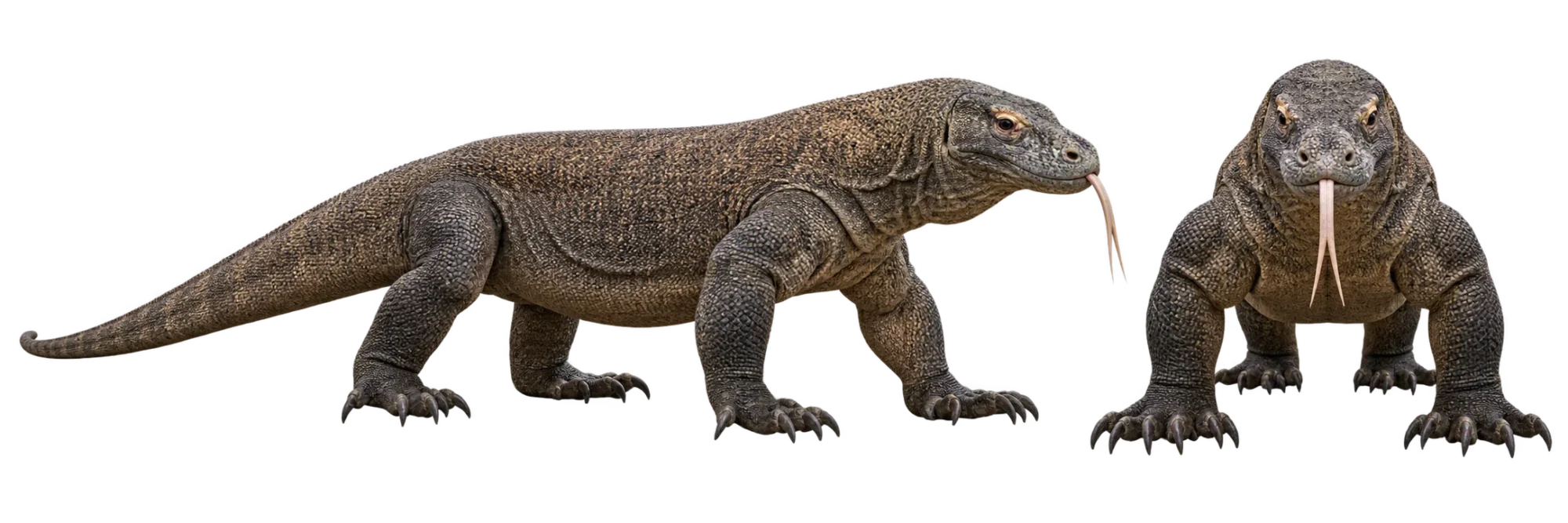
Komodo dragons (Varanus komodoensis) pass through unusually different ecological roles as they grow. A hatchling begins life as a small, largely tree-dwelling lizard, while a large adult can hunt prey many times heavier than the animals eaten during its early years. Reproduction is also tied closely to the seasonal cycle of the Indonesian islands where the species lives.
Nesting Follows a Narrow Seasonal Cycle
Field monitoring in Komodo National Park shows that female reproductive activity follows a clear annual schedule. Breeding females begin appearing at nesting areas in late July and August, during the dry season. Nest preparation takes place mainly in August, followed by egg laying around late August or early September.
A female may spend about two weeks preparing the nest before laying. The finished chamber is deep enough to hold the eggs below the surface, where temperature and moisture conditions are more stable than they are in exposed soil.
Females Use More Than One Kind of Nest
Komodo dragons can dig nests in open ground or hillsides, but some females use the large nesting mounds made by orange-footed scrubfowl. A field study of nesting sites on Komodo Island found that females selected these mound nests more often than the other recorded nest types.
The mound is not simply a convenient hole. Its structure provides a deep mass of soil and organic material in which a female can excavate chambers. Females may also create additional chambers and disturbed areas around a nesting site, making the true egg chamber harder for predators or other dragons to locate.
Guarding Ends Before the Eggs Hatch
Females remain associated with their nests for months after laying. Long-term field observations recorded nest guarding from roughly September through December. The female then leaves, so the young complete the remaining development and emerge without continuing parental care.
In monitored wild nests, hatchling emergence was concentrated into a short period around the end of the wet season. Seven observed clutches emerged between mid-February and mid-March. This timing places newly hatched dragons into the environment when wet-season plant growth is high and small animal prey is relatively abundant.
Hatchlings Begin Life Above the Ground
A newly hatched Komodo dragon is tiny beside an adult. Hatchlings are roughly 30–40 cm long, and recorded weights are below 100 g. Their size places them in a very different predator community from adult dragons.
Young Komodo dragons spend much of their early life in trees. This reduces encounters with large terrestrial dragons, which can prey on smaller members of their own species. Arboreal life also matches the juvenile diet: small reptiles, insects and other relatively small prey can be taken without competing directly with the largest dragons on the ground.
Tree use gradually becomes less practical as body size rises. Young dragons eventually spend more time on the ground, where their movement patterns and available prey change with growth.
Body Size Changes the Kind of Predator They Are
Research following wild Komodo dragons has shown a strong shift in prey use during growth. Small dragons rely on small prey and active searching. As body mass increases, progressively larger prey becomes available.
A marked change has been observed once dragons exceed roughly 20 kg. Animals above this size can move toward a feeding strategy centered on much larger vertebrate prey. Their foraging effort also changes: the largest dragons do not simply continue the highly active searching pattern used by smaller animals.
Male and Female Growth Paths Separate With Age
Komodo dragons grow fastest when young, and growth slows as body size increases. Long-term capture-and-recapture research on hundreds of wild dragons also found that males and females do not follow identical growth trajectories.
The difference becomes more pronounced as the animals approach adulthood. Females divert substantial energy into producing eggs, while males can continue allocating more energy to body growth. This helps explain why mature males commonly reach greater lengths and body masses than females.
Reproductive maturity should therefore not be treated as the moment when growth stops. A dragon can become capable of reproduction while its body is still changing. Published estimates of maturity also vary according to the animals studied and the criteria used. Institutional and field-based estimates commonly place reproductive maturity somewhere within roughly the middle to later part of the first decade of life rather than at one universal age.
Age at reproductive maturity describes when an animal can reproduce. It does not mean that maximum body size has been reached. This distinction matters especially in male Komodo dragons, which can continue developing a much larger adult body after the transition into reproductive life.
Females Can Produce Offspring Without Mating
Komodo dragons have one of the best documented cases of facultative parthenogenesis in a large vertebrate. Genetic testing reported in 2006 confirmed offspring produced by two females that had been isolated from males. One of those females later reproduced sexually, showing that parthenogenesis was an alternative reproductive route rather than a permanently asexual condition.
Komodo dragons use a ZZ/ZW sex-chromosome system. Males are ZZ and females are ZW. During the form of parthenogenesis documented in this species, viable offspring produced from the mother’s genetic material have been male.
This process does not provide the same genetic mixture as reproduction between two parents. Parthenogenetic offspring have much lower genetic variation, so the ability to reproduce without a male should not be interpreted as an equivalent replacement for normal sexual reproduction within a population.
The biological importance lies in the flexibility itself. A female can produce viable offspring in the absence of a mate, yet Komodo dragons normally reproduce sexually when males are available. The two routes can occur within the reproductive history of the same female.