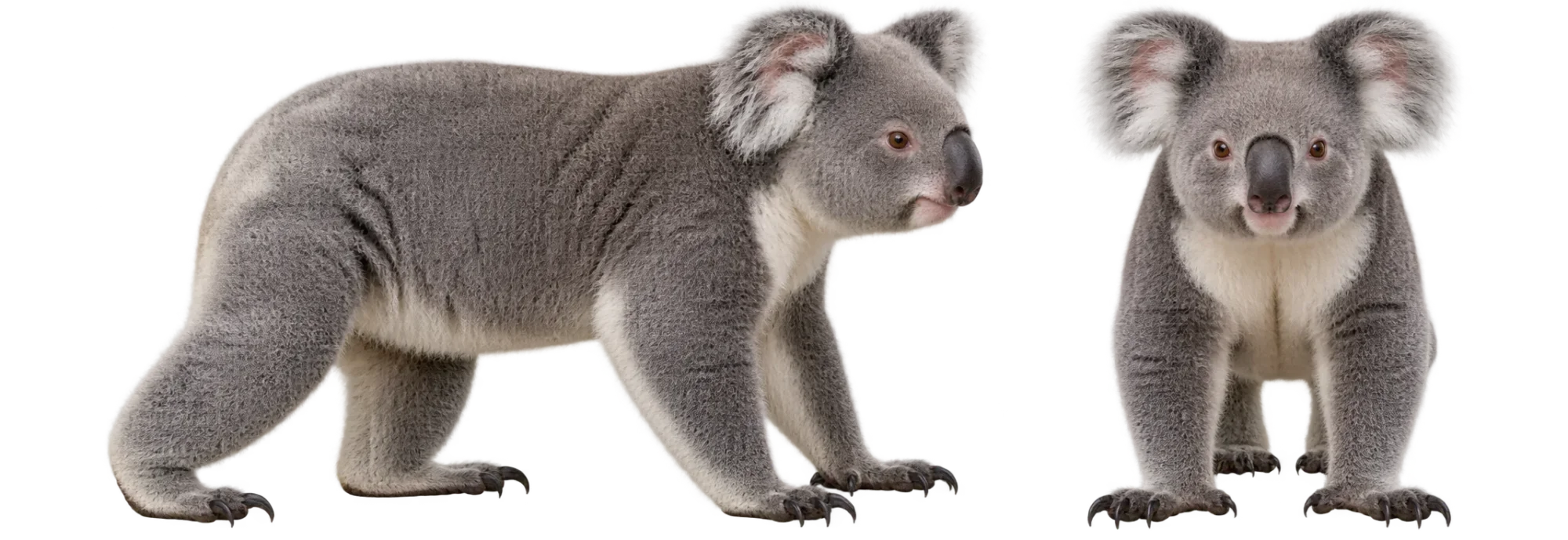
A koala’s pregnancy lasts only about five weeks, but much of the joey’s development happens after birth. The young remains closely tied to its mother for most of its first year while its body, immune system and digestive microbiome become ready for an adult diet dominated by eucalyptus leaves.
Development Continues in the Pouch
Koalas, Phascolarctos cinereus, give birth to extremely undeveloped young. After a gestation of about 35 days, the newborn makes its way to the mother’s rear-opening pouch and attaches to a teat. It then spends roughly six to seven months growing inside the pouch.
This shifts much of development from pregnancy to lactation. Organs and body systems continue maturing while the joey receives milk and remains protected by the mother. By the time it begins emerging from the pouch, it has fur, open eyes and enough physical development to start exploring outside while still depending on milk.
Koala Milk Changes as the Joey Grows
The milk received by a young koala is not chemically fixed throughout development. Marsupial lactation changes over time, allowing the mother to support very different stages of growth without a long pregnancy.
A 2026 proteomics study examining early, middle and late koala lactation found clear shifts in the proteins present at different stages. Proteins linked with nutrition, metabolism and immune function changed as the joey developed. The study also detected proteins associated with antimicrobial defence and detoxification.
The work was based on a small set of milk samples, so individual variation still needs further study. Even so, it adds molecular detail to a feature already visible in koala life history: maternal milk supports development for many months, including after the joey begins leaving the pouch.
Pap Helps Prepare the Joey for Eucalyptus Leaves
Pouch emergence brings another unusual developmental step. Before a young koala can rely heavily on eucalyptus foliage, it consumes a specialized maternal material known as pap. Pap carries microorganisms from the mother’s digestive system to the joey.
Research on both captive and wild koalas shows that this transfer has a lasting biological role. Joey gut microbial communities resemble those of their mothers, and the community continues changing between about six and twelve months of age as leaves make up more of the diet.
During this period, microbes and microbial genes associated with breaking down plant fibre become more common. By around one year of age, the gut community becomes much more adult-like. The change therefore happens alongside weaning rather than at a single moment when the joey first tastes leaves.
Mating Triggers Ovulation
Female koalas are induced ovulators. Ovulation is associated with mating rather than occurring automatically during every reproductive cycle. Hormone studies have recorded the reproductive response after copulation, while later genomic work identified genes that may help explain this mating-linked system.
Females can begin breeding at about two years of age. Males generally start mating later, commonly around three to four years. A female usually produces one joey in a breeding year, while twins are possible but uncommon.
This produces a reproductive pattern built around relatively short pregnancy followed by long maternal investment. A new birth may occur each year, but the previous joey has already required months of pouch development, nursing and gradual dietary transition.
Independence Develops After Pouch Life
Leaving the pouch is only one stage in becoming independent. The joey begins spending more time outside at around six months and is commonly carried on the mother’s back while it continues to nurse and eat increasing amounts of foliage.
Weaning is generally complete at around twelve months. A young koala may then occupy a home range that overlaps with its mother’s rather than immediately moving far away.
Dispersal beyond the natal range often occurs later, commonly between two and three years of age and often around the breeding season. The koala’s juvenile period therefore extends well beyond its highly visible months as a pouch young or back-riding joey.