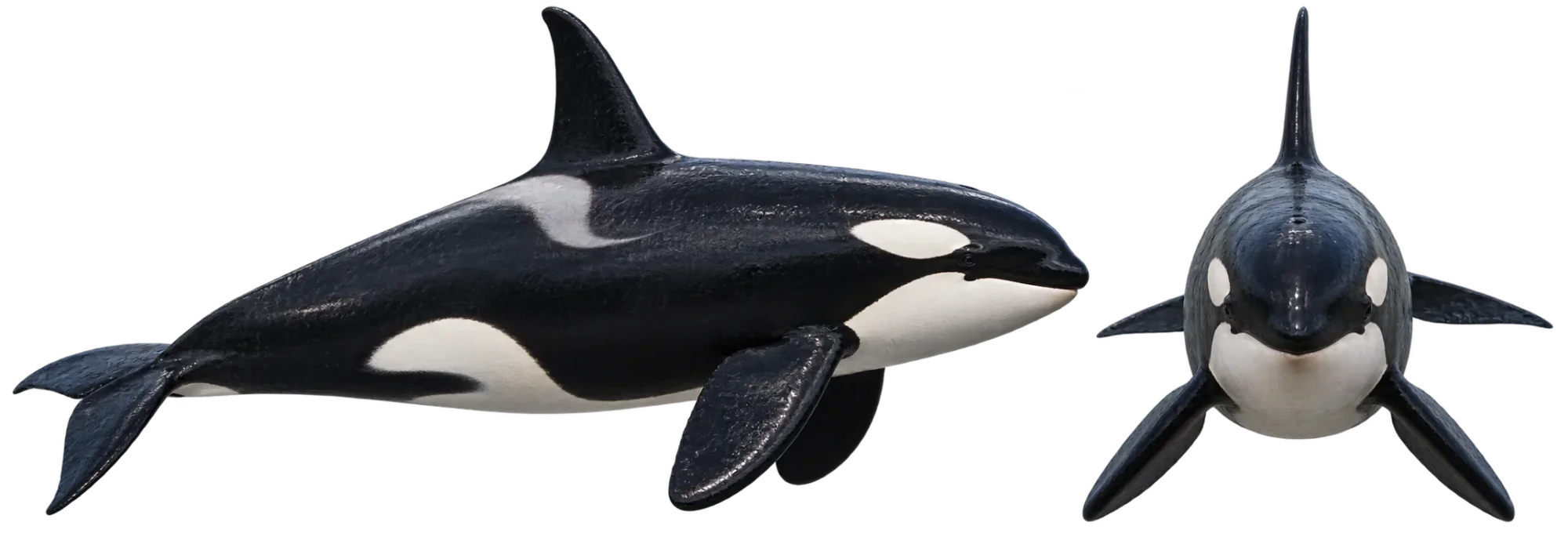
For a killer whale, growing up can happen inside a family that remains socially connected for decades. In well-studied populations, the relationship between a mother and her offspring continues far beyond pregnancy and nursing, shaping reproduction, survival and even the role of females after they stop producing calves.
A Life Cycle Built Around the Maternal Line
Killer whales, Orcinus orca, have an unusually persistent form of family life. Long-term studies of fish-eating resident populations in the northeastern Pacific show that offspring can remain with their maternal family throughout life. Adult males in particular maintain close associations with their mothers instead of becoming socially independent once they reach reproductive age.
This changes what “parental care” means for the species. A calf begins life with direct dependence on its mother, but the relationship can continue after the young whale can feed for itself. Mothers may share prey, travel with adult offspring and remain part of the social setting in which those offspring forage and interact with other whales.
The pattern is not identical in every killer whale population. Bigg’s killer whales, which specialize in marine-mammal prey in the eastern North Pacific, also show strong mother-offspring bonds, but their dispersal pattern is more flexible. Adult males tend to remain closely connected to their mothers, while females are more likely to form new family branches with their own offspring.
Why Population Matters
Killer whales have several ecotypes and populations with different feeding traditions and social systems. Life-history values measured in one well-studied population should not automatically be treated as exact values for every killer whale worldwide.
One Calf Starts Years of Maternal Investment
Female killer whales generally mature during their early teens. Pregnancy is long, commonly estimated at about 15 to 18 months, and a female normally gives birth to one calf. Births can occur throughout the year.
The calf initially depends on milk and close physical association with its mother. Nursing lasts at least a year, while observations from Southern Resident killer whales indicate that maternal nursing and close care may continue for roughly two to three years. The next successful birth may be several years away; an interval of about five years has been reported for some growing populations and is often used when describing Southern Resident reproductive timing.
These long intervals make biological sense when the cost of raising a calf is considered. A 2026 study using a decade of aerial measurements from Northern Resident killer whales found that females had lower body condition during the first two years of lactation. Their condition had recovered by the third year, around the period when weaning is expected.
The same research found that maternal condition tended to decline as the number of living offspring and the number of previous births increased. The number of living offspring showed the strongest relationship. The result fits a life history in which maternal investment continues to carry an energetic cost long after pregnancy itself has ended.
Maternal Care Can Continue After Offspring Reach Adulthood
Resident killer whales provide one of the clearest examples of parental investment extending into adult life. An adult son may be capable of mating and finding prey, yet still gain survival benefits from having his mother alive.
Food sharing is part of this relationship. Resident killer whales commonly divide captured salmon, and mothers can direct food toward their offspring. Older females also carry decades of experience about where and when prey is likely to be available. During periods of poor salmon availability, that accumulated knowledge can have value to the whole maternal family.
Long-term records show that this support can carry a cost for mothers. A study of Southern Resident killer whales found that females with surviving weaned sons had a lower annual probability of producing another viable calf. The association remained even as those sons became older, supporting the idea that care did not simply end after weaning.
More recent work in Northern Residents adds an important qualification. Researchers found that the mother’s body condition was more closely related to her total number of living offspring than specifically to her number of sons. The energetic pattern therefore appears broader than a simple rule that adult sons are always more costly.
Adult Offspring Still Benefit From Mothers
Studies of resident killer whales have linked the presence of mothers with better survival of adult offspring, especially sons. Post-reproductive mothers have also been associated with fewer socially inflicted tooth-rake injuries on their sons. These findings show that maternal influence can remain biologically relevant many years after a calf becomes an adult.
Female Life Extends Far Beyond the Last Calf
Female killer whales can stop reproducing while many years of natural life remain. This prolonged post-reproductive period places killer whales among the small number of mammals for which menopause and extended female life after reproduction have been documented in wild populations.
NOAA currently describes female killer whales as typically living about 50 years in the wild, with some reaching at least 90. Males average about 30 years and can reach at least 60. These figures should be read as lifespan estimates rather than promises of how long an individual whale will live.
Reproduction usually ends much earlier than the upper limits of female longevity. In the closely tracked Southern Resident population, females generally begin reproducing in their teens and become post-reproductive at around 40 years of age. Long-term demographic work on both resident and Bigg’s killer whales has found that more than 30% of adult female years can occur after reproduction has ended.
This later stage is an active part of killer whale life history. Older females can remain embedded within a family containing adult offspring and grandchildren. Research on resident killer whales has found that the presence of post-reproductive mothers can improve the survival prospects of their offspring, while grandmothers can improve calf survival, especially during years when salmon availability is poor.
Comparative research published in 2024 found that menopause in toothed whales appears to have evolved through the extension of female lifespan without a matching extension of the reproductive period. This produces more years in which older females overlap with offspring and grandchildren while reducing the number of years in which mothers and daughters reproduce at the same time.
Long Lives Do Not Produce Rapid Population Growth
Killer whales combine long lives with slow reproduction. A female may spend well over a year pregnant, several more years nursing and supporting a young calf, and then additional years before another successful birth. Even after calves become independent feeders, family relationships can continue to require maternal investment.
This means the lifetime number of calves produced by a female can remain modest despite decades of adult life. It also makes calf survival important to the demographic outcome of each reproductive attempt. A lost calf represents not only one offspring but also a long pregnancy and a period that might otherwise have contributed to raising a surviving descendant.
Population condition can alter the pattern further. Southern Resident killer whales, for example, have shown long inter-calving intervals and many pregnancies that do not result in surviving calves. Those observations describe that endangered population rather than a universal reproductive rate for Orcinus orca.
Interpreting Killer Whale Life-History Data
Longevity
Typical lifespan estimates and the oldest documented or estimated ages describe different things and should remain separate.
Reproduction
Age at maturity, age at first successful birth and the end of reproduction are separate stages rather than interchangeable measurements.
Population
Much of the detailed life-history record comes from individually identified North Pacific populations followed for decades, so exact values can vary among ecotypes and regions.
 Bottlenosed dolphinTursiops truncatus