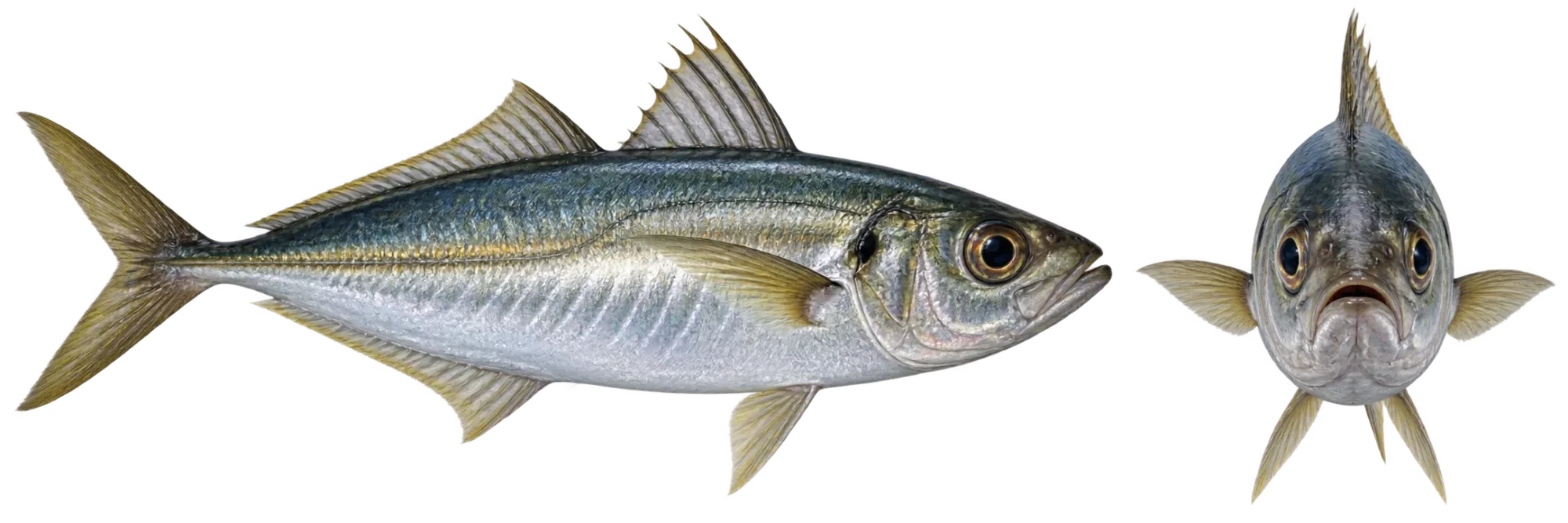
The common name horse mackerel can refer to several fishes, but here it refers to the Atlantic horse mackerel, Trachurus trachurus. Its life history changes noticeably with age: young fish grow quickly, sexual maturity is reached within the first few years, and adults reproduce through repeated spawning events rather than releasing all of their eggs at once.
Growth Changes Sharply After the Juvenile Years
Atlantic horse mackerel put much of their early growth into the first few years of life. Studies covering different parts of the species’ range have found relatively rapid growth up to about age three, followed by a slower pace as the fish become older.
This pattern is not identical everywhere. Growth rates and length at a given age vary among populations. Research across the Atlantic and Mediterranean has found geographic differences large enough that a single growth curve cannot represent every horse mackerel population equally well.
Season also matters. Work in the Saronikos Gulf found that juveniles continued growing in weight through the year, while adults showed more seasonal changes. In older fish, energy is no longer directed only toward body growth; reproductive development also becomes part of the annual energy cycle.
Reading Age From Otoliths
Horse mackerel age is commonly estimated from growth zones in the otoliths, the calcified structures in the inner ear. In some studies, annual rings became increasingly crowded and harder to distinguish in older fish, which adds uncertainty to age estimates at the upper end of the age range.
Maturity Varies Across the Species Range
Sexual maturity does not occur at one fixed length throughout the species. A broad review of Atlantic horse mackerel research found first-maturity estimates ranging roughly from 16 to 25 cm, with values near 21 cm appearing frequently. Female maturity has often been estimated at about two to four years of age, depending on the population and study area.
Geography helps explain part of this spread. Comparisons across the Atlantic have found changes in both length and age at maturity with latitude, while Mediterranean populations do not follow one equally clear geographic pattern. Local conditions, growth histories and population structure can therefore affect when fish enter the reproductive population.
A study published in 2026 using horse mackerel collected off western Libya estimated the length at which half of the sampled fish were mature at about 20.3 cm total length. That result falls close to the range commonly reported for T. trachurus, but the study also illustrates why regional measurements are more informative than treating one maturity value as universal.
Sex differences can vary as well. Earlier broad-scale work often found males becoming mature at a slightly smaller size than females, while the western Libyan sample produced a slightly larger male maturity estimate. The direction of a small male-female difference should therefore not be assumed to apply across the full species range.
Females Spawn in Repeated Batches Across Extended Seasons
Atlantic horse mackerel are multiple spawners. Developing eggs within the ovary are not all synchronized to a single release. Instead, females can release a batch of hydrated eggs and continue developing later batches during the same reproductive period.
The spawning season observed across an entire population can be much longer than the spawning period of a single female. Population-level seasons lasting several months occur because individual fish do not all begin and finish reproduction at the same time.
Timing also shifts geographically. In the northeastern Atlantic, spawning activity can progress from southern areas earlier in the year toward more northern waters later in the season. In the western Libyan study, the main reproductive period was concentrated in winter and spring. These regional differences make calendar dates meaningful only when they are tied to a particular population.
Horse mackerel are generally treated as having indeterminate fecundity. Females can continue recruiting developing oocytes during the spawning season, so counting advanced eggs before spawning begins does not necessarily reveal the total number that will eventually be released.
Temperature Sets the Pace of Egg Development
After fertilization, development can proceed quickly, but water temperature strongly changes the timetable. Experimental work with Atlantic horse mackerel eggs found successful development through hatching across tested temperatures from about 11.7°C to 19°C.
Field surveys have found horse mackerel eggs concentrated mainly in the upper part of the water column, often within the upper 50 metres. Their vertical position can shift during development and as seasonal water-column structure changes.
The transition from larval life to the early juvenile stage is also rapid. Research off the Portuguese coast sampled young Atlantic horse mackerel between 19 and 44 days old and found settlement occurring at roughly 19 to 36 days in the individuals examined. Different hatching groups grew at different rates, showing that early growth can diverge even among young fish produced within the same broader reproductive season.
Those early differences matter because survival to the juvenile stage depends on more than egg production alone. Temperature, hatching date and conditions encountered during the first weeks of growth can alter how quickly young horse mackerel reach the size and developmental stage associated with settlement.