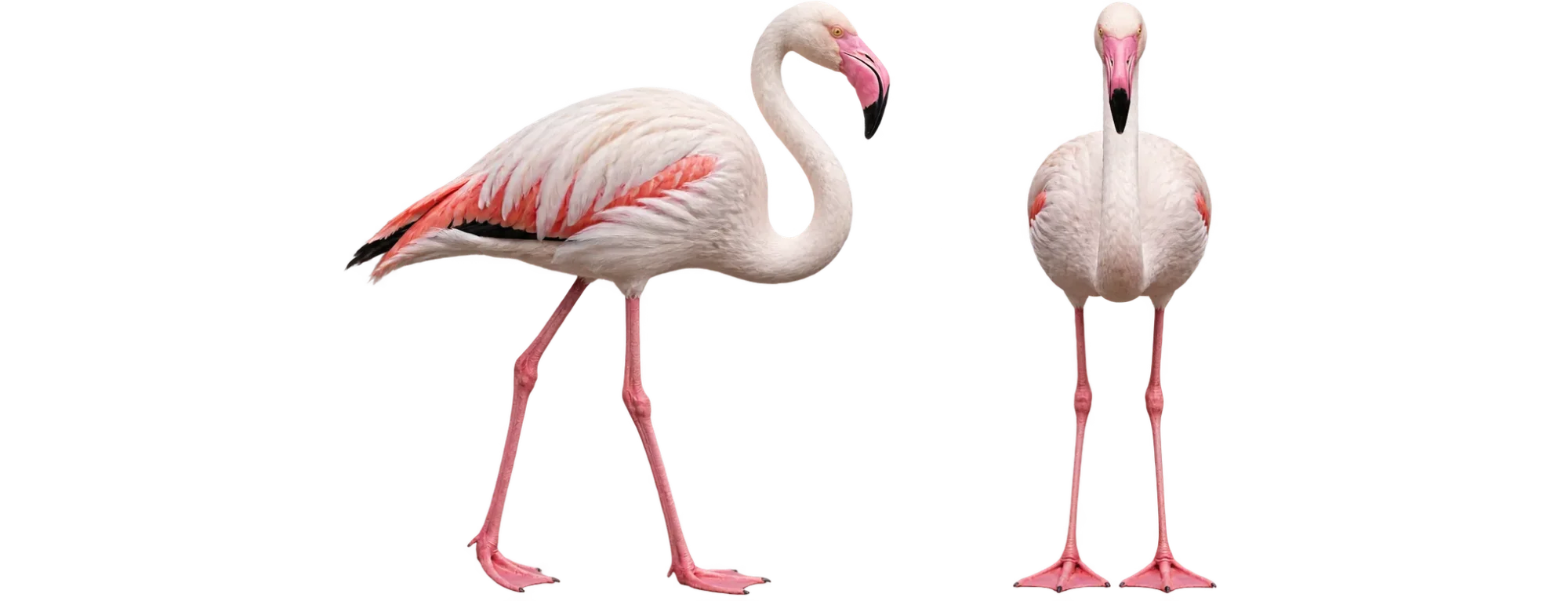
For a Greater Flamingo (Phoenicopterus roseus), a breeding attempt begins long before incubation and can keep both parents tied to one chick for months. Courtship takes place in large synchronized groups, pairs form for the breeding season, and chick rearing may require repeated journeys between a crowded nesting colony and feeding wetlands many kilometres away.
Pair Formation Is Renewed Through Group Courtship
Greater Flamingos perform communal courtship rather than relying on a simple one-to-one display. Large groups move through repeated head, wing and body postures, allowing potential partners to assess one another before nesting begins.
Long-term work on wild birds in the Camargue found that pair bonds did not persist from one breeding season to the next. Adults formed new pairs, even though the pair that eventually nested functioned as a two-parent unit. Both sexes take part in incubation and later in feeding the chick.
A study of known-age wild flamingos between 4 and 37 years old found that courtship sequences became more elaborate through early and middle adulthood and then declined at older ages. Birds performing more complex display sequences were also more likely to be recorded as breeders. Pair formation therefore depends on adult behaviour as well as simply reaching reproductive age.
Age and Experience Shape Breeding Probability
There is no single birthday after which every Greater Flamingo starts breeding regularly. Some wild individuals have reproduced from about three years of age, while many begin later or skip breeding opportunities after they have reached reproductive age.
A 25-year study following 14,716 marked Greater Flamingos found that previous breeding experience helped explain whether a bird would breed again. Experienced birds generally had a higher probability of breeding than inexperienced birds of the same age. In other words, reproductive history can matter separately from chronological age.
This also helps explain why an age-at-maturity value should not be read as an annual breeding schedule. A young adult may be physiologically capable of reproduction without becoming a regular breeder. Pair formation, previous experience and local breeding conditions all affect whether a nesting attempt actually follows.
Greater Flamingos depend on shallow wetlands that provide suitable nesting surfaces and safe separation from terrestrial predators. At Spain’s Fuente de Piedra, breeding has failed to start in years when water levels were too low. A mature bird may therefore pass through a season without nesting because the colony site itself is unsuitable.
Chick Rearing Connects the Colony to Distant Feeding Wetlands
After hatching, a chick is initially dependent on nutrient-rich crop secretions produced by both parents. As chicks become mobile they gather into large crèches, but joining a crèche does not mean parental care has ended. Adults continue returning to locate and feed their own offspring.
For some colonies, that parental care involves remarkable travel. Research at Fuente de Piedra found that adults raising chicks used feeding wetlands more than 130 km from the breeding colony. Parents could remain away for several days before returning with food, turning chick provisioning into a cycle of long-distance foraging and brief colony visits.
Earlier physiological work at this colony also showed that provisioning was not necessarily a daily event. Some chicks experienced intervals without feeding while their parents were away. The crèche system allows young birds to remain together at the colony while adults exploit food sources spread across a much larger wetland network.
Juvenile Growth Continues Through a Long Fledging Period
A recent study of known-age Greater Flamingo chicks followed leg growth from roughly 40 to 200 days of age. Females showed a faster early growth rate in tarsus length, while males approached a larger final size. Rapid structural growth began slowing at around 100 days, close to the usual age at which young flamingos become capable of sustained flight.
Fledging is therefore only one point in a much longer maturation process. A young bird that can fly still differs visibly from an adult, and the specialised feeding structures and plumage continue developing after the earliest chick stages.
Definitive adult plumage commonly appears only after several years, often around four to six years of age. Plumage maturation, the first possible breeding attempt and regular participation in reproduction therefore do not run on exactly the same timetable.
Migration Strategy Changes the Pattern of Aging
Greater Flamingos can remain reproductively active across a long adult life, which makes them unusually useful for studying how movement decisions relate to aging. A study published in 2025 used 44 years of ring-resighting records to compare resident and migratory Greater Flamingos in the Mediterranean population.
Resident birds had lower mortality earlier in adult life and a higher probability of breeding than migrants, while breeding success among birds that did reproduce was similar. Later in life, however, the resident group showed a steeper decline in both survival and reproductive performance. Migrants followed a different age-related trajectory.
The resident-versus-migrant result describes demographic patterns detected in a long-running Mediterranean study. It does not mean that migration alone determines how long an individual flamingo will live, and the same age pattern should not automatically be assumed for every African or Asian population.