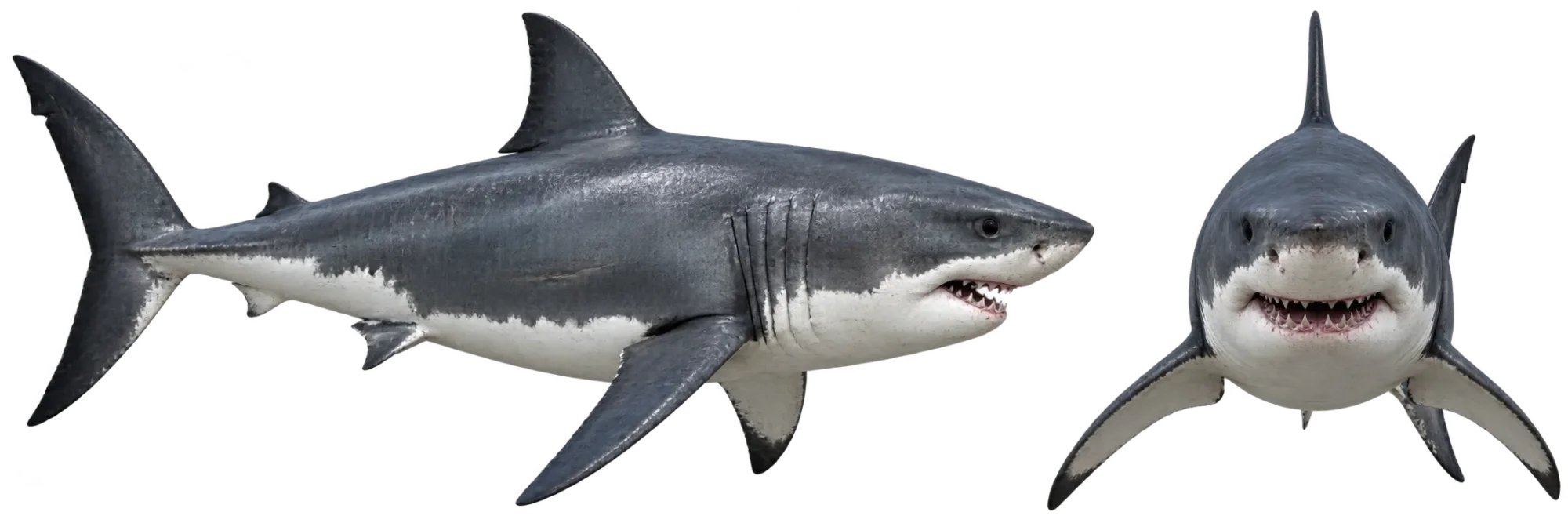
A female great white shark can be more than 4.5 meters long and still be reproductively immature. That mismatch between body size and reproductive state captures one of the hardest parts of interpreting the species’ life history: growth, age, and maturity do not follow one simple schedule, and estimates can change with the population and ageing method being studied.
Age and Growth Estimates Still Depend on the Method
Great white sharks, Carcharodon carcharias, grow over a long period and may live for many decades. Older growth studies often estimated age by counting bands in vertebrae. The difficulty is that these bands cannot always be assumed to represent one year of growth throughout an animal’s life.
Radiocarbon analysis changed the picture. A study of northwestern Atlantic white sharks estimated one large male at about 73 years old and a large female at about 40 years. The male provides evidence that the species can reach or exceed 70 years, but it should not be treated as the normal lifespan of every great white shark.
Age at sexual maturity has the same uncertainty. NOAA currently gives approximate maturity ages of 26 years for males and 33 years for females. A necropsy of a female measuring about 4.6 meters in total length also showed why maturity cannot safely be inferred from size alone. Although the shark was thought to be close to 30 years old, examination of its reproductive organs indicated that it was still immature.
A different picture emerged from a 2026 study in New South Wales, Australia. Instead of relying on vertebral bands, researchers used repeated measurements of individually identified sharks that had been captured, released, and later encountered again. Immature sharks in that dataset grew by an estimated 21.7 centimeters per year on average.
The growth model produced theoretical maturity estimates of roughly 11 years for males and 18 years for females, with a theoretical longevity near 50 years. These figures should be interpreted carefully. The study contained very few mature animals, so its adult estimates were extrapolated mainly from younger sharks rather than measured across complete lifespans.
The differing results do not justify replacing one set of ages with another universal value. They show that white shark ageing remains an active research problem. Sex, regional growth patterns, sample composition, and the method used to estimate age can all affect the resulting life-history schedule.
Embryos Receive Maternal Nutrition Without a Placenta
Great white sharks give birth to live young through aplacental viviparity. The embryos develop inside the uterus, but there is no placental connection like the one found in most mammals.
Early development is more complex than simply living from an original yolk supply. Examination of pregnant females has shown that the uterine wall produces a lipid-rich secretion often called histotroph or uterine milk. Young embryos can use this material while also receiving nutrient eggs produced by the mother.
As development continues, the embryos practice oophagy, consuming unfertilized nutrient eggs inside the uterus. This maternal investment allows each pup to become unusually large before birth. Studies of near-term embryos have recorded lengths around 1.3 to 1.5 meters.
Direct observations of pregnancy are rare, which makes the length of gestation difficult to establish. A study using pregnant white sharks recorded in the northwestern Pacific examined females carrying embryos at different developmental stages. Pregnant females in that dataset carried an average of about six embryos, with as many as ten recorded, and the progression in embryo size produced an estimated gestation period of about 20 months.
That estimate is useful evidence rather than a universal clock for every population. Reproductive cycles are still poorly observed because mature females range widely and pregnant animals are rarely available for examination. Even basic questions such as how often an individual female gives birth remain less settled than the commonly reported numbers might suggest.
The First Years Are Closely Tied to Coastal Nursery Areas
Newborn and young great white sharks do not immediately live like the large adults seen around offshore islands and marine-mammal colonies. Their early life is associated with warmer, shallow coastal waters in several parts of the species’ range.
Research in the northeastern Pacific has identified nursery habitat in the Southern California Bight and along Baja California. Young-of-the-year sharks have been tracked in very shallow water, sometimes within a few hundred meters of shore. Rather than moving continuously through the region, some remain around particular stretches of coastline for days or months.
Temperature appears to help shape these early movements. Juvenile white sharks can tolerate a broad thermal range, yet tracking studies show that they commonly occupy water between about 14°C and 24°C. Because white sharks can keep parts of their bodies warmer than the surrounding water, selecting suitable coastal temperatures may help young animals balance the energy needed for growth, movement, and feeding.
Food use changes as the sharks grow. Juveniles rely heavily on fishes, rays, other small elasmobranchs, and similar prey available in coastal habitats. Larger juveniles and subadults expand their movements and eventually add larger prey, including marine mammals, to their diet. The familiar adult hunting strategy therefore appears only after several earlier stages of growth and changing habitat use.
Nursery habitat is not one permanent location used in exactly the same way every year. Southern California tracking has shown that young sharks can form loose seasonal concentrations at different coastal hotspots, with individual animals displaying repeated residency while the most heavily used areas shift between years.