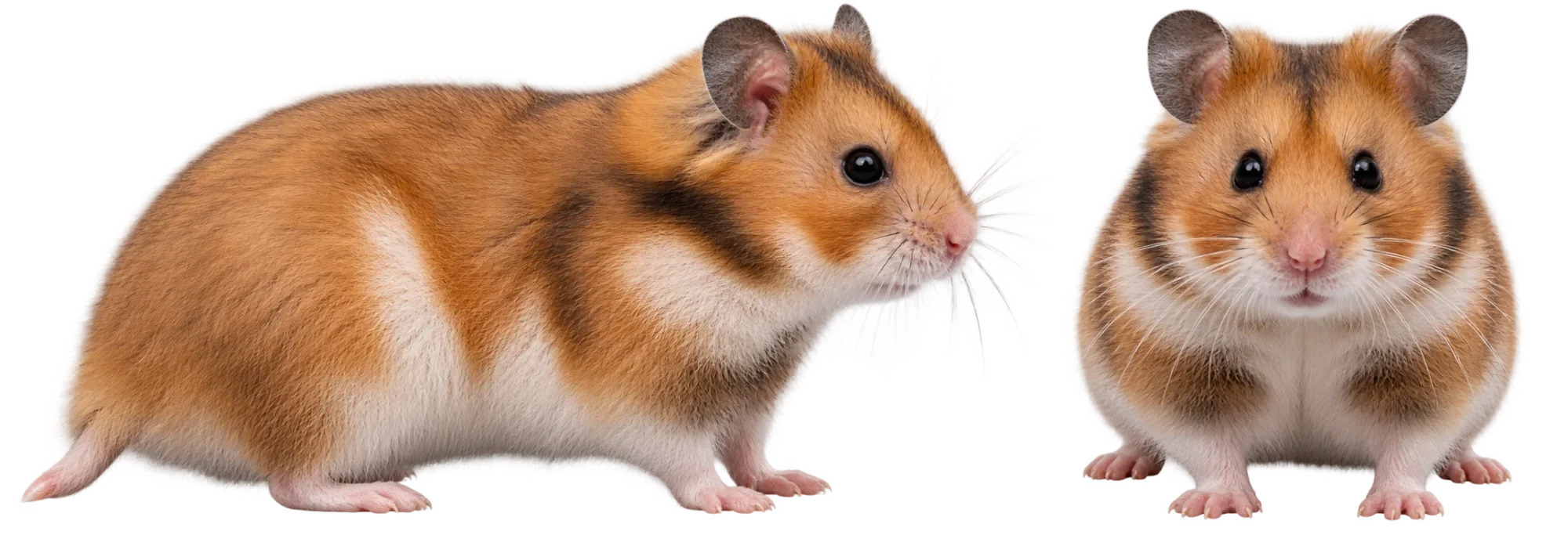
The golden hamster, Mesocricetus auratus, moves through reproduction and early development on a compressed timetable. Females cycle every four days under reproductive conditions, pregnancy usually lasts about 16 days, and newborn pups progress from blind, hairless dependence to weaning in roughly three weeks. Puberty follows soon afterward, although different parts of the reproductive system do not become functional on the same day.
The Four-Day Cycle Behind Golden Hamster Reproduction
Adult female golden hamsters have a remarkably regular four-day estrous cycle. This rhythm has made the species especially useful in reproductive research because ovulation and the stages surrounding it can be followed with unusual precision.
The cycle does not operate independently of the environment. Golden hamsters are long-day breeders. Longer photoperiods support reproductive activity, while prolonged exposure to short days can suppress ovarian cycles in females and reproductive function in males. This seasonal response connects a very fast reproductive system to the part of the year when conditions are more favorable for producing young.
Laboratory studies also show that the short-day response is not permanent. After many weeks under short photoperiods, the reproductive system can reactivate even without a return to long days. This photorefractory phase prevents reproductive dormancy from continuing indefinitely.
A Pregnancy Centered on About Sixteen Days
Golden hamster gestation is usually reported at about 16 days, with broader husbandry references commonly giving a range of roughly 15–18 days. It is one of the shortest gestation periods recorded among placental mammals.
The short pregnancy does not produce developmentally advanced newborns. Golden hamster pups are altricial: they are born small, hairless, with closed eyes and limited ability to regulate their own needs. Maternal investment therefore shifts quickly from pregnancy into an intensive lactation period.
Litters can also be large. Published values vary with population and breeding conditions, with reported litter sizes extending from only a few pups into the mid-teens. Laboratory averages are often near 8–11 pups. A single fixed litter-size value therefore hides real variation between females, colonies and reproductive circumstances.
A 16-day pregnancy explains how quickly birth follows conception, but it does not describe how much maternal effort follows birth. Large, undeveloped litters place much of the reproductive workload into the weeks of nursing and postnatal growth.
Most Visible Pup Development Happens Within Three Weeks
Newborn golden hamsters begin life at only a few grams and depend heavily on their mother. The change over the next 20 days is rapid enough that several major developmental events occur before the end of the first month.
This timetable helps explain why gestation length alone can give a misleading impression of developmental speed. Birth occurs very early, but much of the growth that would occur before birth in a more precocial mammal takes place during the golden hamster’s short nursing period.
Puberty Arrives in Separate Steps Rather Than on One Date
Golden hamsters mature early, but a single “age at maturity” cannot describe the process accurately. Hormonal cycling, sexual behavior, ovulation, successful pregnancy and male fertilizing ability appear at different points.
The female pattern is especially useful for interpreting maturity data. An animal can display one adult reproductive trait before all the physiological processes required for dependable pregnancy are synchronized. Early estrus therefore should not automatically be treated as identical to complete reproductive maturity.
Solitary Adults Produce a Mother-Only Care System
Wild golden hamsters are strongly solitary. Field investigations of occupied burrows in northern Syria found adults living individually rather than as permanent pairs or family groups. Males and females therefore do not form a long-lasting breeding unit.
After mating, parental investment falls on the female. She builds and maintains the nest, nurses the litter and supports the pups through their short but demanding pre-weaning period. The male does not remain as a second caregiver.
This solitary system fits the reproductive timetable. Contact between adults can be brief, while pregnancy, birth and pup care take place within the female’s own reproductive and nesting cycle. The combination of large altricial litters and exclusive maternal care also makes conditions during lactation important to pup survival. Experimental work has shown that ambient temperature and the energetic demands placed on mothers can affect how many pups survive to weaning.
Early Maturity Fits Within a Life Measured in Only a Few Years
Golden hamsters are short-lived mammals. Captive references commonly place average longevity around two to three years, although lifespan varies with strain, individual condition and husbandry. A recorded maximum of 3.9 years appears in the AnAge longevity database.
That maximum should not be read as the expected lifespan of a typical hamster. In a long-term study of 150 male LVG Syrian hamsters that died naturally, the median lifespan was 19.5 months and the longest-lived animal reached 36 months. Such colony measurements describe a particular captive population rather than a universal lifespan for the species.
Most detailed age, reproduction and developmental measurements for Mesocricetus auratus come from captive or laboratory animals. The species has a restricted wild range and has been studied far less extensively in nature. Captive longevity records therefore should not be presented as measured normal survival for wild golden hamsters.
The dependable biological pattern is the pace rather than one exact lifespan value: golden hamsters complete juvenile development quickly, can enter reproduction within weeks of birth, and move through their adult reproductive life within a relatively short total lifespan.