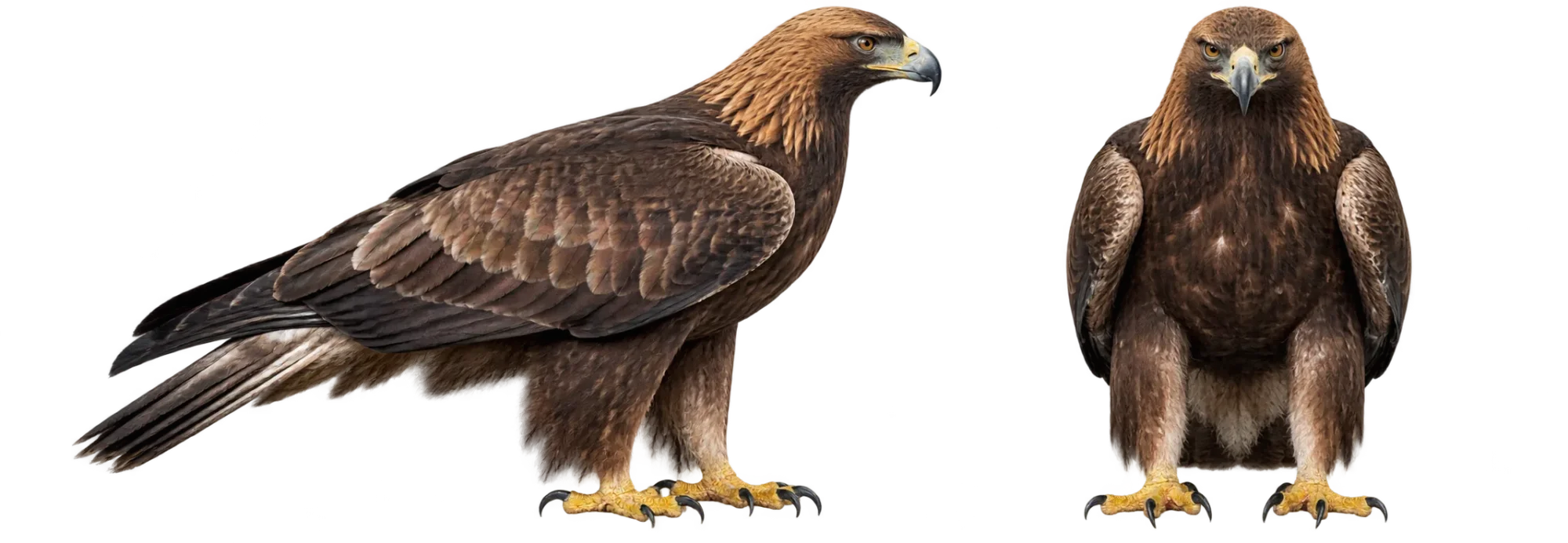
Golden eagles spend years between their first flight and regular reproduction. Young birds reach flight capability within a few months of hatching, yet the transition into the breeding population is much slower. Adult plumage develops over several years, suitable territories may be difficult to obtain, and the species relies heavily on the repeated survival of established adults.
Several Years Separate Fledging From Regular Breeding
Young Aquila chrysaetos become mobile long before they take on an adult reproductive role. Juvenile plumage is gradually replaced, with the adult appearance generally developing between about four and six years of age. Breeding is commonly reported from roughly four to seven years, although these ranges should not be treated as a fixed biological deadline.
Reproductive maturity and actual first breeding are different events. A bird may be physically capable of reproduction but still lack a mate or an available territory. Golden eagles occupy large breeding areas, and established pairs can retain territories for years. Entry into the breeding population therefore depends partly on opportunities created when a territory becomes vacant or a new pairing becomes possible.
Earlier reproduction does occur. A satellite-tracked male in Spain successfully bred while still showing subadult characteristics at about three years of age, and its mate was also a subadult. The case shows that the commonly reported breeding-age range describes a usual pattern rather than an absolute minimum.
A Breeding Attempt Begins Well Before Hatching
Golden eagle pairs invest in breeding sites across repeated seasons. A territory may contain more than one nest, and pairs can alternate among them while returning to the same nesting area over many years. Existing nests are repaired and enlarged, sometimes beginning months before eggs are laid.
Clutches are small, with two eggs common, and a pair normally has one brood during a breeding season. Incubation lasts roughly six weeks. The female performs most incubation, while the male may take shorter incubation shifts and provides much of the food during the early nesting period.
The timing of incubation affects what happens after hatching. Eggs are laid several days apart, and incubation can begin with the first egg. The first chick therefore often hatches before its sibling and starts growing while the second chick is still developing inside the egg.
Hatching Order Can Reshape a Two-Chick Brood
A difference of only a few days at hatching can produce a noticeable size advantage during the fastest part of nestling growth. The older chick can reach food first and may dominate the younger chick during feeding. Golden eagles are therefore considered a species in which brood reduction can occur facultatively: loss of the smaller chick is possible, but it is not an unavoidable outcome of every two-chick nest.
Food availability changes that balance. When adults deliver enough prey, more than one chick can develop successfully. Under poorer feeding conditions, the younger chick begins with both an age disadvantage and less competitive access to food. Studies of golden eagle broods have linked these size differences and sibling interactions with the probability that only one chick survives to fledging.
This makes clutch size an incomplete measure of reproductive output. Two eggs do not automatically become two independent juveniles. Hatching success, prey delivery, sibling competition and survival through the nestling period all stand between egg laying and recruitment into the later population.
First Flight Starts Another Dependent Stage
Golden eagle nestlings remain at the nest for many weeks, with reported nestling periods extending from about 45 to 81 days. First sustained flight is commonly reached at around ten weeks, but fledging is not the same as independence.
Recently fledged eagles continue using their natal area while improving flight control, learning to obtain food and receiving support from their parents. The length of this period varies with population and migration strategy, so a single species-wide independence age can be misleading.
Satellite tracking of migratory golden eagles in Denali National Park and Preserve, Alaska, found an average post-fledging dependence period of about 50 days, with tracked juveniles ranging from 39 to 63 days. Birds that hatched earlier generally spent longer in this stage, but they did not leave the natal area earlier. Instead, departure dates clustered around the onset of autumn migration.
That pattern helps explain why reports from other parts of the range can differ. Resident or short-distance populations may allow young eagles to remain near their parents longer, while northern migrants face a seasonal deadline. Independence is therefore shaped by both development and the ecological calendar the juvenile must follow.
Survival Changes Sharply After the First Year
The golden eagle’s long delay before breeding works only when enough birds survive into later age classes. A population model for golden eagles in the western United States estimated mean annual survival at about 70% for first-year birds and about 90% for adults. These are regional estimates rather than fixed rates for every population, but the age difference illustrates an important feature of the species’ life history.
Once established, an adult can potentially breed across many seasons. Annual reproduction is comparatively limited: the same western U.S. analysis estimated that breeding pairs fledged an average of about 0.53 young per year during the study period. A failed or low-output breeding season can therefore be followed by another attempt if the adults survive.
Population modeling has found adult survival to have especially strong effects on golden eagle population growth. Raising reproductive output has only limited ability to offset persistent losses of breeding adults. The species depends on a relatively small annual flow of young birds passing through the more vulnerable early years and eventually joining a long-lived breeding population.
 White-tailed sea-eagleHaliaeetus albicilla
 Bald eagleHaliaeetus leucocephalus