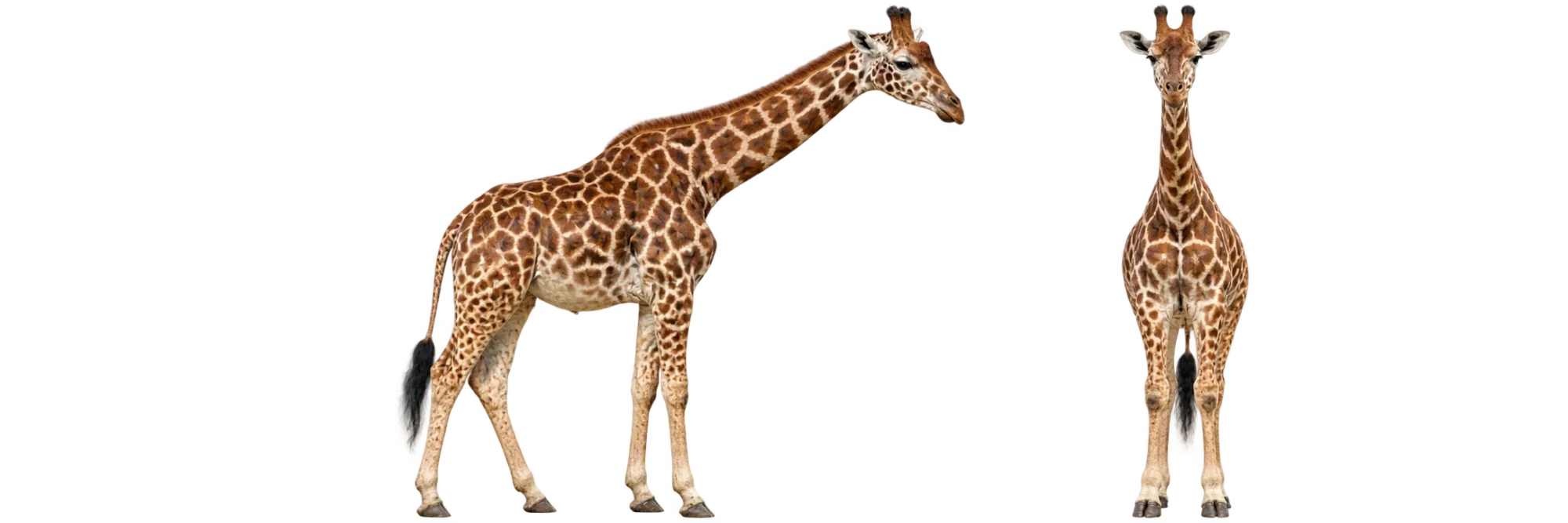
The name “giraffe” now covers several distinct evolutionary lineages rather than one species spread across Africa. That taxonomic change matters when reading older life-history records, because many measurements were collected when all giraffes were grouped under Giraffa camelopardalis. Across the modern species, the clearest shared pattern is a long reproductive cycle built around a lengthy pregnancy, one calf at a time, prolonged maternal care, and relatively late successful breeding.
Current Taxonomy Changes How Giraffe Data Are Read
In 2025, the IUCN SSC Giraffe and Okapi Specialist Group formally recognized four living giraffe species. Earlier references commonly treated giraffes as one species divided into several subspecies, so older research may use scientific names that no longer match the current arrangement.
- Northern giraffe — Giraffa camelopardalis
- Reticulated giraffe — Giraffa reticulata
- Masai giraffe — Giraffa tippelskirchi
- Southern giraffe — Giraffa giraffa
This is especially relevant for gestation, maturity, birth spacing, weaning, and survival records. A value reported simply for “giraffe” may come from one population, a particular modern species, or captive animals. Such measurements can still be useful, but their biological context should be kept with them rather than treated as exact values for every giraffe population.
Pregnancy and Lactation Often Overlap
Giraffe pregnancy lasts roughly 15 months, making each successful birth a long reproductive investment. A single calf is normal, while twins are rare. Giraffes can reproduce throughout the year, although local populations may show seasonal peaks in conception or birth that follow rainfall and food conditions.
A female may begin another reproductive cycle while she is still nursing her existing calf. Hormone monitoring has recorded ovarian cycling returning within weeks after birth in some females, including during active lactation. This allows a new pregnancy to begin before the older calf has finished its period of maternal dependence.
Lactation itself is variable. Field observations and captive studies place weaning across a fairly broad age range, and recent milk research found that the gradual shutdown of milk production can begin around 12 months and may continue toward 15 months. The result is a reproductive schedule in which nursing one calf and carrying the next can overlap for months.
Calving intervals are commonly around 20 months, but they are not fixed biological timers. The survival of the existing calf can affect how quickly the mother returns to another pregnancy, so birth spacing partly reflects what happened during the previous reproductive attempt.
Maturity and First Reproduction Occur at Different Ages
Sexual maturity is only one stage in becoming a breeding adult. Female giraffes can become sexually mature at roughly three to four years of age, while observations of wild populations commonly place first reproduction later, often around five to six years.
The distinction is also important in males. Physiological maturity can occur while a male is still relatively young, but mating opportunities depend heavily on age, body size, competition, and access to receptive females. A biologically mature young male therefore may spend additional years before contributing regularly to reproduction.
This delay separates a simple maturity-age measurement from the age at which an animal actually begins producing offspring. For population studies, the latter can have a larger effect on how quickly one generation replaces the previous one.
Calf Survival Shapes the Reproductive Pace
Giraffe calves are highly mobile soon after birth. A healthy newborn can usually stand within its first hour and begin nursing soon afterward. Maternal dependence, however, continues for many months as the calf grows, learns to browse, and gradually reduces its reliance on milk.
Young giraffes also pass through a much more vulnerable survival stage than adults. Field studies in East Africa have shown that predation can strongly affect survival during the neonatal period and the first months of life. The level of risk can change between places and seasons as predator numbers and the availability of other prey change.
This early mortality feeds directly back into giraffe reproductive biology. Females whose calves die can return to reproductive cycling sooner than females supporting a surviving calf. A population’s birth rate therefore cannot be understood from gestation length alone: calf survival, lactation, and the timing of the next conception are biologically connected.
Long-term field work also shows why one universal juvenile-survival percentage would hide much of the real pattern. Calf survival can shift with local ecological conditions even when adult giraffes in the same population remain comparatively resilient.