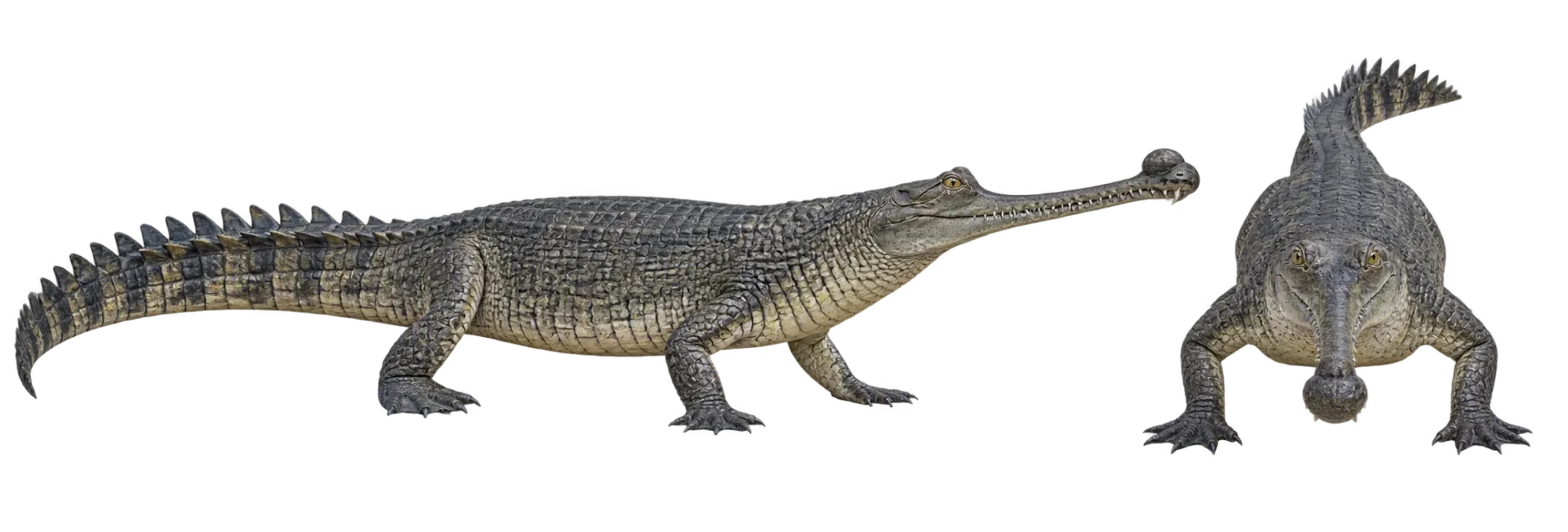
The gharial (Gavialis gangeticus) times reproduction around changing river conditions. Courtship occurs during the dry season, eggs develop inside deep sand nests, and hatching usually comes close to the seasonal rise in water. Its life history also shows an unusually clear split between the sexes: females become reproductive at a smaller body size, while mature males develop the distinctive ghara at the tip of the snout.
The Breeding Cycle Tracks the Dry Season and Monsoon
Gharial reproduction is closely tied to the annual river cycle rather than occurring evenly through the year. Courtship and mating take place during the dry season, followed by nesting when exposed sandbanks are still available. Eggs then develop as temperatures rise toward the monsoon.
This sequence makes the availability of suitable sandbanks time-sensitive. A beach that works for basking or nesting in one season may be reshaped, submerged or replaced after the next monsoon.
Female Maturity Comes Earlier Than the Adult Male Ghara
Reproductive maturity in gharials is often described by body length as well as age. Growth rates vary with conditions, so age estimates should not be treated as exact thresholds for every animal.
The ghara is more than a visual difference between adult males and females. Research on gharial skull development shows that it is a sex-linked adult structure. It alters the nasal region and is associated with the sounds and display behavior of breeding males.
This creates a marked life-history asymmetry. A female can enter the breeding population years before a male of the same generation reaches the large adult size associated with a developed ghara.
Sandbank Position Shapes Egg Development
Female gharials dig chamber nests in sand, often on elevated or steep banks near usable water. Nest position affects more than the distance a female travels from the river. It influences exposure to flooding, solar heating and the thermal conditions experienced by the embryos.
| Field Study | Nesting Record | What It Shows |
|---|---|---|
| Chitwan, Nepal, 2001–2017 | 151 nests; mean clutch size 32.3 eggs; mean incubation about 76 days | Nesting occurred in a narrow seasonal window, while clutch characteristics and hatching success differed between rivers and years. |
| Karnali system, Nepal, 2024–2025 | 16 nests; 509 eggs; about 31 eggs per nest on average | More than 80% of the recorded eggs produced live hatchlings across the two survey years, but individual nests differed sharply in outcome. |
These field results help explain why a single clutch-size figure cannot describe every gharial population. Female size, nesting site, local conditions and year-to-year river changes can all contribute to variation.
Incubation temperature also affects development directly. Gharials have temperature-dependent sex determination. Experimental work supports a female–male–female pattern: intermediate incubation temperatures favor males, while cooler and warmer conditions favor females. The thermal properties of a nest therefore influence both development time and the sex composition of the hatchlings.
In the 2024–2025 Karnali study, nests averaged several metres from the water and were positioned above the river edge. Recorded nests faced south, southeast or west. These measurements describe that river system rather than a fixed nesting rule for every gharial population.
Hatchlings Leave the Nest Without Being Carried to the Water
Near hatching, young gharials produce calls from inside the nest. An attending female can respond by excavating the sand and exposing the eggs and hatchlings. The young then move toward the water themselves.
This differs from the familiar image of broad-snouted crocodilians carrying hatchlings in their jaws. The gharial’s extremely narrow snout is poorly suited to that form of transport. Maternal care instead centers on nest attendance, opening the nest and remaining close to groups of young.
Hatchlings from neighboring nests can gather into crèches, so one group beside the river may contain young from several females. Recent field observations in Nepal documented such groups after nearby nests hatched.
Adult males may also be involved under some conditions. Long-term field observations from the Chambal River have described large males remaining with and guarding communal groups of hatchlings. Male participation should not be treated as identical at every site, but these observations show that gharial care can extend beyond a simple female-and-single-clutch arrangement.
The crèche stage lasts within a changing river environment. As monsoon water rises, nesting areas can disappear and young gharials become more widely dispersed through the river system.