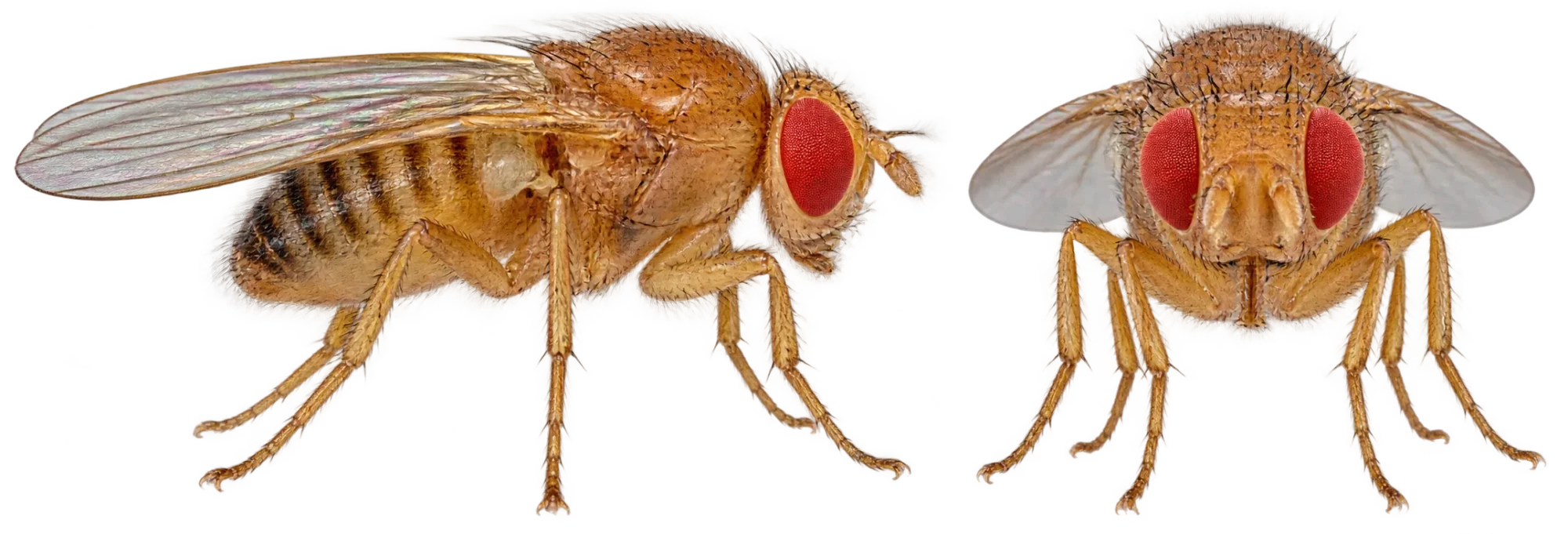
The small fly widely called the fruit fly in genetics and life-history research is Drosophila melanogaster. Its short development is real, but the familiar laboratory timetable is strongly shaped by temperature, food, crowding, strain, and rearing conditions. Under well-fed laboratory conditions near 25°C, development from a newly laid egg to an emerging adult commonly takes about 9–10 days.
Temperature Sets the Egg-to-Adult Schedule
Drosophila melanogaster passes through four main life stages: egg, larva, pupa, and adult. Near 25°C, the embryo normally hatches about a day after the egg is laid. The feeding larva then passes through three instars before leaving the food and preparing to pupate. The pupal period occupies roughly the final four days of the standard laboratory cycle.
The often-quoted 9–10 day cycle should not be treated as a fixed biological constant. Even among laboratory wild-type flies, egg-to-adult timing can spread across a wider range. Cooler development generally takes longer, while rearing temperature also affects adult size and later reproductive performance. Crowding and food conditions can add further variation.
Mating Readiness Changes During the First Adult Days
Emergence from the pupa, or eclosion, produces an adult fly, but adult reproductive function continues to mature afterward. Newly emerged females show very low sexual receptivity during roughly the first 8–12 hours. Studies using different definitions of reproductive maturity have placed female maturation across the first several adult days, while males commonly reach mature reproductive performance at around two days after eclosion.
A fly can become capable of a reproductive behavior before every measure of adult reproductive performance has reached its mature level. First receptivity, first mating, egg production, successful fertilization, and peak fecundity are related events, but they are not identical measurements.
This short transition helps explain why fruit flies can establish a new generation rapidly once adults emerge. It also makes adult age important in experiments: comparing a newly eclosed fly with a three- or five-day-old adult can mean comparing different reproductive states rather than simply flies separated by a few calendar days.
Stored Sperm Separates Mating From Fertilization
Female D. melanogaster do not need a new mating for every egg they fertilize. After mating, sperm move into specialized storage sites in the female reproductive tract, including the seminal receptacle and spermathecae. Stored sperm can later be released as eggs pass through the reproductive tract.
This changes the timing of reproduction in an important way. Mating, fertilization, and egg laying can occur at different times rather than as one tightly linked event. Male seminal-fluid components also alter female reproductive physiology after mating, affecting processes such as sperm storage, egg laying, and receptivity to another male.
Females can mate again while sperm from an earlier mating remain in storage. Laboratory observations show that remating may occur before the existing sperm supply is exhausted. A female may therefore carry sperm from more than one male, making sperm storage and use part of the species’ reproductive life history rather than a short event immediately following copulation.
Egg Laying Peaks Early and Changes With Adult Age
Female reproductive output is strongly age-dependent. Egg laying begins early in adult life, rises as reproductive maturation is completed, and commonly reaches its highest levels during the early adult period. It then declines as the female ages.
The decline is not perfectly uniform between individuals or populations. Work with recently collected wild populations kept under laboratory conditions found differences in fecundity, hatchability, lifespan, and the timing of reproductive decline. Individual females could show distinct reproductive peaks followed by a later period in which egg production fell sharply.
That pattern matters when a fecundity value is reported for a fruit fly. A daily egg count measured near peak reproduction is different from lifetime reproductive output, and neither should automatically be treated as a species-wide constant. Strain, adult age, diet, temperature, mating history, and experimental conditions can all shift the observed result.
Lifespan and Reproductive Lifespan Follow Different Clocks
An adult fruit fly can remain alive after its highest-output reproductive period has passed. In a study that followed individual females descended from recently collected wild populations, researchers found a recognizable post-oviposition phase after reproductive output had declined. Under those laboratory conditions, the post-reproductive portion averaged a large fraction of total female lifespan.
This is one reason a longevity record cannot describe the entire life-history schedule by itself. Two flies with similar total lifespans may differ in when they mature, when egg production peaks, or how long they continue reproducing.
Laboratory lifespan is especially sensitive to genotype, diet, temperature, mating exposure, population density, and husbandry. Protected laboratory survival therefore should not be converted directly into an expected lifespan for a fruit fly living under natural conditions.
The same caution applies when comparing mated and unmated flies or long-maintained laboratory stocks with recently collected populations. Reproductive activity itself can alter survival, while generations of laboratory culture may change the traits being measured. For D. melanogaster, lifespan is best read together with developmental and reproductive timing rather than as an isolated number.