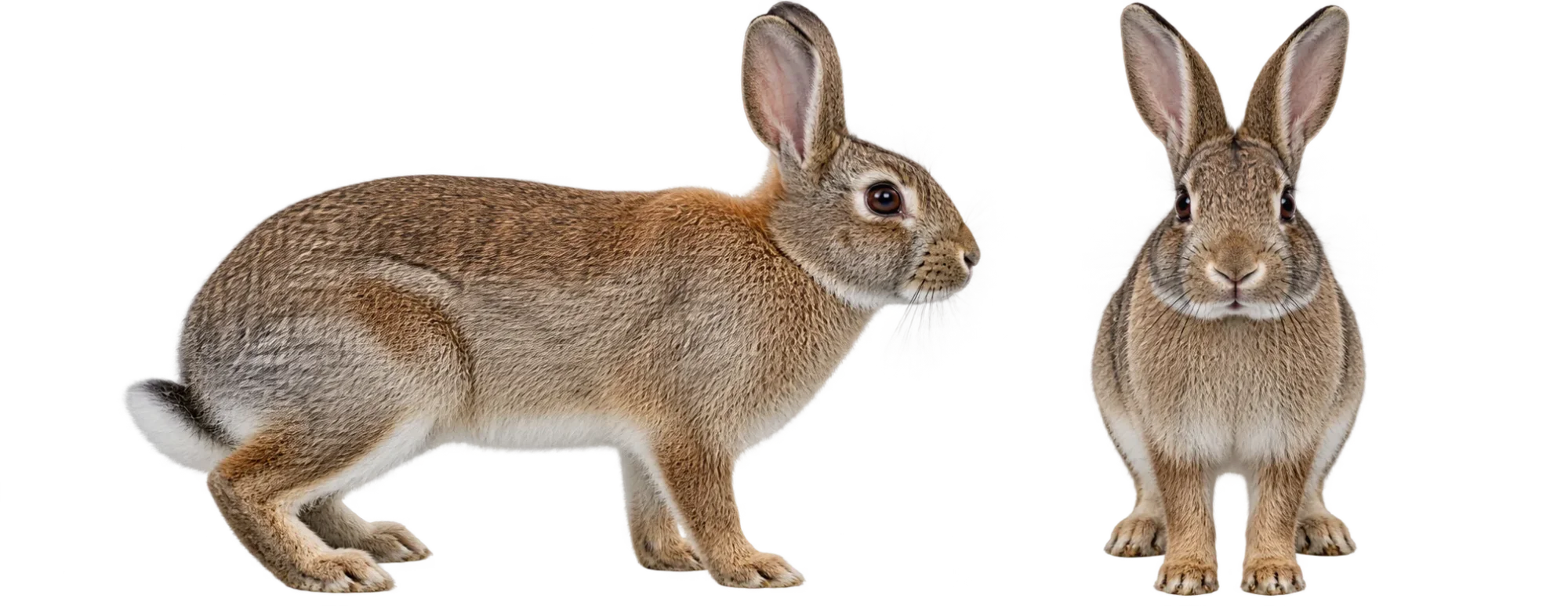
The European rabbit (Oryctolagus cuniculus) can complete a pregnancy in about a month, but wild reproduction is far less uniform than that short interval suggests. Breeding activity rises and falls with season, food conditions and social position, while the first weeks after birth create a steep survival filter. Its life history combines rapid reproductive cycling with unusually brief maternal contact and heavy losses before young rabbits reach their first breeding season.
Breeding Pace Follows Local Conditions
European rabbits are induced ovulators: mating triggers the hormonal process that releases eggs. Females can also become receptive soon after giving birth. Combined with a gestation of roughly 30 days, this makes closely spaced litters biologically possible.
That capacity does not mean that wild females produce a new litter every month throughout the year. The breeding window changes with climate and plant growth. In temperate European populations, reproduction is concentrated mainly from late winter or spring into summer. Studies in Mediterranean environments have also linked reproductive activity with the availability and water content of growing vegetation. In regions with different rainfall patterns, the calendar can shift accordingly.
In the same long-term population, litter size averaged about 4.8 young. Females were biologically capable of producing more litters than they usually did. Pregnancy loss, declining participation later in the breeding season, body condition and social circumstances all reduced realized reproductive output.
Domestic rabbits belong to the same species, but domestic breeding records should be interpreted separately from wild life-history patterns. Controlled feeding, artificial selection, breed size and managed mating can change the age of first reproduction and the number of litters produced.
The Nursery Burrow Concentrates Maternal Care
Shortly before giving birth, a female prepares an underground nursery site. It may be a chamber associated with a communal warren or a separate breeding burrow. Dry plant material forms the nest, and the female adds fur pulled from her own body.
The newborn young are strongly altricial. They begin life with closed eyes, little or no effective insulation of their own, and limited ability to regulate body temperature. The nest therefore does much of the work that continuous physical contact with the mother performs in many other mammals.
Maternal attendance is unusually brief. The female normally leaves after giving birth and returns to the nest for only a few minutes at intervals close to once per day. She nurses the litter during this short visit and then leaves again. In natural conditions, females commonly close the entrance after visiting the young.
This pattern is not evidence of weak maternal investment. Rabbit milk is delivered in a concentrated nursing bout, while the protected nest and litter huddle help the young retain heat between visits. Studies of European rabbits have shown that pups coordinate their activity around the expected nursing period, becoming more active as the mother’s visit approaches.
Littermates also influence one another’s prospects. A larger litter provides more bodies for huddling, which can improve heat conservation, but it also divides the available milk among more young. Individual body mass and position within the huddle can therefore affect early growth and survival.
Early Development Is Compressed Into a Few Weeks
The transition from dependent newborn to independently feeding juvenile happens quickly. During the first days, the young remain almost entirely within the lined nest. Fur develops, sensory ability improves and thermoregulation becomes less dependent on the litter huddle as the pups grow.
The short nursing period fits the female’s reproductive schedule. A female that mates soon after giving birth can be pregnant while nursing the previous litter. By the time another birth is due, the older young are approaching independence.
Puberty and First Breeding Can Occur at Different Times
European rabbits can become sexually mature within their first several months. Wild-population studies commonly place possible puberty at roughly three to five months, although age alone does not determine when an animal actually contributes to the next generation.
Season can separate physiological maturity from first reproduction. In a long-running study of wild-origin rabbits in Germany, young rabbits were capable of reaching sexual maturity within their birth year, yet animals born during one breeding season generally did not reproduce until the following spring. Their reproductive system could mature before the local breeding calendar offered the next normal opportunity.
This distinction matters when comparing life-history records. An age of sexual maturity describes biological capability. Age at first successful reproduction also depends on birth date, body condition, breeding season, access to mates and survival long enough to enter that season.
Social Rank and Juvenile Survival Reshape Lifetime Output
European rabbits live in social groups with dominance relationships in both sexes. For females, position in that hierarchy can affect reproduction far beyond access to mating. A 14-year study following wild European rabbits found that higher-ranking females produced more young and also had more offspring survive to adulthood.
The difference accumulated across a female’s lifetime. In that population, high-ranking females had longer reproductive lives and greater lifetime reproductive output than females occupying lower positions. Only about half of the females followed through the study produced any offspring that survived to adulthood.
Losses among the young were substantial even before they left the nest. Across the same long-term dataset, mortality between birth and day 12 was about 40%. Of more than 7,600 young recorded over the study, only a small fraction survived to the following reproductive season. Those figures describe one intensively monitored population rather than a universal survival rate, but they show why litter production alone gives an incomplete picture of rabbit reproductive success.
The species can produce many young because pregnancies are short and females can begin another reproductive cycle rapidly. Lifetime success, however, depends on a much narrower pathway: a litter must survive the nursery period, juveniles must persist after leaving the burrow, and survivors must reach a later breeding season in condition to reproduce.