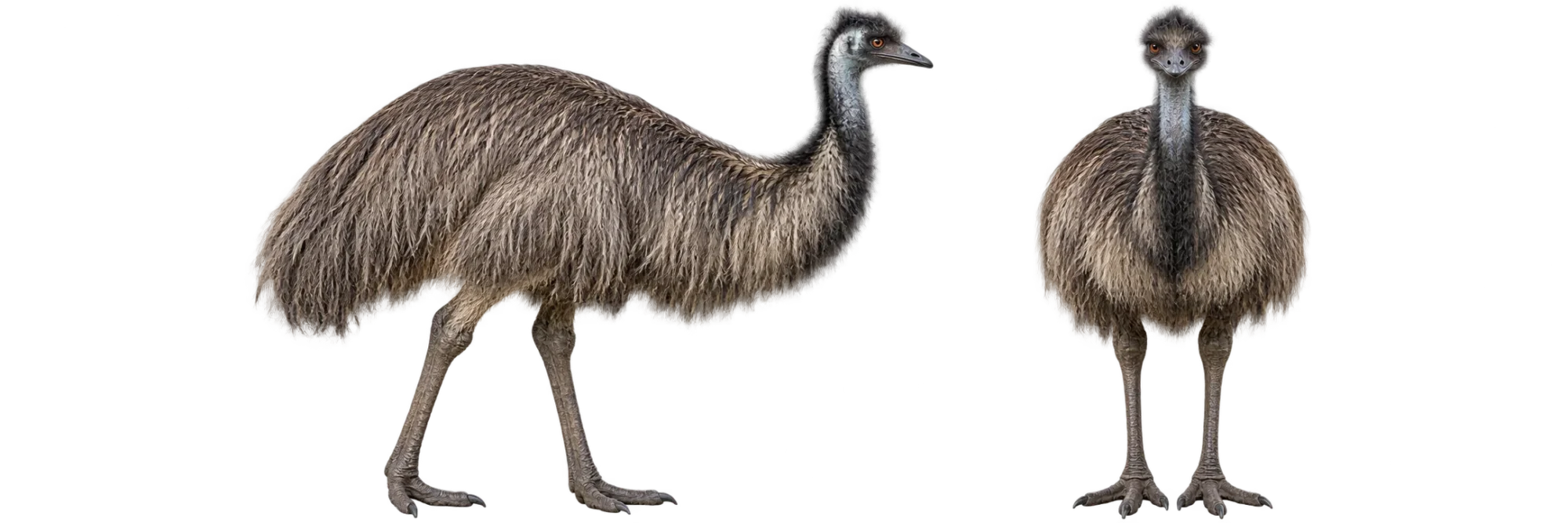
An emu breeding cycle changes hands at the nest. The female invests in a series of large eggs, while the male takes over incubation and later becomes the sole parent accompanying the chicks. That division of effort shapes much of the life history of Dromaius novaehollandiae.
Seasonal Breeding and Flexible Pairing
Emus breed around the cooler part of the Australian year. Nesting is concentrated in winter, with the Australian Museum listing the main breeding period as April to June. Pair formation and courtship can begin well before eggs appear, so the reproductive season extends beyond the weeks spent at the nest.
A female normally lays her eggs several days apart. Fresh eggs are dark bluish-green and unusually large, roughly 130 mm long and 90 mm wide. A nest commonly receives 5 to 15 eggs, although reproductive output varies among birds and conditions.
The mating system is more flexible than a permanent one-male, one-female pair bond. Field observations of free-ranging emus have recorded monogamous pairings alongside sequential polyandry and extra-pair mating. Females may seek another available male after their first partner begins incubating, allowing a female to contribute eggs to more than one nesting attempt during a season.
Females are active in forming and maintaining pairs before nesting. Once a male settles into incubation, his behaviour changes and he may defend the nest even from the female that laid the eggs.
Male Incubation and the 55-Day Fast
The male performs the entire incubation period. For about eight weeks, he remains closely tied to the nest and turns or retrieves eggs while keeping them covered. Hatching usually occurs after roughly 50–56 days of development, with about 55 days often reported for natural incubation.
This is also a prolonged natural fast. An incubating male normally stops eating and drinking and greatly reduces activity. Stored body reserves supply the energy needed to remain with the clutch rather than leaving regularly to forage.
A 2026 study of breeding male emus measured an average loss of about 5.8 kg during 55 days of incubation. That was roughly 15% of their body mass at the start of incubation. The birds entered a strongly energy-conserving metabolic state rather than responding as they would to ordinary food deprivation.
The fasting period ends rapidly once incubation finishes. In the same study, appetite returned within days and the males had regained most of the lost mass within about three weeks. This seasonal cycle means that body reserves accumulated before nesting have a direct reproductive role.
Hatching Leads Directly Into Paternal Care
Emu chicks hatch at a far more developed stage than nest-bound songbird chicks. They emerge covered in striped down, can walk soon after hatching and are able to feed themselves. They therefore do not depend on a parent to bring every meal to the nest.
The father’s role changes from incubator to escort and defender. Once the brood leaves the nest, he keeps the chicks together, leads them through feeding areas and reacts aggressively to threats. The young may stay closely associated with him for about four months and generally separate by around six months of age.
This form of parental care allows the male to protect mobile young without having to provision each chick directly. The striped juvenile plumage gradually disappears as the down is replaced by the duller brown feathers of older birds.
Growth to Reproductive Maturity
Young emus grow rapidly during their first year. By about 12 months they are close to adult body size, but physical size and reproductive maturity do not arrive at exactly the same time.
Anatomical studies generally treat birds older than about one year as skeletally mature, while sexual maturity follows later. Emus can produce viable eggs or breed at roughly 18–20 months, with individual timing affected by development and breeding conditions.
The result is a life cycle in which much of the visible growth happens during the first year, followed by a later transition into the seasonal reproductive cycle. Once mature, males must be capable of entering the long incubation fast, while females must accumulate enough resources to produce a series of exceptionally large eggs.