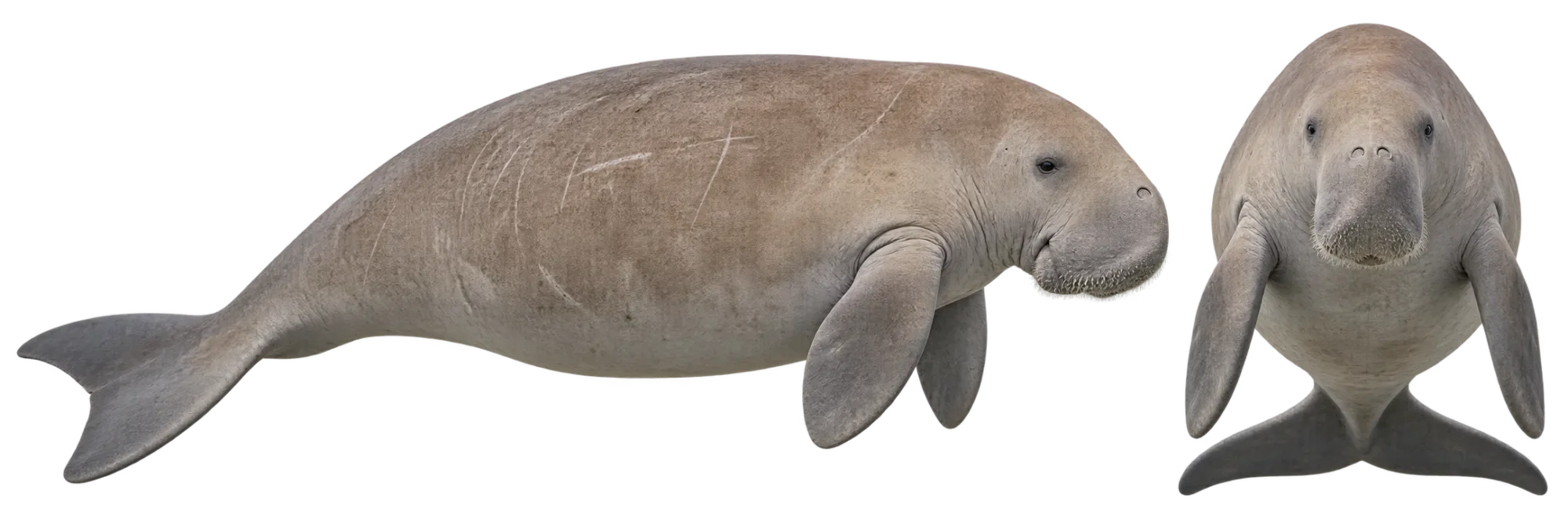
A dugong can spend many years growing before reproduction begins, then invest well over a year in a single calf. That slow schedule is not fixed to one age or interval. In Dugong dugon, reproductive timing can shift with body condition and the availability of seagrass, making life history closely tied to the quality of its food supply.
Reproductive Timing Can Shift by Many Years
Female dugongs do not all begin reproducing at the same age. First calving has been reported from roughly 6 years into the later teenage years. Males also show a broad range in the onset of reproductive maturity rather than reaching it at one predictable body size or age.
This variation is biologically meaningful. Dugongs depend heavily on seagrass, and reproduction requires enough energy for pregnancy, milk production and prolonged care of a calf. Research from Torres Strait found that female reproductive schedules changed between periods with different seagrass conditions. When food conditions were better, females in the studied population reproduced at younger ages and the interval between births was shorter.
Age at first reproduction can differ among populations and individuals. A value such as 10 years may describe part of the observed pattern, but it should not be treated as a universal maturity threshold for every dugong.
Birth spacing is similarly variable. A female commonly produces only one calf and may wait about 3 to 7 years before producing another. Under less favorable feeding conditions, reproductive activity can slow further.
One Calf Occupies a Long Reproductive Cycle
Pregnancy lasts about 14 months, after which a female normally gives birth to a single calf. The reproductive investment continues long after birth because nursing and close maternal association extend through much of the calf’s early development.
The long interval between births therefore reflects more than pregnancy alone. Gestation, nursing, calf association and the female’s condition before another reproductive attempt all occupy time within the cycle.
Reproductive Maturity Comes Before Growth Fully Levels Off
Sexual maturity and physical maturity describe different stages in a dugong’s development. An individual can become reproductively mature while its body is still growing.
A study that compared age estimates from tusk growth layers with body length and weight found that growth remained pronounced through the earlier years and then slowed sharply around 20 years of age. The researchers interpreted this plateau as an approximate point of physical maturity in their sample.
This distinction also explains why body length alone cannot always identify reproductive status. Dugongs of similar size can differ in age, growth history and physiological maturity, while nutrition can alter the rate at which an individual reaches reproductive condition.
Tusk Layers Reveal a Life That Can Extend Beyond 70 Years
Much of what is known about dugong age comes from growth layer groups deposited in the dentine of the tusks. Researchers can count these layers to estimate chronological age, allowing reproductive observations and body measurements to be connected with particular life stages.
The oldest recorded dugong has been aged at about 73 years. That figure is a longevity record, not the expected lifespan of every individual. Maximum recorded age should therefore remain separate from typical survival in a population.
More recent research has tested other age indicators, including changes in telomere length, because intact tusks are not available from every animal. Tusk growth layers remain an important reference for validating these approaches and for reconstructing how slowly dugongs move through growth, reproduction and later life.