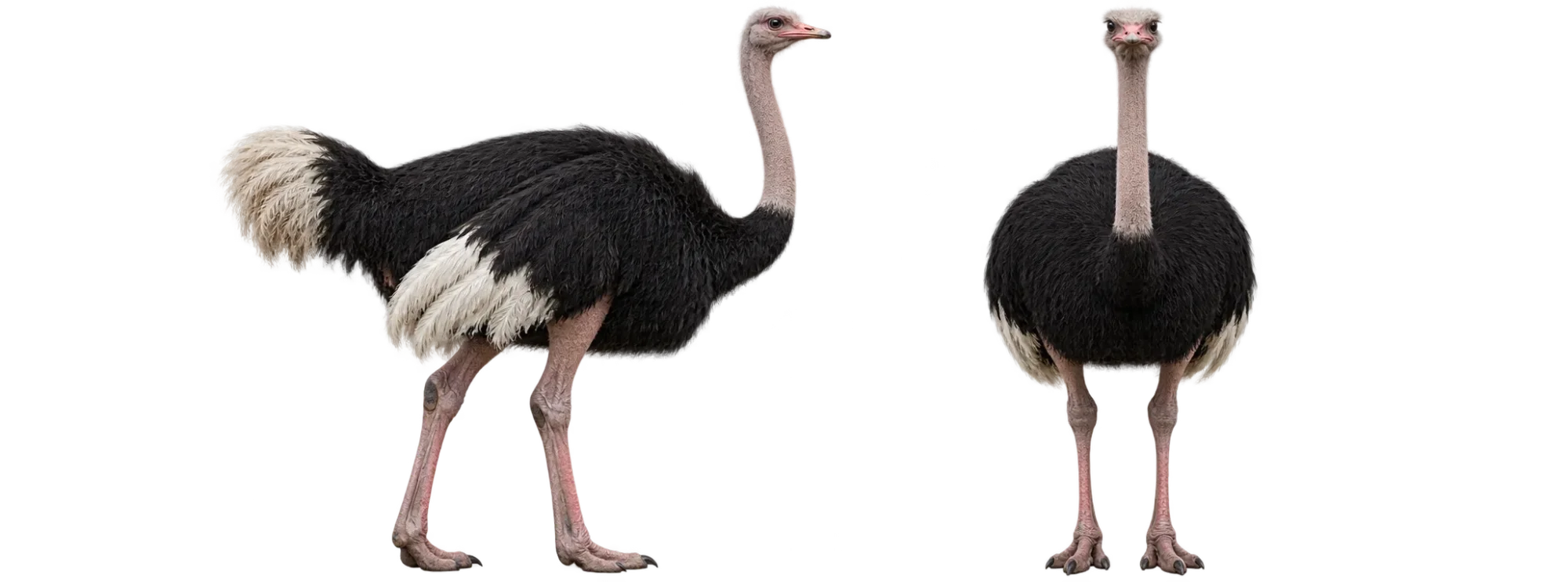
The common ostrich (Struthio camelus) grows from a mobile, well-developed hatchling into the largest living bird, but its life history is shaped as much by an unusual breeding system as by its size. Several females may place eggs in one nest, while most incubation and chick care falls to a resident male and one principal female. Rapid juvenile growth then contrasts with the longer wait before full reproductive maturity.
One Nest Can Contain Offspring From Several Parents
Wild ostriches do not always breed as isolated male-female pairs. Breeding groups can contain several adults, and multiple females may lay in the same shallow ground nest. The female most closely associated with the nest is often called the major female, while other females that add eggs are described as minor females.
This arrangement creates a clutch whose genetic structure is more complicated than its appearance suggests. Parentage work on communal nests in Nairobi National Park found both multiple maternity and multiple paternity. In that study, 68.9% of incubated eggs were not the joint offspring of both the resident territorial male and the major female. Major females themselves could also lay eggs in neighboring communal nests.
The result is a breeding system in which nest membership does not correspond neatly to one pair and its offspring. A single incubated clutch may represent the reproductive efforts of several adults, even though only a much smaller number of birds perform most of the incubation.
Group composition is also flexible. Ostriches may breed in pairs or in larger multi-male and multi-female groups, so the social setting around reproduction can change rather than following one fixed mating arrangement.
The Incubated Clutch Is Smaller Than the Number of Eggs Laid
A communal nest can receive more eggs than one adult can cover effectively. Field observations have recorded nests containing several dozen eggs, while the central group actually incubated is commonly around 20 eggs. Excess eggs may be moved to the edge or completely outside the incubated portion of the nest.
The major female is not selecting eggs at random. Field experiments showed that she can recognize her own eggs and preferentially retain them when reducing an oversized clutch. Her eggs therefore tend to receive protected positions within the central group, although eggs from other females remain there as well.
This creates an important distinction between eggs laid into the communal nest and eggs that form the effective incubated clutch. Counting every egg present around a nest can give a misleading picture of how many embryos are actually being incubated.
The system also explains why clutch-size figures for ostriches can vary widely between observations. Some values describe the contribution of one female, others describe all eggs deposited by several females, and still others refer only to the central eggs retained for incubation. They measure different parts of the same nesting process.
Incubation Is Shared Across the Day-Night Cycle
Once regular incubation begins, the major female and the resident male take the main shifts. Natural incubation lasts about 42 days, with some variation among observations and conditions.
The familiar division of labor is strongly associated with time of day. The brownish-gray female commonly incubates during daylight, while the darker male takes much of the night shift. This keeps the eggs covered through most of the incubation cycle while allowing each adult periods away from the nest.
Incubation is a substantial part of parental investment for both sexes. The adults must maintain contact with the exposed ground nest while also coping with heat, feeding needs and the risk of predators. Experimental work on cooperative breeding has shown that the costs and benefits of breeding in a group can differ between males and females as group size changes.
Hatching therefore represents the end of a prolonged cooperative phase rather than the end of parental care. The chicks that emerge are already built for a mobile life, but they remain dependent on accompanying adults for protection.
Hatchlings Become Mobile Before They Become Independent
Ostrich chicks are precocial. They hatch with open eyes and a developed covering of down, and they can leave the nest and follow adults within roughly two or three days. There is no long nest-bound stage comparable with that of many smaller birds.
Leaving the nest so early does not mean parental care has ended. Adults escort the chicks, shelter them and respond to threats. Broods can also merge after leaving their original nests. Field observations have described progressively combined groups of chicks attended by adults, producing large crèches rather than permanently separate family units.
Growth after hatching is fast. Measurements of captive populations show the characteristic curved growth pattern expected as young birds move rapidly toward adult mass rather than gaining weight at a constant rate. Zoo observations likewise show that juveniles can approach adult stature within their first several months.
Body growth and reproductive development should not be treated as the same milestone. A juvenile that looks nearly adult-sized is not necessarily sexually mature. Adult plumage also develops progressively; males do not acquire the full black-and-white breeding appearance immediately after reaching a large body size.
Fast Growth Is Followed by a Longer Reproductive Transition
Common ostriches generally reach sexual maturity after the rapid growth phase, with many zoological records placing maturity at about three to four years. Females may mature somewhat earlier than males. Reported ages can differ between wild birds and managed populations, where nutrition and husbandry can alter developmental timing.
Breeding is also seasonal rather than simply beginning whenever an individual reaches a particular age. The environmental cues involved vary across the species’ broad African range. At some lower-latitude sites reproductive activity can respond opportunistically to conditions such as rainfall and food availability, while populations farther from the equator can show stronger responses to changing day length.
This produces a life-history sequence in which physical size, sexual maturity and actual breeding opportunity do not arrive at one shared point. An ostrich can pass through most of its visible body growth before entering the reproductive stage, and a sexually mature adult may still wait for the environmental and social conditions associated with a breeding season.