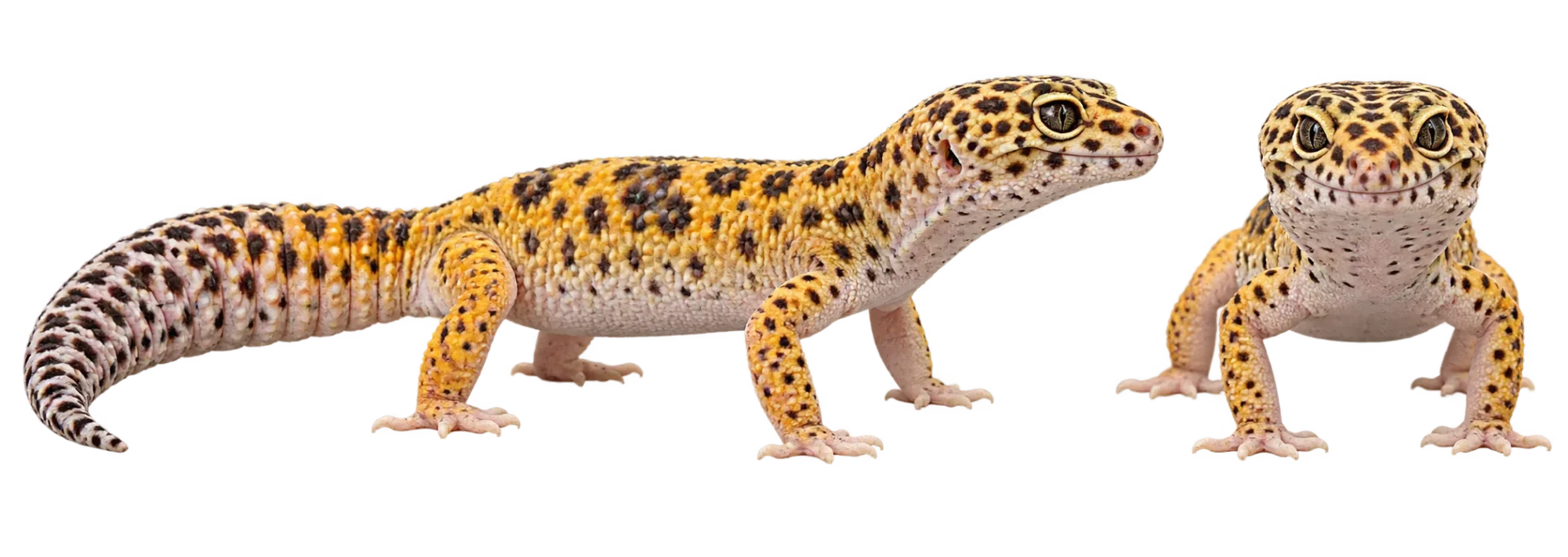
In leopard geckos, conditions experienced before hatching can leave effects that remain visible months later. Eublepharis macularius combines temperature-sensitive embryonic development with a relatively rapid juvenile growth phase and a reproductive pattern based on repeated, usually two-egg clutches. Much of what is known in detail comes from animals bred under controlled conditions, which makes the context of each measurement important.
Incubation Temperature and Development
Leopard geckos have temperature-dependent sex determination. Their response is especially interesting because sex does not shift in a simple straight line from female to male as temperature rises. Controlled incubation experiments have produced mostly females at cooler temperatures, more males at an intermediate warm range, and mostly females again at still higher temperatures.
Classic laboratory work illustrates this pattern. Constant incubation at about 26°C produced females, while 32.5°C produced a male-biased group. At 34°C, females again predominated. These values describe experimental conditions rather than fixed boundaries that should be applied to every egg in nature. Natural nests experience changing temperatures, and other biological influences can add variation.
Incubation temperature is associated with more than the gonads that develop. Experimental studies have linked it with later differences in growth, endocrine physiology and adult social behavior. Researchers have detected these effects even after the animals reached maturity, showing that part of the adult phenotype begins to take shape during embryonic development.
Juvenile development adds another layer. In males studied at 2, 10 and 25 weeks of age, androgen levels rose with age, while secondary sexual structures became progressively more developed. Females also showed age-related hormonal changes, with some variation associated with their incubation temperature. The transition from hatchling to reproductive adult is therefore a continuing developmental process rather than a change that ends when the egg opens.
Juvenile Growth Slows Near the End of the First Year
A recent bone-growth study followed captive leopard geckos from embryonic stages into adulthood and recorded a steep rise in body mass during early life. In that controlled series, average hatchling mass was about 4.4 grams. By 300 days, the animals averaged 38.2 grams, and by 400 days they averaged 52.4 grams.
After roughly 400 days, weight gain slowed and the study animals settled into adult masses of about 60–75 grams. These figures are not a universal growth chart. They came from captive animals kept under controlled conditions, and growth in wild geckos can be shaped by seasonal food supply, temperature, reproductive effort and individual condition.
The skeletal evidence is useful because body mass alone cannot show whether tissue growth has completely stopped. Fluorescent markers placed in developing bone showed that some new bone continued to be deposited later in life, although at much lower rates. In one older individual, several limb bones showed little or no measurable growth across a long interval.
This pattern supports a life history with a concentrated juvenile growth period followed by a much longer adult phase. Reaching near-adult body mass and reaching reproductive maturity are related processes, but they are not identical measurements and should not be treated as interchangeable ages.
Two-Egg Clutches Spread Reproduction Across a Season
Female leopard geckos usually invest in small clutches rather than producing many eggs at once. Two eggs are typical, with single-egg clutches occurring less often. A female can then produce additional clutches during the same breeding season.
This repeated-clutch pattern changes how reproductive output should be interpreted. A clutch size of two does not mean that a female produces only two offspring in a season. Total output depends on how many clutches she produces, whether the eggs are fertile, egg survival and the female’s condition across the reproductive period.
Experimental work following females through their first breeding seasons found a tradeoff between egg size and the number of clutches produced. Females allocating more resources to individual eggs did not necessarily maintain the same clutch frequency. Reproductive effort was also more closely tied to female condition during the first breeding season than during the second.
The female reproductive cycle itself changes through recognizable physiological stages. Hormone concentrations rise and fall as follicles develop, ovulation approaches and ovulation passes. Behavioral receptivity follows the same broad cycle, reaching its highest level around late follicular development in laboratory studies and falling again after ovulation.
For leopard geckos, reproductive output is therefore better understood as a sequence of small investments distributed across part of the year rather than as one large annual clutch.
Captive Research Defines Much of the Detailed Record
Leopard geckos have been bred for many generations and are unusually well represented in experimental developmental research. Their eggs are large enough for detailed embryological work, females can lay several clutches during a breeding period, and hatchlings can be followed through development under known conditions. This has produced unusually detailed information about incubation, growth, hormones and reproduction.
That research strength also creates an important boundary. Exact growth rates, incubation responses and reproductive schedules measured in laboratory colonies should not automatically be presented as typical values for every wild population.
A range-wide genetic study published in 2022 examined wild and captive members of Eublepharis. The sampled pet-trade E. macularius belonged to closely related lineages connected with wild populations from central and southern Pakistan. The study also found deeper diversity elsewhere in the genus, reinforcing the need to keep experimentally studied captive leopard geckos tied to their actual taxonomic and geographic context.
The distinction matters most when precise numbers are involved. Controlled studies can describe what happened to known animals under known temperatures and feeding conditions with unusual accuracy. Field life-history data answer a different question: how the species grows, survives and reproduces while exposed to natural seasonal variation. For leopard geckos, the experimental record is much richer than the equivalent long-term record from wild individuals.