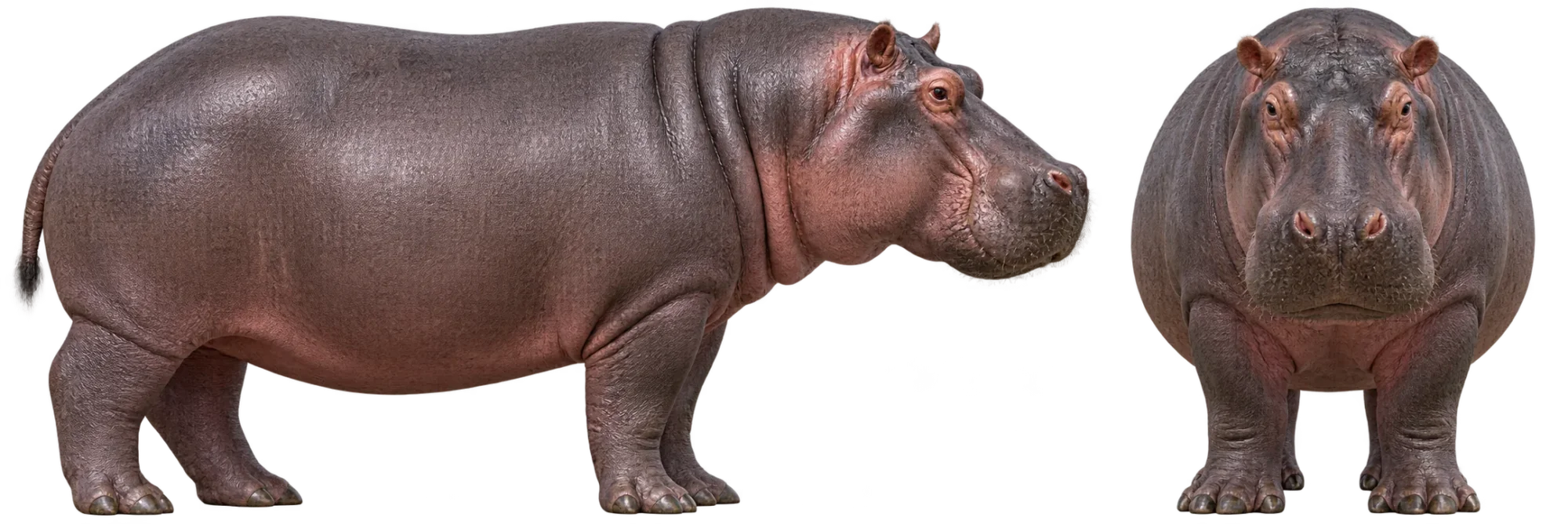
The common hippopotamus, Hippopotamus amphibius, has a reproductive schedule closely tied to its semi-aquatic life. Pregnancy lasts about eight months and usually produces one calf, but the more revealing parts of its life history are the timing of births, the long period of maternal care, and the large difference between physiological puberty and successful breeding in the wild.
Rainfall Helps Shape the Reproductive Calendar
Hippopotamus reproduction does not follow one rigid breeding season across the species’ range. Historical field studies found births during much of the year, often with a stronger birth peak after rainfall. Captive females have also been shown to cycle throughout the year. Together, these observations point to a flexible reproductive system in which local environmental conditions can shift the timing of conception and birth.
Pregnancy is relatively short for such a large-bodied mammal. Directly monitored pregnancies and veterinary references place gestation at roughly 227 to 240 days. Birth normally produces a single calf.
The spacing between calves also reflects what happens after birth. Hormone monitoring of captive females found that nursing commonly suppressed ovulation for about 34 weeks. Among females showing this pattern, the observed interval between births was about 17 months. Other zoological records describe intervals closer to one and a half to two years, so a single interval should not be treated as a fixed species-wide value.
Early Calf Development Moves Between Water and Land
A female approaching birth commonly separates from the larger group. Birth can occur in shallow water or on land, although water is central to the calf’s first days. When a calf is born underwater, the mother helps it reach the surface for its first breaths.
This developmental sequence links maternal care to the same daily water-land cycle followed by adults. Water provides the setting for resting, nursing, and protection, while increasing mobility eventually allows the calf to accompany its mother during feeding trips on land.
Puberty and Breeding Age Can Be Years Apart
Age at maturity is one of the harder hippopotamus traits to express as a single number. Endocrine monitoring of captive females detected the onset of puberty at about three to four years. Older field studies of wild animals produced much later estimates.
A large study of hippopotamuses from Zambia’s Luangwa River found signs of female puberty beginning in some animals at about seven years and reproductive maturity from about eight years. Across that sampled population, however, half of the females were estimated to have reached puberty by about 11 years and reproductive maturity by about 13 years. Some females had still not bred at much older ages. Male puberty in the same work began at about six years, with maturity estimated near eight years.
Captive hormone studies can detect reproductive cycling directly, while older wild studies often estimated age and maturity from anatomy after death. Researchers have questioned some of the historical aging methods. Food supply, body condition, social setting, and opportunities to mate may also separate the earliest possible puberty from the age at which wild animals actually reproduce.
Social position adds another layer for males. Physiological development alone does not provide immediate access to females. Research on wild bulls found young males tolerated within groups until roughly seven or eight years of age, while established breeding bulls were much older. A young male can therefore be reproductively developed before gaining the social position associated with regular mating.