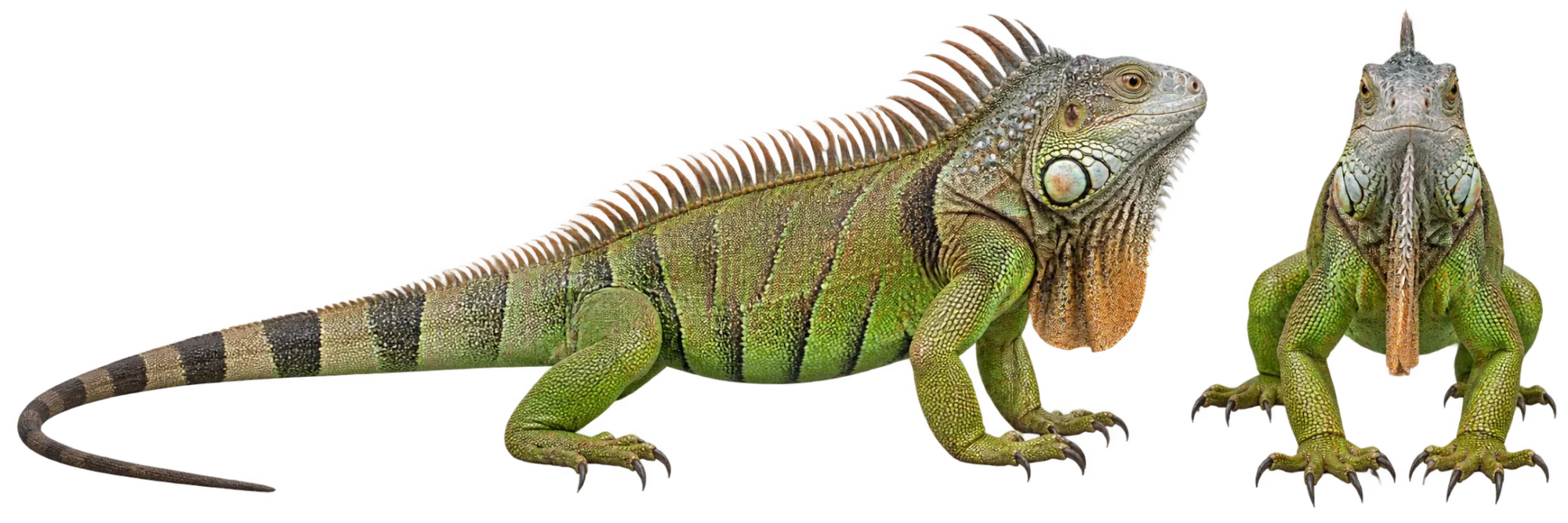
The common green iguana (Iguana iguana) links much of its reproductive cycle to seasonal rainfall. Across many native populations, mating and nesting occur during the drier part of the year, while hatching is timed around the return of rain and fresh plant growth. Females make a large investment in a single nesting season, males and females pass through sexual maturity differently, and hatchlings may begin life in surprisingly organized social groups.
Reproduction Tracks Local Wet and Dry Seasons
Green iguanas do not follow one breeding calendar across their entire range. The timing shifts with local climate. In many studied populations, males establish reproductive territories near the beginning of the dry season, females lay eggs later in that season, and young emerge as wetter conditions return.
This sequence places hatchlings into the environment when tender new leaves are becoming more available. Young foliage is easier for small iguanas to process than older, tougher leaves, so the timing of emergence can affect the food conditions encountered during the first weeks of independent life.
Breeding Months Are Population-Specific
Calendar dates should not be treated as a fixed species-wide schedule. Green iguanas occupy regions with different rainfall cycles, and populations north and south of the equator can breed at different times of year. On Curaçao, for example, hatchling emergence has been recorded before the main rainy period, where early rains can already trigger the production of young leaves.
The useful life-history pattern is therefore the relationship between reproduction and seasonal plant growth, rather than a particular month.
Nest Sites Can Require Long Movements by Females
Egg production is only part of the reproductive cost for a female green iguana. Suitable nesting soil may be separated from the trees and feeding areas used during the rest of the year. Field tracking in the Venezuelan Llanos recorded females travelling roughly 0.8 to 1.5 kilometers to nesting grounds before returning to their usual areas.
Where loose, workable soil is scarce, many females may converge on the same small nesting areas. Where suitable ground is widespread, nests can be much more dispersed. This helps explain why communal nesting can be conspicuous in one population but less obvious in another.
Female size also affects reproductive output. Studies have found larger females producing heavier clutches and more eggs. In a Curaçao population, clutch mass was about 32% of female body mass, showing how much material can be committed to one reproductive event.
The underground nest continues to influence development after the female leaves. Soil temperature and moisture affect incubation conditions and can alter characteristics of the hatchlings. Females therefore influence offspring development through nest placement and construction even though they do not remain to feed or raise the young after hatching.
Long-term observations at a communal nesting site in Panama also found that returning reproductive females added little body length from year to year. The pattern is consistent with a shift in energy allocation: much of a female’s growth occurs before reproduction, while later resources are directed more heavily toward egg production.
Sexual Maturity Is Not a Single Age Threshold
Reported maturity ages for common green iguanas vary because several biological milestones can be described as “maturity.” Producing functional sperm or eggs is not necessarily the same as reaching adult size or successfully breeding in a social population.
Males Can Become Physiologically Mature While Still Small
A captive study of developing males found adult-like sperm production in some individuals at about 15 to 17 months of age, when they were only around 40% of adult body size. Their reproductive system had matured well before their bodies had finished growing.
That did not make all young males equivalent to established adults. Social position mattered. Subordinate males showed differences in reproductive physiology compared with dominant males, while larger males were more likely to display the behaviors associated with breeding. A male may therefore possess functional sperm before having the size, territory or social position that gives him regular mating opportunities.
Females Reach the Reproductive Stage Later
Females in the same developmental research matured one to two years later than males and at a much larger relative body size. Producing a large mass of eggs places a different physical demand on females, making body growth before the first reproductive attempt especially relevant.
Field observations reinforce the idea that there is no precise universal age for the first clutch. Females nesting for the first time in a well-studied Panamanian population varied widely in body size, and age estimates ranged from roughly two to eight years. Growth history, local conditions and the definition used for reproductive maturity can therefore produce very different-looking age values without those values necessarily contradicting one another.
Hatchlings Often Begin Life in Social Groups
Young green iguanas receive no continuing parental care after they leave the nest, yet they do not always disperse alone. Research at communal nesting grounds in Panama documented hatchlings emerging in groups, joining young from other clutches and travelling away from nesting areas together.
The associations can continue beyond the first movement from the nest. On Barro Colorado Island, hatchlings sleeping in larger groups were associated with faster growth during early life. The observation does not by itself show that grouping caused the faster growth, but it demonstrates that juvenile development occurs in a social setting rather than as a purely solitary process.
Controlled research has also shown how access to resources can produce growth differences very early. When juvenile males were kept where preferred basking and perch sites were limited, dominance relationships appeared within the first few months. Dominant males used valuable heat sources more often and grew faster than subordinate animals. Those differences were not reproduced in groups where the resources were not restricted.
Because green iguanas depend on environmental heat to support digestion and activity, access to a good basking position can affect more than behavior. It can change how effectively an individual uses food and grows. Early body size is therefore shaped not only by age, but also by temperature opportunities, resource access and social conditions.
This flexible growth pattern continues into later development. Juvenile growth rates measured in wild populations vary markedly among individuals and locations, so a small young iguana cannot be assigned a reliable age from size alone.