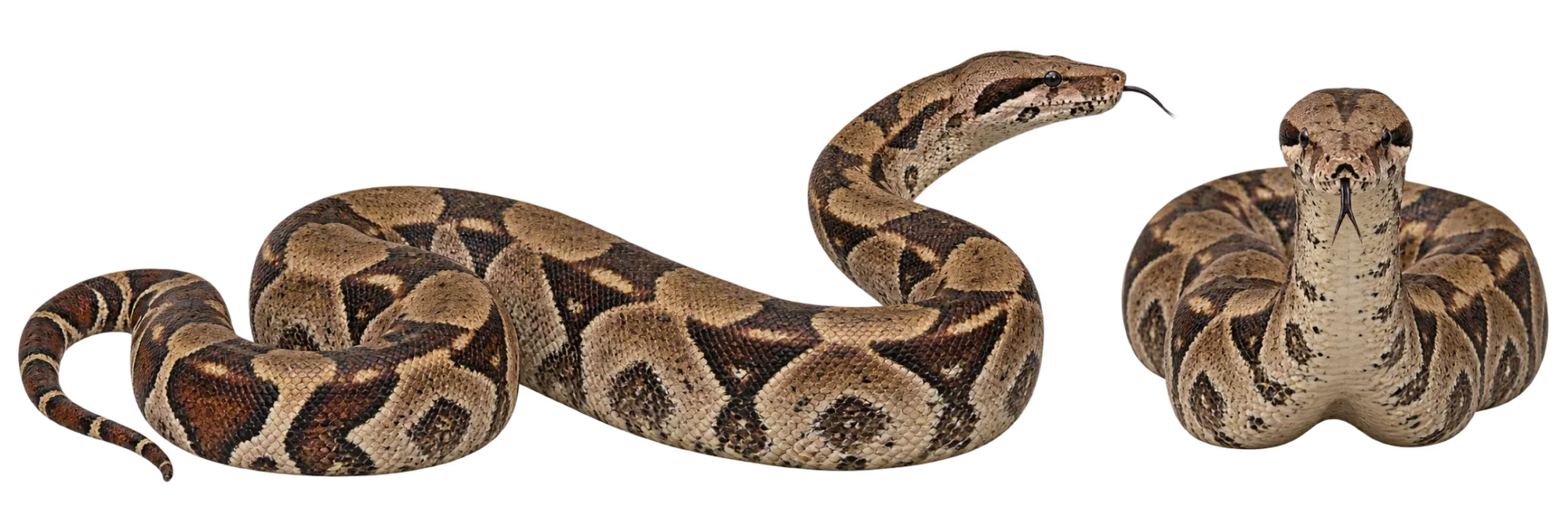
Life-history figures for Boa constrictor are easier to interpret when the animal’s modern taxonomic limits and the way reproductive events are measured are kept separate. Older references often used the name for a broader group of boas than many current taxonomic treatments do, while newer reproductive studies can measure the same pregnancy from different biological starting points.
Why Older Boa Constrictor Data Can Cover More Than One Species
The scientific name Boa constrictor has not always covered the same set of populations. Modern treatments recognize several boas once commonly placed within a broad B. constrictor complex as separate species, including Boa imperator, Boa sigma, Boa nebulosa, and Boa orophias. Under this narrower treatment, B. constrictor is centered in South America.
This matters for life-history data. Older accounts may combine records from Central American and South American animals under the same species name. A gestation period, body size, litter average, or maturity estimate reported simply for “boa constrictor” can therefore describe a population that would receive a different species name today.
Population Context Matters
Values tied to a named population or subspecies are usually more informative than a single species-wide average. Regional boas differ in adult size, climate, reproductive timing, and other traits that can affect the numbers recorded in field and captive studies.
Female Condition Shapes Reproductive Output
Field research on the Argentine boa Boa constrictor occidentalis shows that reproduction is closely linked to female size and stored energy. Adult females in the studied population were larger and heavier than adult males, and females that entered a reproductive cycle were in better body condition than females that did not reproduce.
About half of the adult females examined during one long-term study were reproductive. The result supports a breeding pattern in which a female may skip a season rather than reproduce every year. Producing a litter requires energy accumulated before pregnancy, so age alone does not determine whether an adult female breeds in a given season.
Litter Size Rises With Maternal Size
The same Argentine research found average litters of about 24 to 25 young and a clear relationship between maternal body length and litter size. Larger females could carry more developing young. This makes a single species-wide litter number less useful than it first appears: litter output can vary with the female and with the population being studied.
Broader institutional records report litters ranging from roughly 10 to more than 60 young. Those wider figures describe the range of known outcomes rather than the litter that every female should be expected to produce.
Mating Can Involve Several Males
Boa constrictors are mostly solitary outside the reproductive season, but mating can bring several animals together. Field observations from both Argentina and Brazil have documented females associated with multiple males. A 2025 observation in Brazil’s Caatinga recorded one female with five males, adding direct field evidence that a female may mate with more than one partner during a reproductive period.
Gestation Length Depends on Where the Count Begins
Pregnancy figures for Boa constrictor can look inconsistent because researchers and breeders do not always start the clock at the same event. Ultrasound monitoring of captive females provides a useful example.
From Ovulation
124.5 ± 7 days
Measured from the observed ovulatory event to birth.
From Post-Ovulatory Shed
101.1 ± 4 days
Measured from the shed that followed ovulation to birth.
In that study, the post-ovulatory shed occurred about three weeks after ovulation. Both figures therefore describe the same reproductive process from different starting points. This distinction helps explain why published gestation estimates can differ even when the observations themselves are compatible.
Broader zoological accounts often give a longer range of about five to eight months. Such ranges can include different populations, environmental conditions, and less precisely defined starting dates, so they should not be treated as directly equivalent to an ultrasound-timed pregnancy.
Live Birth Includes Maternal Transfer
Boa constrictor is viviparous and gives birth to fully formed young rather than laying shelled eggs. Embryos receive much of their stored energy from yolk, but experimental work has also detected the transfer of diet-derived amino acids from pregnant females to their offspring. The maternal environment during gestation is therefore biologically active rather than simply serving as a place where yolk-filled eggs are retained until birth.
The young receive no extended post-birth care. They are capable of independent movement soon after delivery, shifting the major maternal investment to the period before and during gestation.
A Forty-Year Record Represents Maximum Longevity
Boa constrictor can live for decades, but the longest recorded lifespan should not be read as the normal lifespan of a wild individual. The AnAge longevity database records a maximum of 40.4 years in captivity, including a wild-caught individual that survived for more than four decades under human care.
Institutional estimates for wild boas are lower, commonly around 20 to 30 years. Captive animals may avoid many causes of death faced in nature and can receive regular food and veterinary care, making exceptional captive longevity a poor substitute for expected wild lifespan.
Sexual maturity is commonly reported at roughly two to three years, well before the upper limits of recorded longevity. Maturity marks the beginning of reproductive capability, not the end of growth or a guarantee of annual breeding, especially in females whose reproductive activity can depend strongly on body condition.