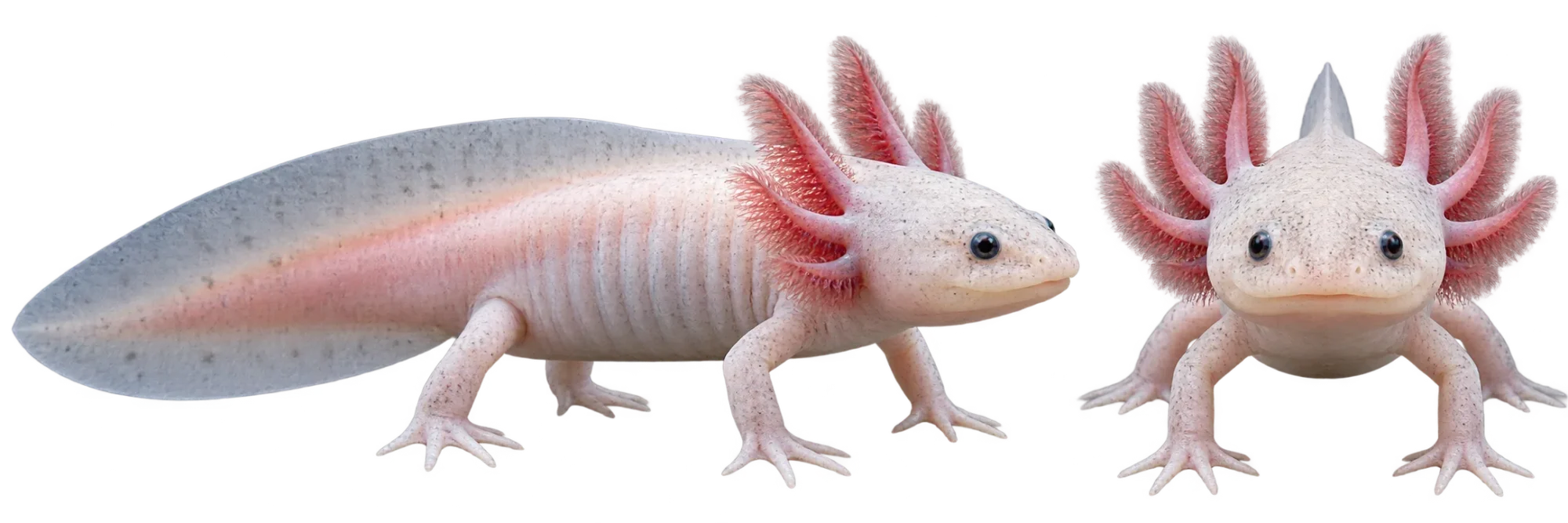
Axolotls reach reproductive adulthood without completing the metamorphosis that usually separates larval and adult life in salamanders. An adult Ambystoma mexicanum therefore keeps external gills, a finned tail and an aquatic body form while its reproductive system becomes fully mature.
Paedomorphosis Shapes the Axolotl Life Cycle
The axolotl’s retained larval form is known as paedomorphosis. Instead of passing through the usual salamander transition to a mostly terrestrial adult, it continues growing and becomes capable of reproduction while remaining aquatic.
This pattern is tied to the hormonal control of metamorphosis. Thyroid hormone normally drives much of the remodeling that occurs when salamander larvae transform. In axolotls, activity in the hormonal pathway that initiates this process is low, so spontaneous metamorphosis is uncommon under normal conditions.
The tissues are still capable of responding to thyroid hormone. Experimental exposure can induce metamorphic changes, including loss of external gills and remodeling of the skin and body. This distinction matters: the axolotl is not biologically stuck at an early larval stage. Growth, gonadal development and reproductive maturation continue even though the usual metamorphic transformation does not.
Sexual Maturity Develops on Different Timetables
Sexual maturation is a gradual process rather than a single age threshold. Recent histological work following captive axolotls from four to twelve months old found clear differences between male and female gonadal development.
These observations help explain why a single maturity figure can hide real biological variation. Age at first successful breeding can also depend on growth, body condition and captive conditions. Around one year is a useful reference point for many managed axolotls, but males may become reproductively capable before females of the same age.
The unusual part is not simply the timing. Gonadal maturation proceeds while external larval traits remain in place, allowing an animal with the appearance and aquatic physiology of a salamander larva to function reproductively as an adult.
Reproduction Leads Directly Into an Aquatic Larval Stage
Mating does not involve external release of sperm over the eggs. A male deposits spermatophores on a surface during courtship, and the female takes a spermatophore into her cloaca. Sperm can then be held within the female reproductive tract before the eggs are laid.
Females attach eggs individually to available surfaces rather than depositing the compact egg masses familiar from many frogs. A spawning event can involve hundreds of eggs, so laying may continue for many hours.
Embryonic development is strongly affected by temperature. A recent developmental study maintained embryos at 16°C and recorded hatching after roughly 312–388 hours, close to two weeks. Other observations place axolotl incubation within a broader range of roughly 9–19 days under different conditions.
That final point makes the axolotl life cycle unusual among salamanders. Hatching begins a long period of aquatic growth, but the larval body plan is retained as reproductive maturity develops.
Reproductive Capacity Can Continue for Many Years
Long-term captive breeding records published in 2026 provide a clearer view of how reproduction changes with age. In those colonies, mating success, egg number and egg quality were highest after maturation, with reproductive performance peaking at about two years of age.
Several measures declined gradually during the next few years, but the pattern did not resemble an abrupt loss of fertility. Changes tended to level off around three to four years of age, and older animals could still reproduce.
Female axolotls also retained early-stage oocytes at advanced ages. In managed breeding trials, some females between six and nearly eleven years old still produced hundreds of eggs. Male reproductive performance also persisted into later life, although the chance of matings without spermatophore deposition rose with age.
These results revise the older assumption that axolotl fertility simply fades after the first few breeding years. They also need the correct context: the strongest age-specific evidence comes from long-running captive colonies. Comparable lifespan-wide reproductive records from wild axolotls are not available, and conditions in managed populations differ greatly from those in Xochimilco.