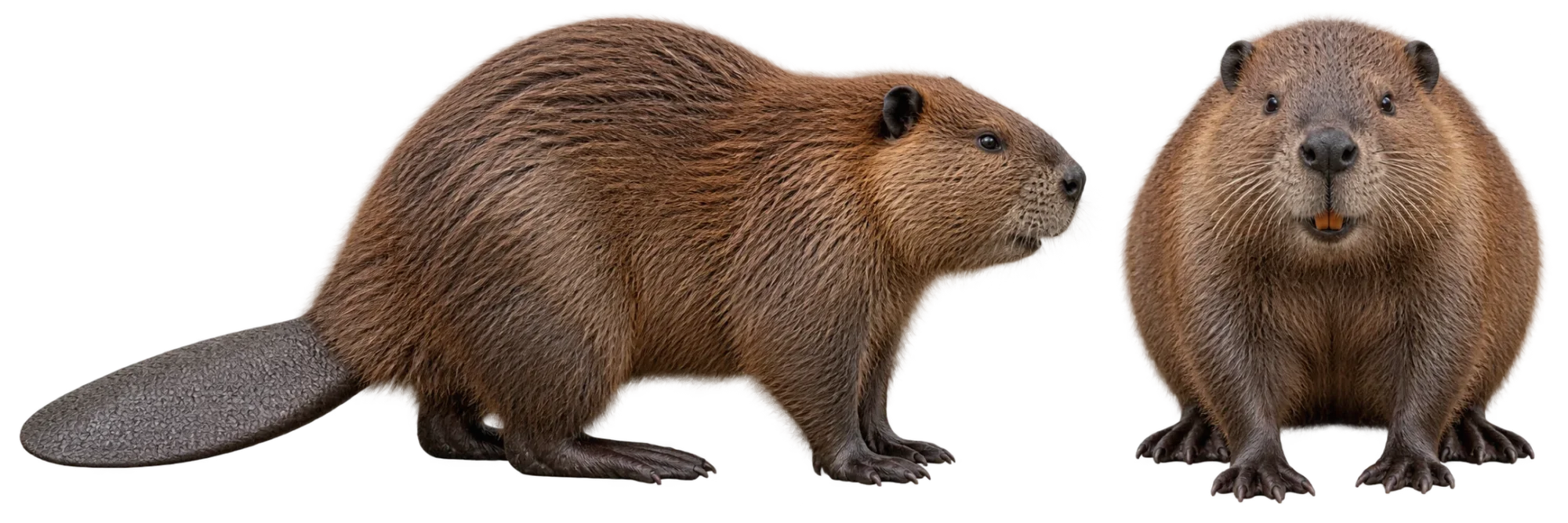
American beaver (Castor canadensis) life history is closely tied to an extended family unit. A breeding pair may share the same territory with newborn kits, yearlings, and sometimes older offspring that have not yet dispersed. Young beavers develop physically quite early, but independence comes much later, creating an unusual gap between being able to swim and feed and being ready to establish a separate territory.
The Colony Holds More Than One Age Group
A beaver colony is usually a family rather than a gathering of unrelated adults. The resident breeding pair normally lives with the current year’s kits and offspring born the previous year. Older subadults may also remain when suitable unoccupied habitat is limited.
This overlapping age structure matters because American beavers generally produce one litter per year. The presence of several young animals in a colony therefore does not mean that they were all born at the same time. A colony observed in summer or autumn can contain siblings separated by a full breeding season.
Yearlings are already much more capable than newborn kits. They take part in activities around the established territory while the newest litter develops. Food gathering, lodge maintenance and other family activity therefore occur in a group containing animals at very different stages of independence.
Colony Size and Litter Size Describe Different Things
A litter counts offspring from one birth. A colony can include the breeding adults plus young from two or more age classes, so colony size should not be interpreted as the number of kits produced in a single year.
Kits Are Mobile Early but Remain Dependent
American beaver kits are born in a relatively advanced physical state. Their eyes are open and they are already covered with fur. They can enter the water very early in life, although effective swimming and diving develop with experience.
Observations of free-living beavers show that the first several weeks are still a distinct developmental period. Young kits spend much of this early phase in or near the lodge while locomotion, feeding, grooming and social behavior develop rapidly.
Milk is important during early growth, while plant material becomes part of the diet as development proceeds. Published descriptions give somewhat different ages for complete weaning, so a single precise weaning day can imply more certainty than the observations support.
Early mobility also does not mark independence. Kits continue living inside the family territory long after they can swim and eat solid food. This extended association separates American beavers from rodents whose young leave the parental area soon after early development.
Winter Breeding Produces a Spring Litter
Breeding is concentrated in winter, most often from January into late winter. Gestation lasts roughly four months, placing most births in spring or early summer. Timing varies across the species’ broad North American range and with local seasonal conditions.
Only the established female normally produces the colony’s annual litter. Reports from different populations commonly place litter size in the low single digits, while larger litters occur less often. This variation is biologically meaningful rather than simple disagreement between records.
Main Mating Period
Gestation Scale
Typical Birth Season
Female age, body condition, food conditions and local environment can influence reproductive output. Studies of American beavers have found that litter or embryo counts can vary between populations and between females. For that reason, one reported litter size should not be treated as a fixed reproductive value for every colony.
Young Beavers Spend About Two Years Before Dispersing
The long family residence is one of the defining parts of American beaver development. Young commonly remain in their natal colony through their first year and well into their second. Reproductive maturity is generally reached around two to three years of age, close to the period when many subadults begin leaving the family territory.
Kit
Rapid physical and behavioral development occurs while the young animal remains closely associated with the lodge and family.
Yearling
The previous year’s offspring remains inside the established colony while a new litter may be raised.
Subadult
Independence increasingly involves leaving the natal territory and finding space suitable for settlement.
Dispersal often occurs during spring. A four-year study of American beavers in a high-density Massachusetts population found that most recorded dispersal movements occurred from April through June. The subadults in that study traveled an average of about 4.5 km along streams and rivers, but that distance describes the studied population rather than a universal dispersal distance for the species.
Some young remain with their parents beyond the usual period, especially where nearby territories are already occupied. Others move into smaller or less favorable waterways when competition for established sites is high. Independence is therefore shaped not only by age but also by the availability of a place where a young beaver can settle.
Delayed Departure Connects Reproduction With Territory Availability
American beavers combine annual reproduction with prolonged family residence. A new litter can arrive while older offspring are still present, producing a repeating cycle in which birth, juvenile development and subadult dispersal overlap within the same territory.
This helps explain why sexual maturity and physical capability should not be treated as identical milestones. A young beaver may already swim well, forage and participate in colony activity long before it has an independent territory. Even reaching reproductive age does not guarantee immediate settlement if nearby habitat is occupied.
Population density can therefore change the timing and outcome of the final developmental transition. Where open habitat is available, dispersing animals may establish new territories. Where beavers are already densely distributed, subadults may remain longer with their family or settle in habitat that differs from the natal site.