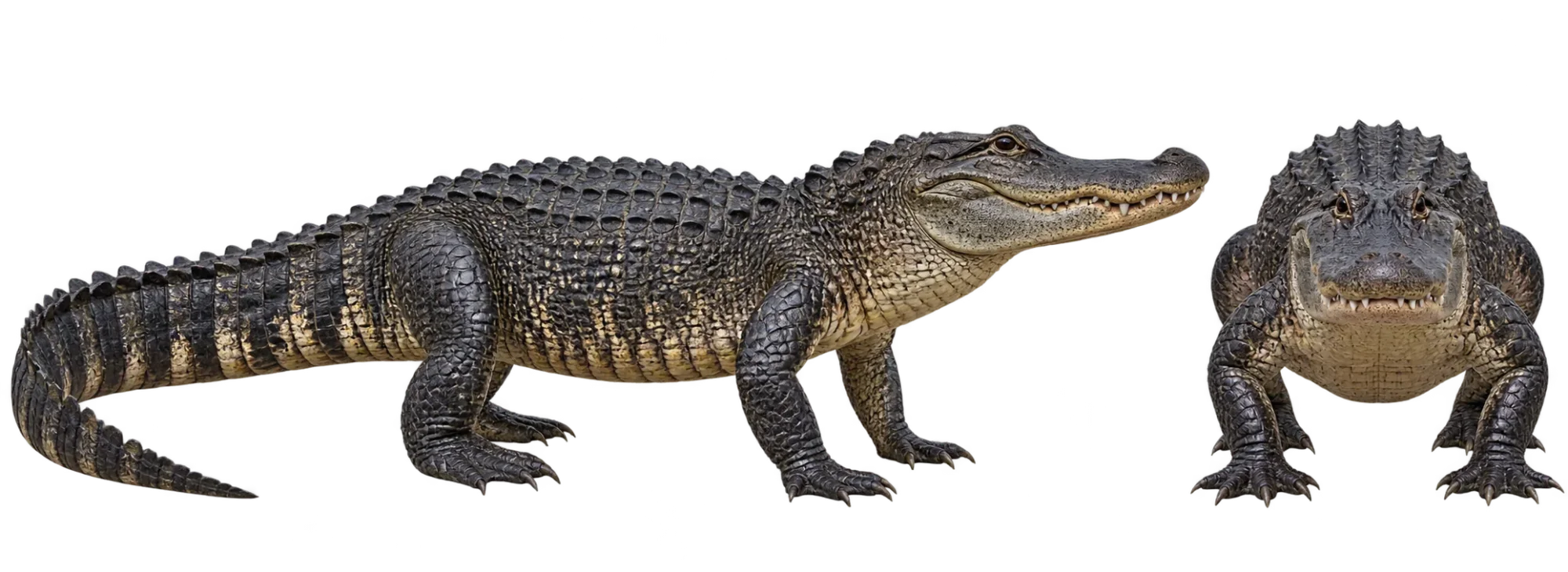
For the American alligator, Alligator mississippiensis, the path from egg to breeding adult depends heavily on temperature and growth. Nest conditions influence the sex of developing embryos, while the age at which an alligator can reproduce varies because maturity is tied more closely to body size than to a fixed birthday.
Growth Sets the Timing of Maturity
American alligators grow fastest during the early part of life, but the pace is not uniform across individuals or populations. Temperature, food availability and local environmental conditions can change how quickly a young alligator adds length and mass. Experimental work with juveniles has also shown faster growth under warmer or cycling temperature conditions than under consistently cool conditions.
This variation matters because reproductive maturity is commonly associated with reaching roughly 1.8 meters (6 feet) in length rather than reaching one exact age. In Florida, alligators may take about 9 to 14 years to reach the size associated with sexual maturity. Other populations can follow somewhat different schedules when growth conditions differ.
Size is therefore only an approximate indicator of age. Two alligators of similar length may not be the same age, especially when they developed under different climatic or feeding conditions. The relationship becomes even less useful for estimating age after growth has slowed in mature animals.
Adult Growth Eventually Becomes Very Small
Crocodilians were long described as animals that continue growing throughout life. Long-term work on American alligators has provided evidence for a more limited pattern. One wild adult followed through repeated captures showed no detectable increase in body length across seven years. Examination of its bones also showed features associated with completed skeletal growth.
This does not mean every alligator stops growing at the same size or age. Males usually attain larger adult sizes than females, and the time required to approach adult dimensions varies. It does show that an exceptionally old alligator should not automatically be expected to keep becoming longer throughout its entire life.
Nest Construction Creates the Embryonic Environment
Breeding activity rises during spring, followed by nesting in early summer. Instead of digging a simple exposed hole for the eggs, a female gathers vegetation, mud and other available plant material into a mound. She places the clutch inside a chamber within this material and covers it again.
A typical clutch often contains roughly 30 to 45 eggs, although clutch size varies among females. Larger females can produce more eggs. Incubation usually lasts a little over two months, with many field accounts placing it near 63 to 70 days.
The mound does more than conceal the eggs. Solar heating and the decomposition of vegetation generate warmth inside it. The resulting thermal conditions affect embryonic development and determine whether the embryos develop as males or females.
The female usually remains near the nest during incubation. Eggs can still be lost to flooding and nest predators, so laying a large clutch does not mean that the same number of hatchlings will emerge.
Incubation Temperature Determines Offspring Sex
American alligators do not use the mammal-like chromosomal system in which sex is fixed by an XX or XY combination at fertilization. Temperature during embryonic development directs sexual differentiation.
Controlled incubation experiments have produced males around 33°C (91.4°F), while cooler conditions near 30°C (86°F) produce females. The relationship is not a simple rule in which every increase in temperature produces progressively more males. At temperatures above the main male-producing range, the proportion of females can rise again.
Natural nests are more complex than laboratory incubators. Temperature changes during the day, differs between parts of a mound and shifts as weather and decomposition alter the nest environment. Eggs within the same nest can therefore experience somewhat different thermal histories.
The Sensitive Period Is Part of a Longer Thermal History
Much of sex determination occurs during a temperature-sensitive phase in the middle portion of embryonic development. Experimental studies have also found that temperatures experienced earlier can change how embryos respond to later thermal conditions. Sex determination is therefore influenced by the sequence of temperatures experienced during development, not merely by one temperature reading taken from a nest.
This connection between nest climate and sex makes reproduction in the American alligator unusual from a life-history perspective: the female chooses and constructs the nest site, but conditions within that nest continue shaping offspring development long after the eggs have been laid.
Hatching Begins a Period of Maternal Protection
Near the end of incubation, hatchlings begin making high-pitched calls from inside their eggs. These sounds help synchronize activity within the clutch and alert the attending female. She can open the vegetation covering the egg chamber, allowing the young to reach the surface more easily.
Newly hatched American alligators are small compared with adults, generally measuring only about 15 to 25 centimeters in total length depending on the population and measurement reported. They emerge already able to feed themselves, but independence from feeding does not mean immediate separation from the mother.
Hatchlings commonly remain together in a pod near the nesting area. The female stays close and may defend the group against potential predators. Young alligators can remain in the same general area for one or two years, and observations from some populations describe associations lasting longer.
This early protection cannot remove the high risks faced by small alligators. Eggs may fail before hatching, and hatchlings can be taken by mammals, birds, large fish, snakes and larger alligators. Individuals that survive this vulnerable stage enter a long juvenile growth period in which local temperature and feeding conditions help determine how quickly they eventually reach reproductive size.